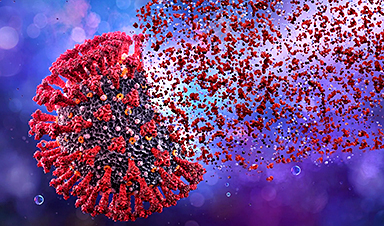

Like periodical cicadas, the insects for which it is nicknamed, SARS-CoV-2 Omicron subvariant BA.3.2 is only just beginning to emerge after lying low for an extended period since it first appeared. Although it was first detected in late 2024, the highly mutated virus did not earn the Variant Under Monitoring designation from the World Health Organization (WHO) until this past December.

“What’s different about this one is not so much how it came to be but what is happening now,” said T. Ryan Gregory, PhD, the University of Guelph evolutionary biologist who nicknamed BA.3.2 as well as several of its notable predecessors, including Nimbus and Stratus. “It’s been around for quite a while. Now it’s having this significant uptick.”

Here’s what to know.

Cicada’s Chronology

Most SARS-CoV-2 variants don’t circulate long, their tenure measured in weeks or months instead of years.

“The first Omicron, BA.1, came and went in a few months,” said Marc Johnson, PhD, a professor of molecular microbiology and immunology at the University of Missouri School of Medicine and a coauthor of a March article on the variant in Morbidity and Mortality Weekly Report, published by the US Centers for Disease Control and Prevention (CDC). “BA.3.2 is an oddball.”

The MMWR article and other publications have detailed the persistent variant’s surprising timeline:

  • BA.3.2 was first identified nearly a year-and-a-half ago, in November 2024, in South Africa.

  • It was then found in Mozambique in March 2025 and in the Netherlands and Germany the following month.

  • It was first detected in the US in June 2025 through the CDC’s Traveler-Based Genomic Surveillance program in a person who had flown to the US from the Netherlands.

  • It eventually subdivided into at least 2 branches. By late 2025, BA.3.2.2 became the dominant BA.3.2 branch globally, representing about 30% of all SARS-CoV-2 sequences collected in Germany and Western Australia, according to a preprint article posted in December.

  • BA.3.2 was first detected in a specimen collected from a US patient in January of this year, 6 months after it was found in the traveler from the Netherlands. By February it had been detected in several US travelers and patients.

  • By early February, it had been identified in at least 23 countries.

The Current Status in the US

As of March 12, BA.3.2 had been detected in 260 wastewater samples in 29 US states, according to the MMWR article.

Even so, it was still not common enough to be singled out in the CDC’s April 11 update of its SARS CoV-2 variant tracker.

However, the number of individuals testing for COVID-19 has declined, as has the number of specimens collected for sequencing. “It’s getting harder to say which variant is where,” Gregory pointed out.

“As clinical testing and sequencing decline, we are losing the power to monitor viral evolution with high precision,” immunologist Yunlong Richard Cao, PhD, an assistant professor at the Peking University Biomedical Pioneering Innovation Center, noted in an email. “Wastewater surveillance is an excellent early warning system, but it doesn’t always provide the high-resolution genomic data needed to understand exactly how the virus is adapting in real time.”

The Health Implications

Compared with JN.1 and LP.8.1, the variants targeted by the current COVID-19 vaccines, BA.3.2 has approximately 70 to 75 substitutions and deletions in the genetic sequence of its spike protein.

And as a descendant of BA.1, the original Omicron lineage, BA.3.2 is quite different from the prevalent SARS-CoV-2 variants worldwide, XFG and NB.1.81, both of which belong to the JN.1 lineage, David Ho, MD, a professor of microbiology and immunology at the Columbia University Vagelos College of Physicians and Surgeons, noted in an email.

Even so, “if one is boosted with the latest available vaccine, one’s antibody responses are quite robust against BA.3.2, including the prevalent form, BA.3.2.2,” Ho said.

According to the WHO, although multiple laboratory studies have found BA.3.2 to be markedly immune evasive, “no data indicate increased severity, hospitalizations, or deaths associated with this variant.”

A Fitness Trade-off

BA.3.2 descends from BA.3, a variant that circulated at low levels beginning in late 2021 before disappearing in early 2022. Scientists believe BA.3.2 came to be the same way as most SARS-CoV-2 variants: it likely evolved in an immunocompromised individual with a persistent SARS-CoV-2 infection.

When a SARS-CoV-2 variant evolves in a chronically infected individual, the changes are random, as opposed to a result of natural selection, Gregory said. The alterations could just as easily put the virus at a disadvantage as they could benefit it, he explained.

BA.3.2’s mutations are a mixed bag.

Last summer, Cao and colleagues reported that in experiments with plasma from people who’d recovered from COVID-19, BA.3.2 “showed profound humoral immune evasion.”

However, Cao’s team also found that the variant exhibited low angiotensin-converting enzyme 2 (ACE2) binding capability and infectivity. SARS-CoV-2 infects people by way of its spike protein binding with the ACE2 receptors on their cells.

It’s thought that BA.3.2 isn’t adept at binding with ACE2 receptors because many of the mutations in its spike protein keep it in the off position, Cao said. That hides the spike protein’s receptor-binding domain from many neutralizing antibodies, granting it superior immune escape, but it also greatly hinders the virus’s ability to latch onto human cells in the first place, he said.

“It is a classic example of a fitness trade-off,” Cao said. “SARS-CoV-2 is under immense pressure from population-level immunity” resulting from vaccines and prior infections, he explained. “In this environment, escaping an antibody is often more beneficial for viral survival than having a ‘perfect’ grip on a cell.”

Another example of a SARS-CoV-2 fitness trade-off occurred when BA.2.86 evolved into JN.1, Cao noted. BA.2.86 grabbed variant trackers’ attention in the summer of 2023 because its spike protein carried more than 30 changes compared with that of its parent.

BA.2.86 never took off as feared. However, with just 1 more change in its spike protein, it evolved into the more immune-evasive JN.1, which ended up soaring quickly to dominance over other circulating variants in early January 2024.

More Infections in Children?

In a late-March Bluesky postRyan Hisner, an Indiana science teacher and citizen scientist, pointed out that BA.3.2’s rapid increase in New York state has been driven entirely by infections in children.

“Data are still coming in on this, but it does seem to favorably infect young children, which is really weird,” Johnson confirmed. “It’s not a huge data set, but the trend seems to have held in various countries,” he added.

Cao, however, said he’s not yet convinced. “I think there is currently no robust molecular evidence suggesting that children are biologically preferred by this variant,” he said. “We are still investigating this closely and awaiting more clinical evidence.”

If BA.3.2 really is infecting kids more than adults, Cao and Gregory said, the likeliest explanation is immunological naivety. Compared with adults, most children have had fewer COVID-19 vaccinations and infections with previous SARS-CoV-2 variants.

Johnson thinks BA.3.2’s partiality toward children is real, but he’s still trying to make sense of it. If immunological naivety explained the trend, SARS-CoV-2 infections also should have skewed toward children after previous major lineage shifts, he wrote in an April blog post. But that wasn’t the case after BA.2.86 and JN.1 displaced XPP in late 2023 and early 2024, leading him to suspect, like Hisner, that a particular deletion in BA.3.2’s spike protein is to blame. Indeed, he noted, an older variant with a comparable deletion also disproportionately infected children.

The Takeaway

BA.3.2 itself is unlikely to have much of an impact, Gregory said. But that isn’t necessarily true for its descendants. “Now you have a starting point for a new evolution,” he explained. “It’s about potential.…It’s about the continued evolution.”

Still, Johnson said, “if there were an easy change for BA.3.2, it would have found it by now.”

Although Cicada is not a cause for alarm, Gregory pointed out, it should serve as a reminder of the importance of continuing to take steps to protect against SARS-CoV-2 infection and keeping up surveillance.

One thing is for sure, he said: “SARS-CoV-2 is not gone.”

Article Information

Published Online: April 17, 2026. doi:10.1001/jama.2026.5535

Conflict of Interest Disclosures: Dr Cao reported being listed as inventor for patent application of SARS-CoV-2 receptor binding domain-specific monoclonal antibodies, 1 of which is licensed to Moderna and another to SinoVac. He also reported cofounding Singlomics Biopharmaceuticals and receiving financial support for his SARS-CoV-2–related research from the Ministry of Science and Technology of China and the National Natural Science Foundation of China. No other disclosures were reported.

News – Curated by Amanda Scott, Alias Group Creative
Follow her on Bluesky

Our books now available worldwide!

Online Sellers other than Amazon, Routledge, and IOPP Indigo Global Health Care Equivalency in the Age of Nanotechnology, Nanomedicine and Artifcial Intelligence Global Health Care Equivalency In The Age Of Nanotechnology, Nanomedicine And Artificial [...]