Scientists just uncovered the cellular "blueprint" that could one day let us regrow real teeth.
Researchers at Science Tokyo have uncovered two distinct stem cell lineages that play a central role in forming tooth roots and the surrounding alveolar bone. By studying genetically modified mice and tracking how individual cells develop over time, the team revealed key signaling processes that guide how stem cells specialize during tooth growth. The findings could help lay the groundwork for future treatments aimed at regenerating teeth and supporting bone.
Why Regrowing Teeth Has Been So Difficult
Replacing lost teeth has long relied on artificial solutions like implants and dentures. While effective, these options cannot fully match the structure, function, or natural feel of real teeth. For years, scientists have been working to understand how teeth form in the first place, hoping to unlock ways to regrow them naturally.
That challenge is complex. Tooth development depends on tightly coordinated interactions between multiple cell types and tissues, including dental pulp, the enamel organ, and bone-forming cells in the jaw. These components communicate through intricate signaling networks that carefully control how each part of the tooth, from crown to root, takes shape. Despite decades of research, many details of this process remain unclear.
Tracking Stem Cells in Developing Teeth
To close these knowledge gaps, a team led by Assistant Professor Mizuki Nagata from the Department of Periodontology, Graduate School of Medical and Dental Sciences at Institute of Science Tokyo (Science Tokyo), Japan, and Dr. Wanida Ono of the University of Texas Health Science Center at Houston (UTHealth), USA, worked with collaborators from the University of Michigan, USA, and other institutions. They conducted two related studies on how stem cells differentiate during tooth development. The results were published in Nature Communications.
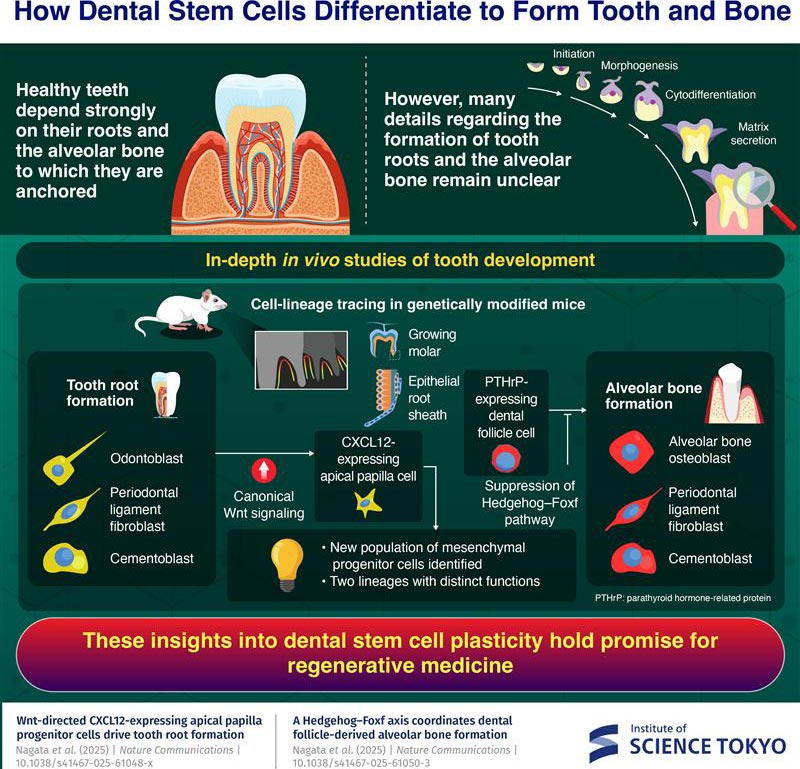
Using genetically engineered mice along with advanced lineage tracing methods, the researchers followed how cells behave at the 'tip' (apical region) of growing tooth roots. Techniques such as high-resolution microscopy, fluorescent labeling, and gene silencing allowed them to observe how specific signaling proteins influence what types of cells stem cells ultimately become.
Credit: Institute of Science Tokyo
Two Distinct Stem Cell Lineages Discovered
The team identified a previously unknown group of mesenchymal stem cells that split into two separate developmental paths. One lineage is closely tied to the formation of the tooth root, while the other contributes to building the alveolar bone that anchors the tooth in place.
The first lineage originates in the apical papilla, a soft tissue region located within the epithelial root sheath at the tip of a developing tooth root. These cells produce CXCL12, a protein known for its role in bone formation in bone marrow. Through a signaling route called the canonical Wnt pathway, these CXCL12-expressing cells can become several different cell types. They can form odontoblasts, which create dentin in teeth, as well as cementoblasts that produce the outer layer of the root. Under regenerative conditions, they can even develop into osteoblasts that generate alveolar bone.
A Second Pathway Controls Bone Formation
The second lineage is found in the dental follicle, a sac-like structure that surrounds the developing tooth and helps form the tissues that support it. Within this region, the researchers identified cells that express parathyroid hormone-related protein (PTHrP). These cells are capable of differentiating into cementoblasts, ligament fibroblasts, and osteoblasts that form alveolar bone.
However, this transformation is not automatic. It depends on specific molecular conditions. As Nagata explains, "We observed that the Hedgehog–Foxf pathway needs to be suppressed to drive the alveolar bone osteoblast fate of PTHrP-expressing cells in the dental follicle, unraveling a unique tooth-specific mechanism of bone formation requiring deliberate on–off regulation of Hedgehog signaling."
A Step Toward Regenerating Teeth and Bone
Together, these discoveries provide a clearer picture of how teeth and their supporting bone develop inside the body. By mapping the roles of these two stem cell lineages and the signals that guide them, researchers now have a stronger framework for understanding tooth root formation.
Nagata highlights the broader impact, stating, "Our findings provide a mechanistic framework for tooth root formation and pave the way for innovative stem-cell-based regenerative therapies for dental pulp, periodontal tissues, and bone."
The studies were published under the titles "Wnt-directed CXCL12-expressing apical papilla progenitor cells drive tooth root formation" and "A Hedgehog–Foxf axis coordinates dental follicle-derived alveolar bone formation."
References:
"Wnt-directed CXCL12-expressing apical papilla progenitor cells drive tooth root formation" by Mizuki Nagata, Gaurav T. Gadhvi, Taishi Komori, Yuki Arai, Hiroaki Manabe, Angel Ka Yan Chu, Ramandeep Kaur, Meer Ali, Yuntao Yang, Chiaki Tsutsumi-Arai, Yuta Nakai, Yuki Matsushita, Nicha Tokavanich, W. Jim Zheng, Joshua D. Welch, Noriaki Ono and Wanida Ono, 1 July 2025, Nature Communications.
DOI: 10.1038/s41467-025-61048-x
"A Hedgehog–Foxf axis coordinates dental follicle-derived alveolar bone formation" by Mizuki Nagata, Gaurav T. Gadhvi, Taishi Komori, Yuki Arai, Chiaki Tsutsumi-Arai, Angel Ka Yan Chu, Seth N. Nye, Yuntao Yang, Shion Orikasa, Akira Takahashi, Peter Carlsson, W. Jim Zheng, Joshua D. Welch, Noriaki Ono and Wanida Ono, 2 July 2025, Nature Communications.
DOI: 10.1038/s41467-025-61050-3
Funding: National Institutes of Health, Cancer Prevention and Research Institute of Texas, Japanese Society of Periodontology, Japan Society for the Promotion of Science

News – Curated by Amanda Scott, Alias Group Creative
Follow her on Bluesky
Cancer’s Hidden Antioxidant Shield Helps It Escape the Immune System
Blocking an antioxidant protein that tumors use to suppress immune attacks improved cancer immunotherapy responses in mice. Cancer cells can release antioxidants that interfere with the immune cells trying to kill them. Researchers have [...]

Scientists Find a Berry Compound That Helps Muscle Cells Burn Fat
Pterostilbene, a compound found naturally in some foods, affects how skeletal muscles process fats by stabilizing a protein called PPARδ and increasing its signaling activity. Pterostilbene, a natural compound found in blueberries, grapes, and [...]
Two Hidden Forces Help Build the Human Brain Before Birth
Scientists have uncovered two surprising forces that help guide how the human brain forms before birth. Before birth, the human brain is shaped in large part by an unusual class of stem cells known [...]

Researchers Uncover a Hidden Trigger Behind Chronic Inflammation
The findings offer new insights that could help guide the development of future therapies. A protein called human resistin may help flip on one of the immune system’s most powerful inflammatory switches. Researchers at [...]
Scientists Have Uncovered Previously Hidden Microbial Activity on Human Skin
The most abundant microbes on your skin may not be the ones doing most of the work. Human skin supports vast communities of bacteria, fungi, and viruses that can influence its protective barrier, immune [...]
Brazilian Tree Compounds Fight COVID-19 on Multiple Fronts
Scientists found compounds in a Brazilian tree that hit SARS-CoV-2 on multiple fronts, revealing a promising new lead in the search for COVID-19 treatments. Researchers have found that galloylquinic acids extracted from the leaves [...]
Cutting Two Amino Acids Slowed Prostate Cancer in Mice
A newly identified link between amino acid metabolism and cholesterol production may help prostate tumors adapt to hormone therapy. Prostate cancer can find ways around treatments designed to deprive tumors of the hormones they [...]

Largest-Ever Physics Survey Raises New Doubts About Our Model of the Universe
Physicists around the world remain deeply divided on key mysteries of the universe, from dark matter to quantum gravity. The standard cosmological model failed to gain majority support, and no leading theory dominated the [...]

Scientists Just Overturned a 100-Year-Old Belief About Bacteria in the Lungs
New findings raise questions about the role of microbes living in the lungs. More than 35 trillion bacteria live throughout the human body, forming microbiomes in the gut, mouth, lungs, skin, and urogenital tract. [...]

GHCE Concept
From the preface of the book Global Health Care Equivalency in the Age of Nanotechnology, Nanomedicine and Artificial Intelligence, Edited by Frank Boehm: Since the publication of my first book (Nanomedical Device and Systems [...]
Novartis, Ionis drug failure spurs questions
Pelacarsen didn’t protect heart health despite lowering levels of a protein particle, “Lp(a),” in a large clinical trial — a result with important implications for cardiovascular drug research. Dive Brief: An RNA drug from [...]
New injectable treatment helps the brain rebuild after stroke
Biomedical engineers at Duke University have created an injectable biomaterial that may help the brain recover from damage left behind by an ischemic stroke. In experiments with mice, the material transformed the cavity created [...]
Scientists Discover a Hidden “Immune Organ” Inside the Skull
Researchers discovered lymph node-like immune hubs inside skull bone marrow that appear to act as rapid-response centers for the brain. For decades, the brain was thought to operate largely apart from the immune system. [...]

Engineered tRNAs and lipid nanoparticles target nonsense mutation cystic fibrosis
Researchers have developed a potential new approach for treating a form of cystic fibrosis caused by so-called nonsense mutations, combining chemically modified transfer RNAs with lipid nanoparticles designed to deliver the therapy directly to [...]

New pancreatic cancer drug carries a $39,800 monthly list price
A groundbreaking treatment for one of the most common forms of pancreatic cancer has been approved in pill form by the FDA. Revolution Medicines’ oral tablet daraxonrasib, branded as Rasonque, reduced the risk of [...]
Researchers Have Discovered a New Way To Reduce Chronic Nerve Pain
A cancer-linked protein called BRAF may help drive chronic nerve pain, and existing cancer drugs targeting it reduced pain sensitivity in preclinical models. Chronic nerve pain can persist long after an injury and often [...]