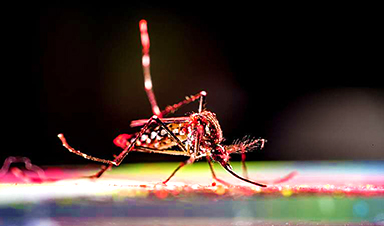
The symptoms come on quickly—acute fever, followed by debilitating joint pain that can last for months. Though rarely fatal, the chikungunya virus, a mosquito-borne illness, can be particularly severe for high-risk individuals, including newborns and older adults.
While the virus is common in tropical and subtropical regions, including Asia, Africa and South America, public health officials have been tracking reported infections in Europe and, in September, a confirmed case in Long Island, New York.
Outbreaks of chikungunya have prompted the Centers for Disease Control to issue health notices to travelers bound for Bangladesh; Cuba; Guangdong Province, China; Kenya; Madagascar; Somalia; and Sri Lanka.
In Guangdong Province, an “unprecedented” outbreak recently prompted government officials in China to mandate quarantines for anyone suspected of being infected by the virus, spraying individuals with mosquito repellent and spraying impacted buildings and other areas with insecticide.
In a new study, published in Science Advances, researchers at the University of Notre Dame analyzed more than 80 outbreaks of chikungunya virus to improve prediction of future outbreaks and inform vaccine trial development.
“Chikungunya outbreaks are unpredictable in both size and severity,” said Alex Perkins, the Ann and Daniel Monahan Collegiate Professor of infectious disease epidemiology in the Department of Biological Sciences, and co-author of the study. “You can have one outbreak that infects just a few people, and another in a similar setting that infects tens of thousands. That unpredictability is what makes public health planning—and vaccine development—so difficult.”
For the study, Alexander Meyer, a postdoctoral researcher in Perkins’ lab and lead author of the study, and a team of researchers reconstructed and analyzed 86 chikungunya outbreaks, creating the largest comparative dataset of its kind.
“Instead of looking at outbreaks in isolation, looking at many, all of which varied in size and severity, allowed us to search for patterns among them,” Meyer said.
Chikungunya was first identified in the 1950s. Outbreaks have become increasingly frequent and widespread, but they’re also sporadic and difficult to predict, posing a challenge to public health officials when it comes to planning for and preventing infections.
Changes in outbreaks of chikungunya, transmitted by bites from infected mosquitoes—Aedes aegypti or Aedes albopictus are the primary vectors—and other mosquito-borne illnesses are often considered in relation to climate change, as warmer, more humid conditions can promote mosquito activity.
But Perkins said this study showed that climate isn’t necessarily the most important factor when trying to predict the severity of an outbreak of disease caused by a virus like chikungunya.
“Climate factors like temperature and rainfall can tell us where outbreaks are possible, but this study shows that they don’t help very much in predicting how severe they will be,” he said. “Local conditions matter—things like housing quality, mosquito density and how communities respond. Some variation is simply due to chance. That randomness is part of the story, too.”
Currently, only two vaccines for chikungunya have received regulatory approval—but they are not widely available in regions where the virus is most common.
That is why having such a large, comprehensive dataset is so helpful when it comes to vaccine development, Perkins said.
To test for efficacy, vaccine makers need accurate predictions of where an outbreak might occur before it happens, to conduct trials and monitor whether candidate vaccines are effective.
The study demonstrates how a more comprehensive analysis of past outbreaks can help public health officials prepare for future outbreaks, thereby protecting vulnerable populations and aiding vaccine development.
More information: Alexander D. Meyer et al, Predictability of infectious disease outbreak severity: Chikungunya as a case study, Science Advances (2025). DOI: 10.1126/sciadv.adt5419

News

After only a short training, people in a coma managed to send targeted signals
Researchers have succeeded in communicating with brain-injured patients who are unconscious. They see enormous potential in this for future treatments. Patients who lie motionless in bed after a severe brain injury and do not [...]
MIT Scientists Reprogram Immune Cells Inside the Body To Destroy Cancer
Natural killer cells reprogrammed inside mice eliminated lymphoma tumors and helped damaged livers heal, though whether this approach could help people with cancer or autoimmune disease remains unknown. To make a cancer treatment from [...]

Melanoma mRNA Vaccine Shows Promise in Preventing Disease Recurrence
Key takeaways: Phase 3 trial finds personalized intismeran plus pembrolizumab may better prevent high-risk melanoma recurrence after surgery The trial enrolled 1,137 patients and builds on phase 2 results showing about half the recurrence [...]

Scientists Discover a Powerful New Weapon Against a Dangerous Gut Infection
The promise of an experimental treatment for C. difficile gut infections lies partly in the bacteria it leaves alive, according to early laboratory and mouse research. Broad-spectrum antibiotics can disrupt the gut’s microbial community, [...]
Your Bones May Hold a Hidden Clue to Blood Cancer Survival
For people with blood cancers called myelodysplastic syndromes, osteoporosis may hold an overlooked clue to survival, a three-year observational study suggests. In blood cancers that develop in the bone marrow, an important clue to [...]

Researchers Discover What Reading for Pleasure May Be Doing to Your Brain
Reading for pleasure may offer surprising benefits for the brain, with research linking the habit to better mental health, stronger cognitive abilities, and a lower risk of dementia. Reading for pleasure may do far [...]
Scientists Discover a Hidden Trigger That Keeps Inflammation Alive
Inflammation persists after proteins detach from immune receptors, revealing a potential target for autoimmune treatments. Since a Nobel Prize-winning discovery in the 1990s identified molecules called Toll-like Receptors as the guardians of the human [...]
A Virus Gives Itself Away the Moment It Attacks
Researchers have found the trigger behind a powerful bacterial defense against viruses. Viruses that prey on bacteria could become an increasingly important tool for treating bacterial infections, particularly as antibiotic resistance makes some infections [...]

Scientists Discover Aspirin May Slash Dementia Risk by 70% – but Only for Certain People
Aspirin was linked to a sharply lower dementia risk in some older adults, and their genes may hold the clue. A Monash University analysis found that older adults with a particular genetic profile had [...]
Inflammation May Awaken Dormant Cancer Cells Years After Treatment
The body’s response to inflammation may disturb cancer cells that have been lying silent for years, giving them an opportunity to grow again. Researchers at the Francis Crick Institute have found that gut inflammation [...]

Where do nanoparticles go once they enter the body?
New international best practice guidance, co-written at ANSTO, sets out how to measure where nanoparticles like titanium dioxide end up in the body and how long they remain. The guidance has been shared by [...]
Long-Acting HIV Shots Could Solve a Major Treatment Challenge for Young People
A major African trial suggests that changing how HIV treatment is delivered could significantly improve viral suppression in adolescents. Young people with HIV were more likely to keep the virus suppressed when they received [...]

WHO Factsheets – The top 10 causes of death
In 2023, the 10 leading causes of death accounted for 33 million deaths, or 54% of the total 61 million deaths worldwide. The top global causes of death, in order of total number of lives lost, [...]
Aging Cells May Be Hiding From the Immune System – Scientists Think They Know How
Your immune system is supposed to clear out damaged cells. Researchers may have found how some of them hide and linger as the body ages. Researchers led by Cedars-Sinai Health Sciences University have identified [...]

Your Voice May Reveal How Fast Your Brain Is Aging
Researchers have developed a machine-learning “speech clock” that estimates age from subtle patterns in how people speak and what they say. It is possible that people’s voices may contain certain signals of aging that [...]
Optogenetics Pioneers Win 2026 Nobel Prize in Physiology or Medicine
The 2026 Nobel Prize in Physiology or Medicine has been awarded to Peter Hegemann, Georg Nagel, and Karl Deisseroth for the development of optogenetics, a revolutionary technology that uses light to control individual neurons [...]