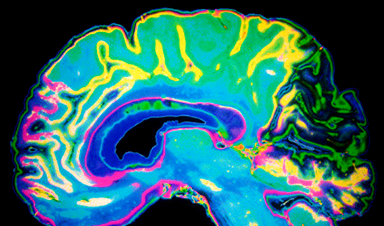
Scientists at the Swiss Light Source SLS have succeeded in mapping a piece of brain tissue in 3D at unprecedented resolution using X-rays, non-destructively. The breakthrough overcomes a long-standing technological barrier that had limited the use of X-rays for such studies.
With the SLS upgrade now complete, the path lies open to imaging much larger samples of brain tissue at high resolution – and to gaining new understanding of its complex architecture. The study, a collaboration between PSI and the Francis Crick Institute in the UK, is published in Nature Methods.
The brain is one of the most complex biological systems in the world.”
Adrian Wanner, Group Leader, Structural Neurobiology Research Group, Paul Scherrer Institute PSI
How neurons are wired together is what his group is trying to unravel – a field known as connectomics.
Let’s talk numbers: in one cubic millimetre of brain tissue there are about 100 000 neurons, connected through about 700 million synapses and 4 kilometres of ‘cabling’.
How these neurons are connected to each other through synapses determines how the brain works. It is linked to diseases such as Alzheimer’s. Yet the complexity of this wiring in three dimensions is extraordinarily difficult to study. “If you take a neural network with 17 neurons, there are more ways to connect them than atoms in the universe, says Wanner. “So you can’t just try to model it. We need to measure it.”
It is on the backdrop of this immense problem that a major technological advance by Wanner and colleagues at the Swiss Light Source SLS – in collaboration with the Francis Crick Institute in the UK – stands.
X-rays peer into the ultrastructure
Currently, the go-to technique for this type of imaging is volume electron microscopy. As electrons penetrate only shallowly, cubic millimetres of brain tissues must be sliced into tens of thousands of ultra-thin sections. These are then imaged individually and computationally reconstructed to map the 3D connectivity of the neurons through the slices – a process that is very error prone and inevitably results in loss of information.
A solution lies with X-rays. These can penetrate millimetres – or even centimetres – and thus could in principle image chunks of brain tissue without sectioning.
At the coherent small-angle X-ray scattering beamline of the SLS, known for short as cSAXS, high-brilliance X-rays have enabled computer chips to be imaged to a resolution of just 4 nanometres – a world record. “But for biological tissues, the problem is contrast,” explains Ana Diaz, scientist at cSAXS. “Computer chips are made of copper wires that naturally have a high contrast to their embedding material. When we have the building blocks of life – proteins, lipids and so on, against a matrix dominated by water, the X-ray interaction is very weak and it’s harder to achieve high resolution.”
To overcome these challenges of contrast, scientists stain the brain tissue using heavy metals. However, these absorb the X-rays, leading to another problem: the sample deforms. Embedding materials can stabilise the sample – but these also possess the same problems that they deform in the presence of X-rays, bubbling and destroying the fine ultrastructure of the brain tissue.
A resin for the aerospace industry
To overcome this problem, Wanner, Diaz and colleagues came up with a new approach. The main development is an epoxy resin that is still able to infiltrate the biological tissue while offering exceptional radiation tolerance – a material usually used in aerospace and nuclear industries and in particle accelerators.
They complement this with a specially designed stage that allows them to image the samples whilst cooled to -178 degrees Celsius with liquid nitrogen. Finally, a reconstruction algorithm compensates for small amounts of deformation that still do occur.
With this approach, the researchers could study pieces of mouse brain tissue up to 10 microns thick, achieving a resolution of 38 nanometres in three dimensions. “We believe this marks a record resolution using X-ray imaging on an extended biological tissue,” says Diaz.
At this resolution, they could reliably identify synapses and other features of the neurons and their connections, such as axons and dendrites. “This is not breakthrough information on the brain: it matches the best results with state-of-the-art volume electron microscopy – the current gold standard,” adds Wanner. “What’s exciting is that this marks the start of what’s to come.”
Coherent X-rays set for a boost with SLS upgrade
Although a 10-micron thick piece of brain tissue may still sound tiny, this is already orders of magnitude thicker than the slivers studied with electron microscopy. Currently a limiting factor on sample size is the acquisition time: taking enough data to reconstruct a high-resolution image can take days. This bottleneck is related to the X-rays.
The researchers are using a technique known as ptychography – a type of imaging that doesn’t use lenses but relies on coherent X-rays. “Coherence is exactly where we are set to gain with the SLS upgrade,” says Diaz.
The SLS has just completed a comprehensive upgrade to become a 4th-generation synchrotron – the most advanced type of synchrotron in the world. The technological improvements mean that, at the cSAXS beamline, ptychography experiments will benefit from up to one hundred times higher flux of coherent X-rays.
“With one hundred times more X-ray photons hitting our sample every second, we will be able to – in principle – either image the sample one hundred times faster or image volumes one hundred times larger,” explains Diaz. “In practice, we will need to learn how to do this in an efficient way. But the potential is there.”
The publication coincides with an important milestone at the beamline: in July 2025, the first X-rays were seen at cSAXS following the upgrade. Now that technical barriers to using X-ray ptychography for biological imaging have been overcome, the way lies open to studying much larger samples of brain tissue in 3D at high resolution.

News

New Toothpaste Stops Gum Disease Without Harming Healthy Bacteria
Researchers have developed a targeted approach to combat periodontitis without disrupting the natural balance of the oral microbiome. The innovation could reshape how gum disease is treated while preserving beneficial bacteria. The human mouth [...]
Plastic Without End: Are We Polluting the Planet for Eternity?
The Kunming Montreal Global Biodiversity Framework calls for the elimination of plastic pollution by 2030. If that goal has been clearly set, why have meaningful measures that create real change still not been implemented? [...]
Scientists Rewire Natural Killer Cells To Attack Cancer Faster and Harder
Researchers tested new CAR designs in NK-92 cells and found the modified cells killed tumor cells more effectively, showing stronger anti-cancer activity. Researchers at the Ribeirão Preto Blood Center and the Center for Cell-Based [...]
New “Cellular” Target Could Transform How We Treat Alzheimer’s Disease
A new study from researchers highlights an unexpected player in Alzheimer’s disease: aging astrocytes. Senescent astrocytes have been identified as a major contributor to Alzheimer’s progression. The cells lose protective functions and fuel inflammation, particularly in [...]

Treating a Common Dental Infection… Effects That Extend Far Beyond the Mouth
Successful root canal treatment may help lower inflammation associated with heart disease and improve blood sugar and cholesterol levels. Treating an infected tooth with a successful root canal procedure may do more than relieve [...]
Microplastics found in prostate tumors in small study
In a new study, researchers found microplastics deep inside prostate cancer tumors, raising more questions about the role the ubiquitous pollutants play in public health. The findings — which come from a small study of 10 [...]
All blue-eyed people have this one thing in common
All Blue-Eyed People Have This One Thing In Common Blue Eyes Aren’t Random—Research Traces Them Back to One Prehistoric Human It sounds like a myth at first — something you’d hear in a folklore [...]
Scientists reveal how exercise protects the brain from Alzheimer’s
Researchers at UC San Francisco have identified a biological process that may explain why exercise sharpens thinking and memory. Their findings suggest that physical activity strengthens the brain's built in defense system, helping protect [...]

NanoMedical Brain/Cloud Interface – Explorations and Implications. A new book from Frank Boehm
New book from Frank Boehm, NanoappsMedical Inc Founder: This book explores the future hypothetical possibility that the cerebral cortex of the human brain might be seamlessly, safely, and securely connected with the Cloud via [...]
Deadly Pancreatic Cancer Found To “Wire Itself” Into the Body’s Nerves
A newly discovered link between pancreatic cancer and neural signaling reveals a promising drug target that slows tumor growth by blocking glutamate uptake. Pancreatic cancer is among the most deadly cancers, and scientists are [...]

This Simple Brain Exercise May Protect Against Dementia for 20 Years
A long-running study following thousands of older adults suggests that a relatively brief period of targeted brain training may have effects that last decades. Starting in the late 1990s, close to 3,000 older adults [...]
Scientists Crack a 50-Year Tissue Mystery With Major Cancer Implications
Researchers have resolved a 50-year-old scientific mystery by identifying the molecular mechanism that allows tissues to regenerate after severe damage. The discovery could help guide future treatments aimed at reducing the risk of cancer [...]

This New Blood Test Can Detect Cancer Before Tumors Appear
A new CRISPR-powered light sensor can detect the faintest whispers of cancer in a single drop of blood. Scientists have created an advanced light-based sensor capable of identifying extremely small amounts of cancer biomarkers [...]
Blindness Breakthrough? This Snail Regrows Eyes in 30 Days
A snail that regrows its eyes may hold the genetic clues to restoring human sight. Human eyes are intricate organs that cannot regrow once damaged. Surprisingly, they share key structural features with the eyes [...]
This Is Why the Same Virus Hits People So Differently
Scientists have mapped how genetics and life experiences leave lasting epigenetic marks on immune cells. The discovery helps explain why people respond so differently to the same infections and could lead to more personalized [...]
Rejuvenating neurons restores learning and memory in mice
EPFL scientists report that briefly switching on three “reprogramming” genes in a small set of memory-trace neurons restored memory in aged mice and in mouse models of Alzheimer’s disease to level of healthy young [...]