A new CRISPR-powered light sensor can detect the faintest whispers of cancer in a single drop of blood.
Scientists have created an advanced light-based sensor capable of identifying extremely small amounts of cancer biomarkers in blood. The technology could eventually allow doctors to detect early warning signs of cancer and other diseases through a routine blood test.
Biomarkers such as proteins, fragments of DNA, or other molecules can signal whether cancer is present, how it is progressing, or a person's level of risk. The challenge is that at the earliest stages of disease, these molecules exist in very tiny amounts, making them difficult to measure.
"Our sensor combines nanostructures made of DNA with quantum dots and CRISPR gene editing technology to detect faint biomarker signals using a light-based approach known as second harmonic generation (SHG)," said research team leader Han Zhang from Shenzhen University in China. "If successful, this approach could help make disease treatments simpler, potentially improve survival rates and lower overall healthcare costs."
Writing in Optica, Optica Publishing Group's journal for high-impact research, Zhang and colleagues reported that the sensor detected lung cancer biomarkers in patient samples at sub-attomolar levels. That means it was able to generate a clear signal even when only a handful of molecules were present. Because the system is programmable, it could potentially be adapted to identify viruses, bacteria, environmental toxins, or biomarkers linked to conditions such as Alzheimer's disease.
"For early diagnosis, this method holds promise for enabling simple blood screenings for lung cancer before a tumor might be visible on a CT scan," said Zhang. "It could also help advance personalized treatment options by allowing doctors to monitor a patient's biomarker levels daily or weekly to assess drug efficacy, rather than waiting months for imaging results."
Amplification-Free Optical Sensing Technology
Most current methods for detecting biomarkers require chemical amplification to boost tiny molecular signals, a process that can add time, complexity, and cost. The researchers aimed to design a direct detection method that avoids these extra steps.
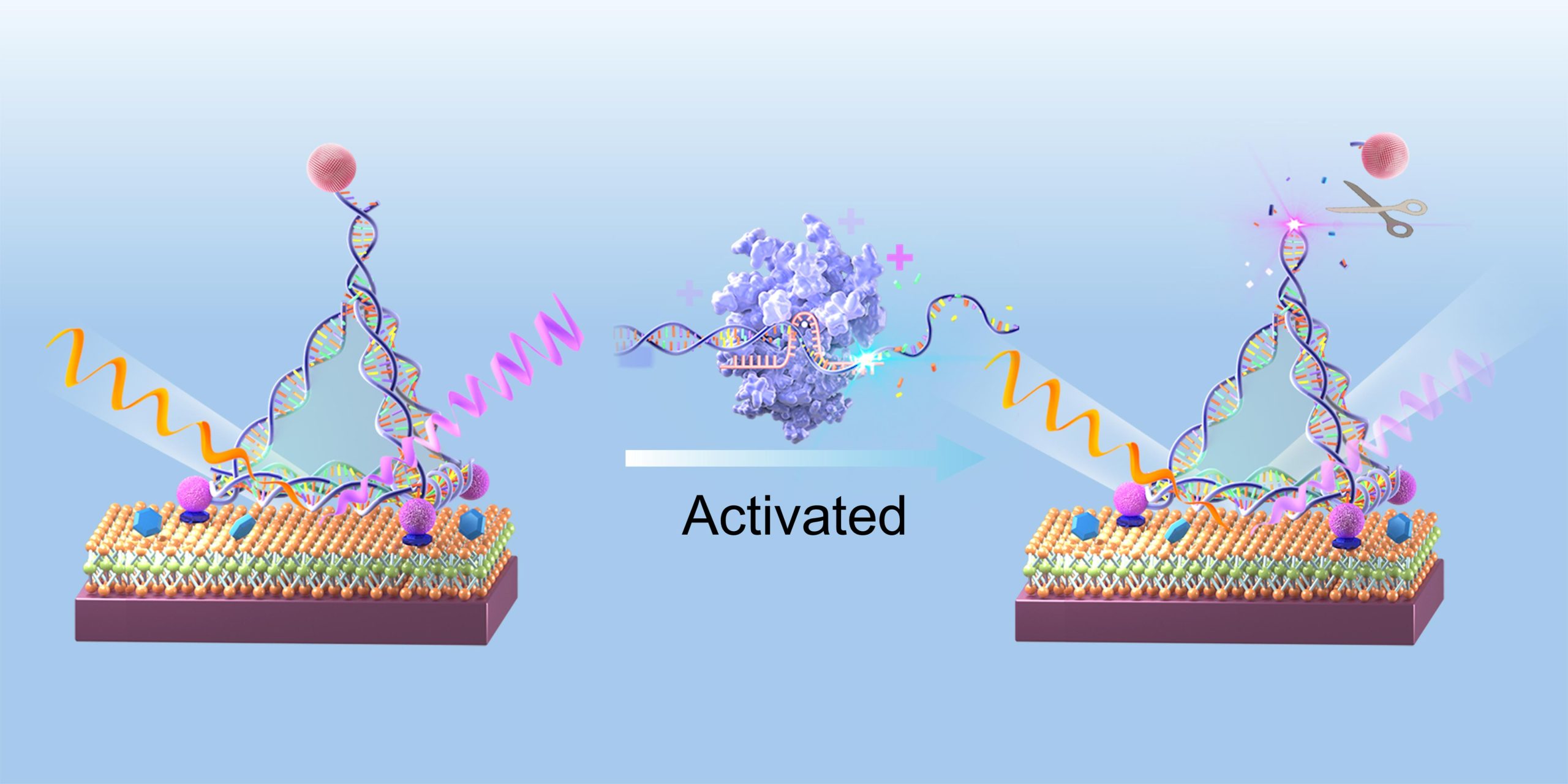
The new platform relies on SHG, a nonlinear optical effect in which incoming light is transformed into light with half the wavelength. In this system, SHG takes place on the surface of a two-dimensional semiconductor called molybdenum disulfide (MoS2).
To fine-tune the signal, the team used DNA tetrahedrons, which are small pyramid-shaped nanostructures built entirely from DNA, to position quantum dots at exact distances from the MoS2 surface. These quantum dots intensify the local optical field, strengthening the SHG response.
CRISPR-Cas gene editing was then incorporated to recognize specific biomarkers. When the Cas12a protein identifies its target, it cuts the DNA strands anchoring the quantum dots. This action produces a measurable decrease in the SHG signal. Because the SHG technique generates very little background noise, the system can detect extremely low biomarker concentrations with high sensitivity.
"Instead of viewing DNA only as a biological substance, we use it as programmable building blocks, allowing us to assemble the components of our sensor with nanometer-level precision," said Zhang. "By combining optical nonlinear sensing, which effectively minimizes background noise, with an amplification-free design, our method offers a distinct balance of speed and precision."
Successful Tests With Lung Cancer Samples
To evaluate performance, the researchers focused on miR-21, a microRNA linked to lung cancer. After confirming detection in a controlled buffer solution, they tested the sensor using human serum from lung cancer patients, mimicking real-world blood testing conditions.
"The sensor worked exceptionally well, showing that integrating optics, nanomaterials, and biology can be an effective strategy to optimize a device," said Zhang. "The sensor was also highly specific, ignoring other similar RNA strands and detecting only the lung cancer target."
The next step is to shrink the optical system. The team hopes to develop a compact, portable device suitable for bedside use, outpatient clinics, or remote areas with limited medical resources.
Reference: "Sub-Attomolar-Level Biosensing of Cancer Biomarkers Using SHG Modulation in DNA-Programmable Quantum Dots/MoS2 Disordered Metasurfaces" by Siyi Han, lingfeng gao, Qiao Jiang, Wenbo Du, Shi Chen, Yi Liu, Han Zhang, Xilin Tian, Yong Liu, Zheng Xie, Linjun Li, Ke Jiang and Zhi Chen, 12 February 2026, Optica.
DOI: 10.1364/OPTICA.577416

News

Back and shoulder surgery is often worse than useless
Millions of operations should be scrapped SIX IN TEN Britons have surgery at some point. So do lots of Americans, at a cost of perhaps $500bn a year, a third of all spending on [...]
Cocaine plays with mind, hijacks brain circuit, drives increasingly rigid and repetitive behavior
Researchers have found that cocaine hijacks brain circuit, which to drive increasingly rigid and repetitive behavior. The brain circuit that normally participates in selecting natural mouth and face movements, but which becomes disproportionately engaged [...]
Injectable nanodevices could provide effective treatment for drug-resistant glioblastoma
The brain cancer glioblastoma is one of the most aggressive and treatment-resistant cancers known to medicine, carrying a median survival of just 12-15 months, even with the best available care. Now, researchers at the [...]
New Treatment Cuts “Bad” Cholesterol in Half for a Full Year
A single infusion of an experimental CRISPR-Cas9 therapy was reported to safely lower LDL cholesterol by 52.5% and triglycerides by 47.8%, as measured 12 months after treatment. What if one infusion could keep cholesterol [...]

Too Much RNA Can Drain a Cell’s Energy, Scientists Discover
A virus may cripple a cell’s power supply simply by producing too much of a molecule the cell needs to survive. New research from the Texas A&M College of Veterinary Medicine and Biomedical Sciences [...]

West African scientists warn of weakening health systems and urge stronger outbreak detection
LOME, Togo (AP) — West African laboratory scientists called on governments Friday to strengthen capacity to detect disease outbreaks to avoid another major outbreak, saying health systems across the region are becoming weaker. Participants [...]

A Little-Known Protein Could Point to a New Way To Treat Alzheimer’s
A study suggests that increasing SORLA protein levels could help treat Alzheimer’s disease and other disorders involving tau protein. Increasing SORLA, a protein with a protective role in the brain, helped mice withstand damage [...]

Cancer’s Hidden Antioxidant Shield Helps It Escape the Immune System
Blocking an antioxidant protein that tumors use to suppress immune attacks improved cancer immunotherapy responses in mice. Cancer cells can release antioxidants that interfere with the immune cells trying to kill them. Researchers have [...]

Scientists Find a Berry Compound That Helps Muscle Cells Burn Fat
Pterostilbene, a compound found naturally in some foods, affects how skeletal muscles process fats by stabilizing a protein called PPARδ and increasing its signaling activity. Pterostilbene, a natural compound found in blueberries, grapes, and [...]

Two Hidden Forces Help Build the Human Brain Before Birth
Scientists have uncovered two surprising forces that help guide how the human brain forms before birth. Before birth, the human brain is shaped in large part by an unusual class of stem cells known [...]

Researchers Uncover a Hidden Trigger Behind Chronic Inflammation
The findings offer new insights that could help guide the development of future therapies. A protein called human resistin may help flip on one of the immune system’s most powerful inflammatory switches. Researchers at [...]

Scientists Have Uncovered Previously Hidden Microbial Activity on Human Skin
The most abundant microbes on your skin may not be the ones doing most of the work. Human skin supports vast communities of bacteria, fungi, and viruses that can influence its protective barrier, immune [...]

Brazilian Tree Compounds Fight COVID-19 on Multiple Fronts
Scientists found compounds in a Brazilian tree that hit SARS-CoV-2 on multiple fronts, revealing a promising new lead in the search for COVID-19 treatments. Researchers have found that galloylquinic acids extracted from the leaves [...]

Cutting Two Amino Acids Slowed Prostate Cancer in Mice
A newly identified link between amino acid metabolism and cholesterol production may help prostate tumors adapt to hormone therapy. Prostate cancer can find ways around treatments designed to deprive tumors of the hormones they [...]

Largest-Ever Physics Survey Raises New Doubts About Our Model of the Universe
Physicists around the world remain deeply divided on key mysteries of the universe, from dark matter to quantum gravity. The standard cosmological model failed to gain majority support, and no leading theory dominated the [...]

Scientists Just Overturned a 100-Year-Old Belief About Bacteria in the Lungs
New findings raise questions about the role of microbes living in the lungs. More than 35 trillion bacteria live throughout the human body, forming microbiomes in the gut, mouth, lungs, skin, and urogenital tract. [...]