A newly discovered link between pancreatic cancer and neural signaling reveals a promising drug target that slows tumor growth by blocking glutamate uptake.
Pancreatic cancer is among the most deadly cancers, and scientists are still working to understand what drives its aggressive behavior. A research team at the Technical University of Munich (TUM) has identified a biological mechanism that helps explain this lethality.
Their findings show that pancreatic cancer cells can take advantage of the body's nervous system by forming structures called pseudosynapses. Using a specific receptor, these tumor cells take up the neurotransmitter glutamate, which then promotes their growth. The researchers believe this discovery could point to new drug targets that disrupt this process in patients.
The link between the nervous system and cancer progression has been recognized for years. One well-known example is "neural invasion," a process in which nerve fibers from nearby healthy tissue grow into tumors. This phenomenon is commonly associated with poorer outcomes and more aggressive disease.
About six years ago, scientists in the United States reported a surprising finding in brain tumors. They showed that some cancers can form their own synapses, allowing them to directly exploit neuronal signaling. Inspired by this work, Professor Ekin Demir, a clinician scientist in the Department of Surgery at the TUM University Hospital, and his team set out to investigate whether tumors outside the brain might use a similar tactic.
Searching for "tumor synapses"
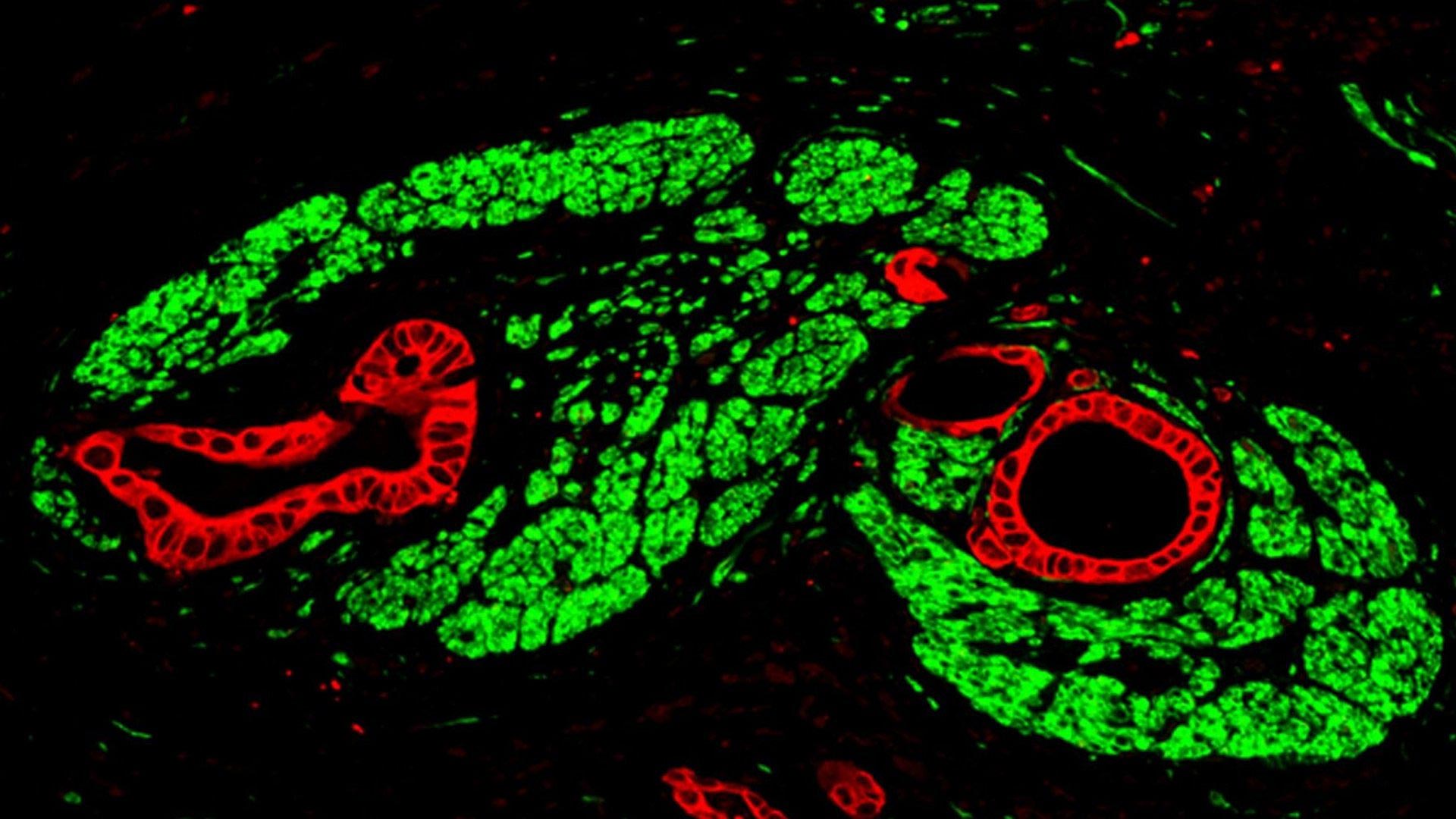
Pancreatic tumors were an obvious candidate because neural invasion is especially common in this cancer type. The researchers analyzed pancreatic tumor samples, looking for clusters of receptors that interact with specific neurotransmitters.
In several samples, they found elevated levels of NMDA receptors, which bind glutamate. Further analysis using electron microscopy revealed structures that closely resemble synapses. Because these formations differ in important physiological details from typical neuronal synapses, the team refers to them as pseudosynapses.
Calcium waves promote tumor growth
What advantage do pancreatic tumors gain by forming pseudosynapses? Like other glands, the pancreas is regulated by the nervous system. Depending on the body's needs, healthy pancreatic cells receive the neurotransmitter glutamate through their synapses. This triggers a series of processes. Pseudosynapses exploit this natural mechanism.
"When glutamate binds to the cancer cells' NMDA receptors, a channel opens, and calcium flows into the cell," explains Professor Demir. "This influx triggers molecular signaling cascades that drive tumor growth and metastasis." The team observed that the cancer cells generate characteristic slow, long-lasting calcium waves that drive tumor growth in a sustained way.
Yet this remarkable mechanism may open up a path to new cancer therapies. In mouse experiments, the researchers successfully blocked the NMDA receptors on tumor cells with a drug. The result: pancreatic tumors grew more slowly, developed fewer metastases, and the animals lived longer.
"We are currently using bioinformatic methods to identify approved drugs that, in addition to their primary effects, can also block these specific NMDA receptors in pancreatic cancer cells," says Professor Ekin Demir. "Therapies targeting the interface between the nervous system and tumors could open up entirely new treatment options." The team suspects that other tumor types may also form pseudosynapses to accelerate their growth.
Reference: "Sensory neurons drive pancreatic cancer progression through glutamatergic neuron-cancer pseudo-synapses" by Lei Ren, Chunfeng Liu, Kaan Çifcibaşı, Markus Ballmann, Gerhard Rammes, Carmen Mota Reyes, Sergey Tokalov, Andreas Klingl, Jennifer Grünert, Keshav Goyal, Peter H. Neckel, Ulrich Mattheus, Benjamin Schoeps, Saliha Elif Yıldızhan, Osman Ugur Sezerman, Nedim Can Cevik, Elif Arik Sever, Didem Karakas, Okan Safak, Katja Steiger, Alexander Muckenhuber, Kıvanç Görgülü, Zongyao Chen, JingCheng Zhang, Linhan Ye, Mohammed Inayatullah Maula Ali, Vijay K. Tiwari, Nataliya Romanyuk, Florian Giesert, Dieter Saur, Roland Rad, Roland M. Schmid, Hana Algül, Achim Krüger, Helmut Friess, Güralp O. Ceyhan, Rouzanna Istvanffy and Ihsan Ekin Demir, 25 September 2025, Cancer Cell.
DOI: 10.1016/j.ccell.2025.09.003
I.E.D. and L.R. were supported by a grant of the Deutsche Forschungsgemeinschaft (DFG, German Research Foundation)—Project-ID DE 2428/11-1. I.E.D. was supported by the Else Kröner Clinician Scientist Professorship Program of the Else Kroner-Fresenius Foundation.

News
Researcher at Russian plague laboratory dies of ‘unknown’ infection
Russian authorities have imposed "anti-epidemic measures" after a laboratory worker at an institute in Siberia dedicated to studying the plague and other infectious diseases died of a mysterious illness. The researcher, a 28-year-old female [...]

GHCE Concept
From the preface of the book Global Health Care Equivalency in the Age of Nanotechnology, Nanomedicine and Artificial Intelligence, Edited by Frank Boehm: Since the publication of my first book (Nanomedical Device and Systems [...]

A Surprising Brain Signal Could Explain Why Eating Less Protein Extends Lifespan
A new paper suggests that limiting protein intake triggers a coordinated response throughout the body that may help explain how protein restriction affects healthy aging. Animals respond to protein restriction, or reduced protein in [...]

Back and shoulder surgery is often worse than useless
Millions of operations should be scrapped SIX IN TEN Britons have surgery at some point. So do lots of Americans, at a cost of perhaps $500bn a year, a third of all spending on [...]
Cocaine plays with mind, hijacks brain circuit, drives increasingly rigid and repetitive behavior
Researchers have found that cocaine hijacks brain circuit, which to drive increasingly rigid and repetitive behavior. The brain circuit that normally participates in selecting natural mouth and face movements, but which becomes disproportionately engaged [...]
Injectable nanodevices could provide effective treatment for drug-resistant glioblastoma
The brain cancer glioblastoma is one of the most aggressive and treatment-resistant cancers known to medicine, carrying a median survival of just 12-15 months, even with the best available care. Now, researchers at the [...]
New Treatment Cuts “Bad” Cholesterol in Half for a Full Year
A single infusion of an experimental CRISPR-Cas9 therapy was reported to safely lower LDL cholesterol by 52.5% and triglycerides by 47.8%, as measured 12 months after treatment. What if one infusion could keep cholesterol [...]
Too Much RNA Can Drain a Cell’s Energy, Scientists Discover
A virus may cripple a cell’s power supply simply by producing too much of a molecule the cell needs to survive. New research from the Texas A&M College of Veterinary Medicine and Biomedical Sciences [...]

West African scientists warn of weakening health systems and urge stronger outbreak detection
LOME, Togo (AP) — West African laboratory scientists called on governments Friday to strengthen capacity to detect disease outbreaks to avoid another major outbreak, saying health systems across the region are becoming weaker. Participants [...]

A Little-Known Protein Could Point to a New Way To Treat Alzheimer’s
A study suggests that increasing SORLA protein levels could help treat Alzheimer’s disease and other disorders involving tau protein. Increasing SORLA, a protein with a protective role in the brain, helped mice withstand damage [...]
Cancer’s Hidden Antioxidant Shield Helps It Escape the Immune System
Blocking an antioxidant protein that tumors use to suppress immune attacks improved cancer immunotherapy responses in mice. Cancer cells can release antioxidants that interfere with the immune cells trying to kill them. Researchers have [...]

Scientists Find a Berry Compound That Helps Muscle Cells Burn Fat
Pterostilbene, a compound found naturally in some foods, affects how skeletal muscles process fats by stabilizing a protein called PPARδ and increasing its signaling activity. Pterostilbene, a natural compound found in blueberries, grapes, and [...]
Two Hidden Forces Help Build the Human Brain Before Birth
Scientists have uncovered two surprising forces that help guide how the human brain forms before birth. Before birth, the human brain is shaped in large part by an unusual class of stem cells known [...]

Researchers Uncover a Hidden Trigger Behind Chronic Inflammation
The findings offer new insights that could help guide the development of future therapies. A protein called human resistin may help flip on one of the immune system’s most powerful inflammatory switches. Researchers at [...]
Scientists Have Uncovered Previously Hidden Microbial Activity on Human Skin
The most abundant microbes on your skin may not be the ones doing most of the work. Human skin supports vast communities of bacteria, fungi, and viruses that can influence its protective barrier, immune [...]
Brazilian Tree Compounds Fight COVID-19 on Multiple Fronts
Scientists found compounds in a Brazilian tree that hit SARS-CoV-2 on multiple fronts, revealing a promising new lead in the search for COVID-19 treatments. Researchers have found that galloylquinic acids extracted from the leaves [...]