Successful root canal treatment may help lower inflammation associated with heart disease and improve blood sugar and cholesterol levels.
Treating an infected tooth with a successful root canal procedure may do more than relieve pain. New research suggests it could also lower inflammation tied to heart disease and improve blood sugar and cholesterol levels.
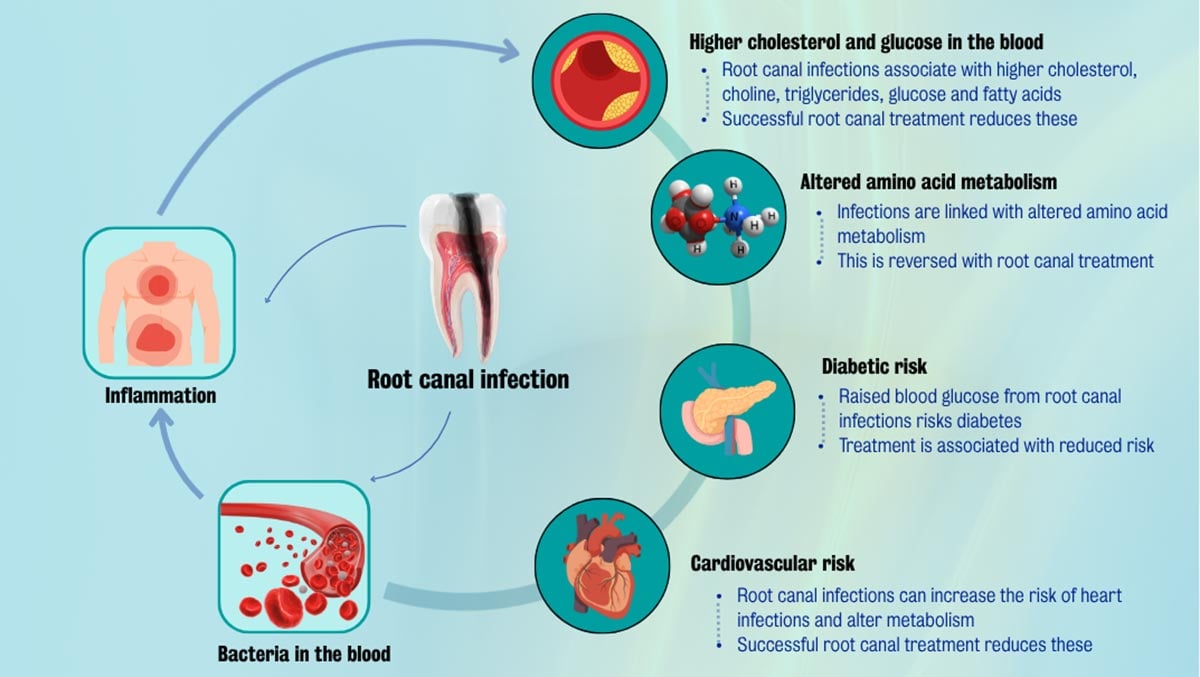
In a first-of-its-kind clinical investigation, researchers at King's College London monitored changes in blood chemistry after patients received treatment for a common dental infection known as apical periodontitis. This infection occurs when bacteria invade the root of a tooth and surrounding tissue. If left untreated, bacteria can enter the bloodstream, trigger inflammation, and potentially raise the risk of cardiovascular problems while also interfering with the body's ability to regulate blood sugar.
Although previous studies have linked dental infections to broader health concerns, no research has directly examined whether successful root canal treatment could produce measurable improvements in heart and metabolic health. This study set out to explore that possibility.
Dental infection affects systemic health
The team discovered that successful root canal treatment was associated with:
- Healthier blood sugar control: Over the two years following treatment, patients showed a meaningful decline in blood glucose levels, an important step in lowering the risk of developing diabetes.
- Stronger cholesterol and fat balance: In the short term, levels of blood cholesterol and circulating fatty acids improved, both of which play a central role in maintaining heart health.
- Lower levels of inflammation: Biological markers associated with inflammation, which are commonly tied to cardiovascular disease and other long-term health conditions, gradually decreased.
- System-wide metabolic effects from oral bacteria: Microbes originating from infected teeth were linked to measurable shifts in the body's overall metabolic processes, suggesting that dental infections can influence more than just oral tissues.
Root canal infections can cause bacteria to enter the blood, leading to inflammation, heart disease, and diabetes risk. Successful treatment reduces these risks.
Blood markers track recovery
The study followed the health of 65 patients from Guy's and St Thomas' NHS Foundation Trust over two years after root canal treatment. Scientists analyzed molecules in the blood of patients to reveal how the body processes sugar, fat, other key substances, and responds to disease and treatment. They used a technique known as nuclear magnetic resonance (NMR) spectroscopy, used to analyze proteins in the body.
The findings suggest that monitoring blood metabolic markers, such as glucose, fats known as triglycerides, and the protein tryptophan, could help assess recovery and risk after dental treatment.
Integrated care may reduce risk
Lead Author Dr Sadia Niazi, Senior Clinical Lecturer in Endodontology, King's College London, said: "Our findings show that root canal treatment doesn't just improve oral health—it may also help reduce the risk of serious health conditions like diabetes and heart disease. It's a powerful reminder that oral health is deeply connected to overall health.
"Long-standing root canal infections can allow bacteria to enter the bloodstream, trigger inflammation, and increase blood glucose and fats levels – raising the risk of serious health issues like heart disease and diabetes. It is vital that dental professionals recognize the wider impact of these root canal infections and advocate for early diagnosis and treatment.
"We also need to move towards integrated care, where dentists and general practitioners work together to monitor the risks through these blood markers and protect overall health. It's time to move beyond the tooth and embrace a truly holistic approach to dental care."
While more research is needed to confirm these effects in larger populations, the study opens exciting new doors for understanding how oral care can support general health and well-being.
Reference: "Successful endodontic treatment improves glucose and lipid metabolism: a longitudinal metabolomic study" by Yuchen Zhang, Adrien Le Guennec, Pirkko Pussinen, Gordon Proctor and Sadia Ambreen Niazi, 18 November 2025, Journal of Translational Medicine.
DOI: 10.1186/s12967-025-07110-0
Funded by the Faculty of Dental Surgery of the Royal College of Surgeons (RCS) England

News
Aging Cells May Be Hiding From the Immune System – Scientists Think They Know How
Your immune system is supposed to clear out damaged cells. Researchers may have found how some of them hide and linger as the body ages. Researchers led by Cedars-Sinai Health Sciences University have identified [...]

Your Voice May Reveal How Fast Your Brain Is Aging
Researchers have developed a machine-learning “speech clock” that estimates age from subtle patterns in how people speak and what they say. It is possible that people’s voices may contain certain signals of aging that [...]
Optogenetics Pioneers Win 2026 Nobel Prize in Physiology or Medicine
The 2026 Nobel Prize in Physiology or Medicine has been awarded to Peter Hegemann, Georg Nagel, and Karl Deisseroth for the development of optogenetics, a revolutionary technology that uses light to control individual neurons [...]
Molecular Manufacturing: The Future of Nanomedicine – From NanoappsMedical Inc.
This book explores the revolutionary potential of atomically precise manufacturing technologies to transform global healthcare, as well as practically every other sector across society. This forward-thinking volume examines how envisaged Factory@Home systems might enable the cost-effective [...]

What is ‘American Covid’ and how bad is it?
Cases of so-called ‘American Covid’ are on the rise in the UK. The strain is officially called XFG, or ‘Stratus’, and is the most common variant in North America, hence the name. It might soon [...]
Researcher at Russian plague laboratory dies of ‘unknown’ infection
Russian authorities have imposed "anti-epidemic measures" after a laboratory worker at an institute in Siberia dedicated to studying the plague and other infectious diseases died of a mysterious illness. The researcher, a 28-year-old female [...]

GHCE Concept
From the preface of the book Global Health Care Equivalency in the Age of Nanotechnology, Nanomedicine and Artificial Intelligence, Edited by Frank Boehm: Since the publication of my first book (Nanomedical Device and Systems [...]

A Surprising Brain Signal Could Explain Why Eating Less Protein Extends Lifespan
A new paper suggests that limiting protein intake triggers a coordinated response throughout the body that may help explain how protein restriction affects healthy aging. Animals respond to protein restriction, or reduced protein in [...]

Back and shoulder surgery is often worse than useless
Millions of operations should be scrapped SIX IN TEN Britons have surgery at some point. So do lots of Americans, at a cost of perhaps $500bn a year, a third of all spending on [...]

Cocaine plays with mind, hijacks brain circuit, drives increasingly rigid and repetitive behavior
Researchers have found that cocaine hijacks brain circuit, which to drive increasingly rigid and repetitive behavior. The brain circuit that normally participates in selecting natural mouth and face movements, but which becomes disproportionately engaged [...]
Injectable nanodevices could provide effective treatment for drug-resistant glioblastoma
The brain cancer glioblastoma is one of the most aggressive and treatment-resistant cancers known to medicine, carrying a median survival of just 12-15 months, even with the best available care. Now, researchers at the [...]
New Treatment Cuts “Bad” Cholesterol in Half for a Full Year
A single infusion of an experimental CRISPR-Cas9 therapy was reported to safely lower LDL cholesterol by 52.5% and triglycerides by 47.8%, as measured 12 months after treatment. What if one infusion could keep cholesterol [...]

Too Much RNA Can Drain a Cell’s Energy, Scientists Discover
A virus may cripple a cell’s power supply simply by producing too much of a molecule the cell needs to survive. New research from the Texas A&M College of Veterinary Medicine and Biomedical Sciences [...]

West African scientists warn of weakening health systems and urge stronger outbreak detection
LOME, Togo (AP) — West African laboratory scientists called on governments Friday to strengthen capacity to detect disease outbreaks to avoid another major outbreak, saying health systems across the region are becoming weaker. Participants [...]

A Little-Known Protein Could Point to a New Way To Treat Alzheimer’s
A study suggests that increasing SORLA protein levels could help treat Alzheimer’s disease and other disorders involving tau protein. Increasing SORLA, a protein with a protective role in the brain, helped mice withstand damage [...]
Cancer’s Hidden Antioxidant Shield Helps It Escape the Immune System
Blocking an antioxidant protein that tumors use to suppress immune attacks improved cancer immunotherapy responses in mice. Cancer cells can release antioxidants that interfere with the immune cells trying to kill them. Researchers have [...]