A snail that regrows its eyes may hold the genetic clues to restoring human sight.
Human eyes are intricate organs that cannot regrow once damaged. Surprisingly, they share key structural features with the eyes of a freshwater apple snail, an animal capable of fully regenerating its vision. Alice Accorsi, assistant professor of molecular and cellular biology at the University of California, Davis, investigates how these snails rebuild their eyes with the long-term goal of applying those lessons to people with eye injuries.
In research published in Nature Communications, Accorsi and her colleagues report that apple snail eyes and human eyes have striking similarities in both anatomy and genetics.
“Apple snails are an extraordinary organism,” said Accorsi. “They provide a unique opportunity to study regeneration of complex sensory organs. Before this, we were missing a system for studying full eye regeneration.”
Her laboratory also created new tools to edit the apple snail genome, opening the door to detailed studies of the genes and molecular pathways that drive eye regrowth.
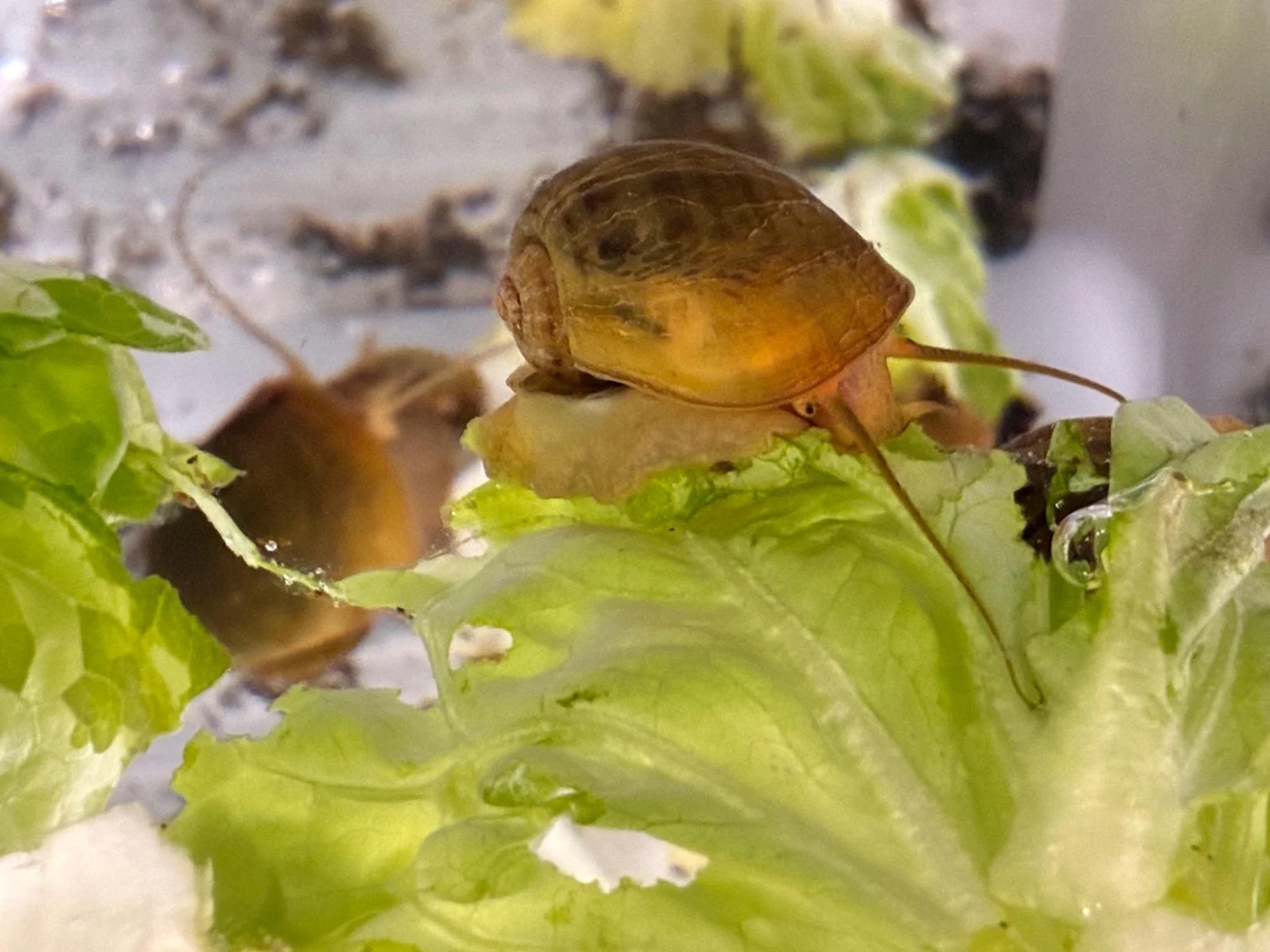
Golden Apple Snail
The golden apple snail has camera-type eyes that are fundamentally similar to the human eye. Unlike humans, the snail can regenerate a missing or damaged eye. UC Davis biologist Alice Accorsi is studying how the snails accomplish this feat. This knowledge could help us understand eye damage in humans and even lead to new ways to heal or regenerate human eyes. Credit: Alice Accorsi, UC Davis
Why the Golden Apple Snail Is a Powerful Research Model
The golden apple snail (Pomacea canaliculata) is native to South America but has spread widely and become invasive in many regions. According to Accorsi, the same traits that allow it to thrive in new environments also make it well-suited for laboratory research.
“Apple snails are resilient, their generation time is very short, and they have a lot of babies,” she said.
They are easy to breed and maintain in controlled settings. Importantly, they possess “camera-type” eyes, the same general eye design found in humans.
Scientists have recognized snails’ regenerative abilities for centuries. In 1766, a researcher documented that decapitated garden snails could regrow their entire heads. Despite that long history, Accorsi is the first to apply this ability specifically to modern regeneration research.
“When I started reading about this, I was asking myself, why isn’t anybody already using snails to study regeneration?” said Accorsi. “I think it’s because we just hadn’t found the perfect snail to study, until now. A lot of other snails are difficult or very slow to breed in the lab, and many species also go through metamorphosis, which presents an extra challenge.”
Camera-Type Eyes in Snails and Humans
Across the animal kingdom, eyes vary widely. Camera-type eyes stand out for producing sharp, high-resolution images. These eyes include a protective cornea, a lens that focuses incoming light, and a retina packed with millions of light-sensitive photoreceptor cells. They are present in all vertebrates, as well as in some spiders, squid, octopi, and certain snails.
Through dissections, advanced microscopy, and genomic studies, Accorsi’s team demonstrated that apple snail eyes closely resemble human eyes in both structure and gene activity.
“We did a lot of work to show that many genes that participate in human eye development are also present in the snail,” Accorsi said. “After regeneration, the morphology and gene expression of the new eye is pretty much identical to the original one.”
How Snails Regrow an Entire Eye
When an apple snail loses an eye, regrowth unfolds in stages over roughly one month. The first step is rapid wound healing to prevent infection and fluid loss, typically completed within 24 hours. Next, undifferentiated cells move into the injured area and begin multiplying. Over the following week and a half, these cells specialize and form essential eye components such as the lens and retina. By day 15 after amputation, all major structures, including the optic nerve, are present. Even then, the eye continues to mature and expand for several additional weeks.
“We still don’t have conclusive evidence that they can see images, but anatomically, they have all the components that are needed to form an image,” said Accorsi. “It would be very interesting to develop a behavioral assay to show that the snails can process stimuli using their new eyes in the same way as they were doing with their original eyes. That’s something we’re working on.”
The researchers also tracked gene activity throughout regeneration. Immediately after amputation, about 9,000 genes showed altered expression compared to normal adult snail eyes. After 28 days, 1,175 genes were still expressed at different levels in regenerated eyes. This suggests that although the eye appears fully formed after a month, its final maturation may take longer at the molecular level.
CRISPR Reveals Genes Behind Eye Development
To pinpoint which genes control regeneration, Accorsi developed CRISPR-Cas9 techniques tailored to apple snails.
“The idea is that we mutate specific genes and then see what effect it has on the animal, which can help us understand the function of different parts of the genome,” said Accorsi.
As an initial experiment, the team used CRISPR/Cas9 to alter a gene called pax6 in snail embryos. Pax6 plays a central role in organizing the brain and eye in humans, mice, and fruit flies. Like humans, snails inherit two copies of each gene, one from each parent. The scientists found that snails with two nonfunctional copies of pax6 developed without eyes, confirming that pax6 is essential for early eye formation in apple snails.
The next phase of research will test whether pax6 is also required for eye regeneration in adults. To answer that question, researchers must switch off or mutate pax6 in mature snails and then assess their ability to regrow eyes.
Accorsi is also examining additional eye-related genes, including those responsible for forming specific structures such as the lens or retina, as well as genes that regulate pax6.
“If we find a set of genes that are important for eye regeneration, and these genes are also present in vertebrates, in theory we could activate them to enable eye regeneration in humans,” said Accorsi.
Reference: “A genetically tractable non-vertebrate system to study complete camera-type eye regeneration” by Alice Accorsi, Brenda Pardo, Eric Ross, Timothy J. Corbin, Melainia McClain, Kyle Weaver, Kym Delventhal, Asmita Gattamraju, Jason A. Morrison, Mary Cathleen McKinney, Sean A. McKinney and Alejandro Sánchez Alvarado, 6 August 2025, Nature Communications.
DOI: 10.1038/s41467-025-61681-6
Additional authors on the study are Asmita Gattamraju of UC Davis, Brenda Pardo, Eric Ross, Timothy J. Corbin, Melainia McClain, Kyle Weaver, Kym Delventhal, Jason A. Morrison, Mary Cathleen McKinney, Sean A. McKinney, and Alejandro Sanchez Alvarado of the Stowers Institute for Medical Research. Accorsi performed most of the research for this study at Stowers Institute for Medical Research, where she worked as a postdoctoral fellow before joining UC Davis in 2024.
Funding was provided by the Howard Hughes Medical Institute, the Society for Developmental Biology, the American Association for Anatomy and the Stowers Institute for Medical Research.

News
Cocaine plays with mind, hijacks brain circuit, drives increasingly rigid and repetitive behavior
Researchers have found that cocaine hijacks brain circuit, which to drive increasingly rigid and repetitive behavior. The brain circuit that normally participates in selecting natural mouth and face movements, but which becomes disproportionately engaged [...]
Injectable nanodevices could provide effective treatment for drug-resistant glioblastoma
The brain cancer glioblastoma is one of the most aggressive and treatment-resistant cancers known to medicine, carrying a median survival of just 12-15 months, even with the best available care. Now, researchers at the [...]
New Treatment Cuts “Bad” Cholesterol in Half for a Full Year
A single infusion of an experimental CRISPR-Cas9 therapy was reported to safely lower LDL cholesterol by 52.5% and triglycerides by 47.8%, as measured 12 months after treatment. What if one infusion could keep cholesterol [...]
Too Much RNA Can Drain a Cell’s Energy, Scientists Discover
A virus may cripple a cell’s power supply simply by producing too much of a molecule the cell needs to survive. New research from the Texas A&M College of Veterinary Medicine and Biomedical Sciences [...]
West African scientists warn of weakening health systems and urge stronger outbreak detection
LOME, Togo (AP) — West African laboratory scientists called on governments Friday to strengthen capacity to detect disease outbreaks to avoid another major outbreak, saying health systems across the region are becoming weaker. Participants [...]

A Little-Known Protein Could Point to a New Way To Treat Alzheimer’s
A study suggests that increasing SORLA protein levels could help treat Alzheimer’s disease and other disorders involving tau protein. Increasing SORLA, a protein with a protective role in the brain, helped mice withstand damage [...]
Cancer’s Hidden Antioxidant Shield Helps It Escape the Immune System
Blocking an antioxidant protein that tumors use to suppress immune attacks improved cancer immunotherapy responses in mice. Cancer cells can release antioxidants that interfere with the immune cells trying to kill them. Researchers have [...]
Scientists Find a Berry Compound That Helps Muscle Cells Burn Fat
Pterostilbene, a compound found naturally in some foods, affects how skeletal muscles process fats by stabilizing a protein called PPARδ and increasing its signaling activity. Pterostilbene, a natural compound found in blueberries, grapes, and [...]
Two Hidden Forces Help Build the Human Brain Before Birth
Scientists have uncovered two surprising forces that help guide how the human brain forms before birth. Before birth, the human brain is shaped in large part by an unusual class of stem cells known [...]
Researchers Uncover a Hidden Trigger Behind Chronic Inflammation
The findings offer new insights that could help guide the development of future therapies. A protein called human resistin may help flip on one of the immune system’s most powerful inflammatory switches. Researchers at [...]
Scientists Have Uncovered Previously Hidden Microbial Activity on Human Skin
The most abundant microbes on your skin may not be the ones doing most of the work. Human skin supports vast communities of bacteria, fungi, and viruses that can influence its protective barrier, immune [...]
Brazilian Tree Compounds Fight COVID-19 on Multiple Fronts
Scientists found compounds in a Brazilian tree that hit SARS-CoV-2 on multiple fronts, revealing a promising new lead in the search for COVID-19 treatments. Researchers have found that galloylquinic acids extracted from the leaves [...]
Cutting Two Amino Acids Slowed Prostate Cancer in Mice
A newly identified link between amino acid metabolism and cholesterol production may help prostate tumors adapt to hormone therapy. Prostate cancer can find ways around treatments designed to deprive tumors of the hormones they [...]

Largest-Ever Physics Survey Raises New Doubts About Our Model of the Universe
Physicists around the world remain deeply divided on key mysteries of the universe, from dark matter to quantum gravity. The standard cosmological model failed to gain majority support, and no leading theory dominated the [...]
Scientists Just Overturned a 100-Year-Old Belief About Bacteria in the Lungs
New findings raise questions about the role of microbes living in the lungs. More than 35 trillion bacteria live throughout the human body, forming microbiomes in the gut, mouth, lungs, skin, and urogenital tract. [...]
GHCE Concept
From the preface of the book Global Health Care Equivalency in the Age of Nanotechnology, Nanomedicine and Artificial Intelligence, Edited by Frank Boehm: Since the publication of my first book (Nanomedical Device and Systems [...]