Researchers have developed an innovative and versatile system designed for a new generation of short-pulse lasers.
Lasers that produce extremely short bursts of light are known for their remarkable precision, making them indispensable tools in manufacturing, medical technology, and scientific research. However, creating short-pulse lasers that are both powerful and efficient typically requires large, complex, and costly setups.
A research team at the University of Stuttgart, working in collaboration with Stuttgart Instruments GmbH, has now overcome this challenge. Their newly developed laser system is more than twice as efficient as existing designs, small enough to fit in the palm of a hand, and adaptable for a variety of uses. Details of their innovation have been published in the journal Nature.
Eighty percent efficiency is possible
“With our new system, we can achieve levels of efficiency that were previously almost unattainable,” says Prof. Harald Giessen, Head of the 4th Physics Institute at the University of Stuttgart.
In their experiments, the researchers showed that it is fundamentally possible to reach an 80% efficiency rate with a short-pulse laser. In practical terms, this means that 80% of the energy supplied to the system can be effectively utilized.
“For comparison: current technologies achieve only about 35%—which means they lose much of their efficiency and are correspondingly expensive,” explains Giessen.
A lot of energy in an extremely short time
Short-pulse lasers emit bursts of light lasting only nano-, pico-, or femtoseconds (i.e., a few billionths to quadrillionths of a second). This capability enables them to deliver immense energy to a very small area in an incredibly brief period.
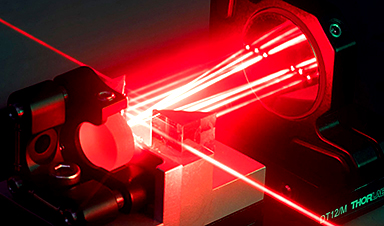
The process involves two lasers working in tandem: a pump laser and the short-pulse laser. The pump laser channels light energy into a special crystal that forms the core of the system. This crystal transfers energy from the pump laser to an ultrashort signal pulse, converting the incoming light particles into infrared light.
The result is a tool that can perform experiments, measurements, and production tasks not possible with visible light. In manufacturing, these lasers are used for ultra-precise and delicate material processing. In medicine, they enable advanced imaging techniques, while in quantum research, they allow scientists to conduct exceptionally precise measurements at the molecular scale.
Synchronize laser amplification and bandwidth
“Designing short-pulse lasers efficiently remains an unsolved challenge,” explains Dr. Tobias Steinle, lead author of the study. “In order to generate short pulses, we need to amplify the incoming light beam and cover a wide range of wavelengths.” Until now, it has not been possible to combine both properties simultaneously in a small and compact optical system.”
Laser amplifiers with a wide bandwidth require special crystals that are particularly short and thin. Efficient amplifiers, on the other hand, require especially long crystals. Connecting several short crystals in series is one possible way to combine both. It is already being pursued in research. The key is to ensure that the pulses from the pump laser and the signal laser remain synchronized.
New multipass concept
Researchers have now solved this problem with a new multipass procedure. Instead of using a single long crystal or many short crystals, they use a single short crystal and repeatedly run the light pulses through this crystal in their optical parametric amplifier.
Between two passes through the crystal, the separated pulses are precisely realigned so that they remain synchronized. The system can generate pulses shorter than 50 femtoseconds, occupies only a few square centimeters, and consists of just five components.
Highly versatile
“Our multipass system demonstrates that extremely high efficiencies need not to come at the expense of bandwidth,” explains Steinle. “It can replace large and expensive laser systems with high power losses, which were previously required to amplify ultrashort pulses.”
The new system is highly versatile and can be adapted to other wavelength ranges beyond infrared light as well as to different crystal systems and pulse durations. With this concept, the researchers aim to build small, lightweight, compact, portable, and tunable lasers capable of precisely adjusting wavelengths. They see potential areas of application in medicine, analytics, gas sensor technology, and environmental research.
Reference: “Dispersion-engineered multipass optical parametric amplification” by Jan H. Nägele, Tobias Steinle, Johann Thannheimer, Philipp Flad and Harald Giessen, 5 November 2025, Nature.
DOI: 10.1038/s41586-025-09665-w
The study was supported by the Federal Ministry of Research, Technology and Space (BMFTR) as part of the KMU-Innovativ funding line, the Federal Ministry for Economic Affairs and Energy (BMWE), the Baden-Wuerttemberg Ministry of Science, Research and the Arts, the German Research Foundation (DFG), the Carl Zeiss Foundation, the Baden-Wuerttemberg Foundation, the Center for Integrated Quantum Science and Technology (IQST), and the Innovation Campus Mobility of the Future (ICM). It was carried out by the 4th Physics Institute of the University of Stuttgart in cooperation with Stuttgart Instruments GmbH as part of the MIRESWEEP project (a novel, cost-effective tunable mid-infrared laser source for analytical applications).

News
Researcher at Russian plague laboratory dies of ‘unknown’ infection
Russian authorities have imposed "anti-epidemic measures" after a laboratory worker at an institute in Siberia dedicated to studying the plague and other infectious diseases died of a mysterious illness. The researcher, a 28-year-old female [...]

GHCE Concept
From the preface of the book Global Health Care Equivalency in the Age of Nanotechnology, Nanomedicine and Artificial Intelligence, Edited by Frank Boehm: Since the publication of my first book (Nanomedical Device and Systems [...]

A Surprising Brain Signal Could Explain Why Eating Less Protein Extends Lifespan
A new paper suggests that limiting protein intake triggers a coordinated response throughout the body that may help explain how protein restriction affects healthy aging. Animals respond to protein restriction, or reduced protein in [...]

Back and shoulder surgery is often worse than useless
Millions of operations should be scrapped SIX IN TEN Britons have surgery at some point. So do lots of Americans, at a cost of perhaps $500bn a year, a third of all spending on [...]
Cocaine plays with mind, hijacks brain circuit, drives increasingly rigid and repetitive behavior
Researchers have found that cocaine hijacks brain circuit, which to drive increasingly rigid and repetitive behavior. The brain circuit that normally participates in selecting natural mouth and face movements, but which becomes disproportionately engaged [...]
Injectable nanodevices could provide effective treatment for drug-resistant glioblastoma
The brain cancer glioblastoma is one of the most aggressive and treatment-resistant cancers known to medicine, carrying a median survival of just 12-15 months, even with the best available care. Now, researchers at the [...]

New Treatment Cuts “Bad” Cholesterol in Half for a Full Year
A single infusion of an experimental CRISPR-Cas9 therapy was reported to safely lower LDL cholesterol by 52.5% and triglycerides by 47.8%, as measured 12 months after treatment. What if one infusion could keep cholesterol [...]

Too Much RNA Can Drain a Cell’s Energy, Scientists Discover
A virus may cripple a cell’s power supply simply by producing too much of a molecule the cell needs to survive. New research from the Texas A&M College of Veterinary Medicine and Biomedical Sciences [...]

West African scientists warn of weakening health systems and urge stronger outbreak detection
LOME, Togo (AP) — West African laboratory scientists called on governments Friday to strengthen capacity to detect disease outbreaks to avoid another major outbreak, saying health systems across the region are becoming weaker. Participants [...]

A Little-Known Protein Could Point to a New Way To Treat Alzheimer’s
A study suggests that increasing SORLA protein levels could help treat Alzheimer’s disease and other disorders involving tau protein. Increasing SORLA, a protein with a protective role in the brain, helped mice withstand damage [...]

Cancer’s Hidden Antioxidant Shield Helps It Escape the Immune System
Blocking an antioxidant protein that tumors use to suppress immune attacks improved cancer immunotherapy responses in mice. Cancer cells can release antioxidants that interfere with the immune cells trying to kill them. Researchers have [...]

Scientists Find a Berry Compound That Helps Muscle Cells Burn Fat
Pterostilbene, a compound found naturally in some foods, affects how skeletal muscles process fats by stabilizing a protein called PPARδ and increasing its signaling activity. Pterostilbene, a natural compound found in blueberries, grapes, and [...]

Two Hidden Forces Help Build the Human Brain Before Birth
Scientists have uncovered two surprising forces that help guide how the human brain forms before birth. Before birth, the human brain is shaped in large part by an unusual class of stem cells known [...]

Researchers Uncover a Hidden Trigger Behind Chronic Inflammation
The findings offer new insights that could help guide the development of future therapies. A protein called human resistin may help flip on one of the immune system’s most powerful inflammatory switches. Researchers at [...]

Scientists Have Uncovered Previously Hidden Microbial Activity on Human Skin
The most abundant microbes on your skin may not be the ones doing most of the work. Human skin supports vast communities of bacteria, fungi, and viruses that can influence its protective barrier, immune [...]

Brazilian Tree Compounds Fight COVID-19 on Multiple Fronts
Scientists found compounds in a Brazilian tree that hit SARS-CoV-2 on multiple fronts, revealing a promising new lead in the search for COVID-19 treatments. Researchers have found that galloylquinic acids extracted from the leaves [...]