Researchers from Tokyo Metropolitan University have found that the motion of unlabeled cells can be used to tell whether they are cancerous or healthy. They observed malignant fibrosarcoma cells and healthy fibroblasts on a dish and found that tracking and analysis of their paths can be used to differentiate them with up to 94% accuracy. Beyond diagnosis, their technique may also shed light on cell motility related functions, like tissue healing.
While scientists and medical experts have been looking at cells under the microscope for many centuries, most studies and diagnoses focus on their shape, what they contain, and where different parts are located inside. But cells are dynamic, changing over time, and are known to be able to move. By accurately tracking and analyzing their motion, we may be able to differentiate cells which have functions relying on cell migration. An important example is cancer metastasis, where the motility of cancerous cells allows them to spread.
However, this is easier said than done. For one, studying a small subset of cells can give biased results. Any accurate diagnostic technique would rely on automated, high-throughput tracking of a significant number of cells. Many methods then turn to fluorescent labeling, which makes cells much easier to see under the microscope. But this labeling procedure can itself affect their properties. The ultimate goal is an automated method which uses label-free conventional microscopy to characterize cell motility and show whether cells are healthy or not.
Now, a team of researchers from Tokyo Metropolitan University led by Professor Hiromi Miyoshi have come up with a way of tracking cells using phase-contrast microscopy, one of the most common ways of observing cells. Phase-contrast microscopy is entirely label free, allowing cells to move about on a petri dish closer to their native state, and is not affected by the optical properties of the plastic petri dishes through which cells are imaged. Through innovative image analysis, they were able to extract trajectories of many individual cells. They focused on properties of the paths taken, like migration speed, and how curvy the paths were, all of which would encode subtle differences in deformation and movement.
As a test, they compared healthy fibroblast cells, the key component of animal tissue, and malignant fibrosarcoma cells, cancerous cells which derive from fibrous connective tissue. They were able to show that the cells migrated in subtly different ways, as characterized by the “sum of turn angles” (how curvy the paths were), the frequency of shallow turns, and how quickly they moved. In fact, by combining both the sum of turn angles and how often they made shallow turns, they could predict whether a cell was cancerous or not with an accuracy of 94%.
The team’s work not only promises a new way to discriminate cancer cells, but applications to research of any biological function based on cell motility, like the healing of wounds and tissue growth.
This work was supported by JSPS KAKENHI Grant Number JP24K01998, Tokyo Metropolitan Government Advanced Research Grant Number R2-2, and the TMU Strategic Research Fund for Social Engagement.
Endo, S., et al. (2025). Development of label-free cell tracking for discrimination of the heterogeneous mesenchymal migration. PLoS ONE. doi.org/10.1371/journal.pone.0320287.
Image Credit:
[/fusion_text][/fusion_builder_column][/fusion_builder_row]
[/fusion_builder_container]
News
3D Human Brain Tissue Model Replicates Alzheimer’s Pathology
Summary: Researchers introduced a highly reproducible three-dimensional human brain tissue model capable of replicating complex neurodegenerative processes in Alzheimer’s disease. Developed over nine years using human stem cells, the self-organizing tissue spheroids integrate functional neurons, [...]
A Common Sugar May Loosen Cancer Cells and Help Them Spread
Chemotherapy may kill most ovarian cancer cells, but the few that survive can turn dangerously active. By releasing fructose, they may help nearby tumor cells break free and spread. Researchers at The Wistar Institute [...]
COVID-19 can wake up dormant viruses in the body, large study confirms
Virus reactivations by SARS-CoV-2 could worsen initial symptoms and increase risk of Long Covid. Early in the COVID-19 pandemic, scientists noticed that a SARS-CoV-2 infection can “wake up” other, dormant viruses already present in [...]
Scientists Discover the Brain May Enter a New Biological Phase Between 50 and 75
A single-cell study reveals major changes in immune cells, genome organization, and gene regulation within the aging human hippocampus, offering important insights into brain aging and dementias associated with age. Between roughly ages 50 [...]
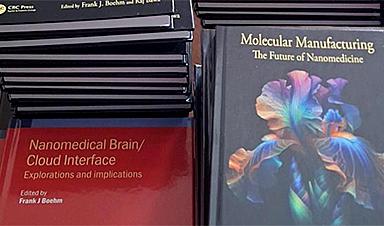
Our books now available worldwide!
Online Sellers other than Amazon, Routledge, and IOPP Indigo Global Health Care Equivalency in the Age of Nanotechnology, Nanomedicine and Artifcial Intelligence Global Health Care Equivalency In The Age Of Nanotechnology, Nanomedicine And Artificial [...]
Unzipping the Code of Life: Scientists Pinpoint Where DNA First Opens
Researchers mapped where DNA first opens and how a helicase gate may release one strand as genome copying begins. Before a cell can divide, it must open its tightly wound DNA and begin copying the entire [...]
Scientists Tested an 8-Hour Eating Window and Found a Surprising Brain Benefit
Limiting the daily eating window may provide brain benefits beyond those associated with weight loss. Eating within a shorter daily window may provide cognitive benefits beyond those associated with weight loss alone, according to [...]

Focused Ultrasound Opens Blood-Brain Barrier to Treat Brain Cancer
Summary: A new study demonstrates that primary brain tumors (gliomas) are particularly receptive to targeted drug delivery using focused ultrasound (FUS) combined with microbubbles. The team developed a high-resolution MRI protocol to track blood-brain barrier [...]

AI’s promise and practical limits in drug discovery
AI tools are becoming increasingly common in early drug discovery, allowing scientists to analyse data and navigate large volumes of research. However, according to Dr Raminderpal Singh, turning that potential into consistent scientific workflows [...]

GHCE Concept
From the preface of the book Global Health Care Equivalency in the Age of Nanotechnology, Nanomedicine and Artificial Intelligence, Edited by Frank Boehm: Since the publication of my first book (Nanomedical Device and Systems [...]

Healthcare Headlines: Challenges and Advances in 2026
Health-related updates reveal financial adjustments by Universal Health Services due to Medicaid reimbursement uncertainties, significant pollution-linked health concerns from French-British oil firm Perenco in Congo, drug trial setbacks, potential restructuring at major medical firms, [...]
Scientists Discover the Brain Protein That Helps Alzheimer’s Spread Through the Brain
Scientists have identified a brain protein that may help Alzheimer’s spread, revealing a potential new target for slowing the disease’s progression. Alzheimer’s disease is closely linked to the accumulation of a toxic form of the protein [...]
How Immune Dysregulation Contributes to Psychiatric Disorders
Introduction Growing evidence suggests that disruptions in immune function may play an important role in the development and progression of psychiatric disorders. However, immune mechanisms probably contribute more strongly in some patients than others, [...]

Electrostatic Discharge Boosts Triboelectric Nanogenerator Current and Enables DC Output
Controlled electrical discharges could enable triboelectric nanogenerators to achieve higher peak currents, extending nano-enabled energy harvesting into chemical processing and self-powered sensing. Paper: Electrostatic discharge as a breakthrough strategy for triboelectric nanogenerators. A new review [...]
Swiss laboratory uses old drugs against rare diseases
Researchers at the University of Geneva are combing through collections of approved drugs to find new therapies for rare diseases – with some success. This approach is gaining traction around the world, while pharmaceutical [...]

Nanozyme Aptasensors Show Promise for Faster Food, Health, and Environmental Testing
By pairing robust artificial enzymes with highly selective aptamers, nanozyme aptasensors could help detect disease biomarkers, pathogens, and contaminants faster, but the review shows that real-world deployment still depends on overcoming matrix interference, biofouling, [...]