New research into Amazonian cocoa reveals that its value may extend beyond flavor alone.
Chocolate from the Amazon is already known worldwide for its distinctive taste, but new research suggests it may offer even greater value. Scientists at São Paulo State University (UNESP) in Brazil found that post-harvest methods, especially fermentation, along with careful selection of cocoa varieties, can enhance both flavor and nutritional content. These improvements could help expand the product's appeal in global markets.
"Unlike soybeans, corn, and wheat, which are priced by volume, cocoa is one of the few agricultural products where quality is much more significant in determining price. In this study, we saw that Amazonian cocoa has the potential to excel in both areas. That's why we selected the best cultivar and post-harvest practices to achieve nutritional and flavor quality," said Renato de Mello Prado, a professor at the Faculty of Agricultural and Veterinary Sciences (FCAV) at UNESP's Jaboticabal campus who led the study.
Funded by FAPESP, the research took place at the Frederico Afonso Experimental Station, part of the Executive Committee of the Cocoa Farming Plan (CEPLAC) in Rondônia, Brazil. The team examined nine cocoa clones using two processing approaches: traditional fermentation and pre-drying without fermentation.
The project brought together researchers from several institutions, including the Brazilian Agricultural Research Corporation (EMBRAPA) in Porto Velho, the Federal University of Rondônia (UNIR, Rolim de Moura campus), and the Federal University of Amazonas (UFAM, Humaitá campus).
Fermentation and Nutritional Trade-Offs
"Fermentation is an important process in chocolate production. Without it, the cocoa bean doesn't develop the color and aroma we know, but there's a significant nutritional cost to this process," says Edilaine Istéfani Franklin Traspadini, a FAPESP postdoctoral fellow.
"For that reason, we suggest creating blends that combine fermented and unfermented beans as a strategy to balance flavor and nutritional value. This strategy could increase the value of Amazonian cocoa in the chocolate market, following a very similar approach to that of the coffee sector," she says.
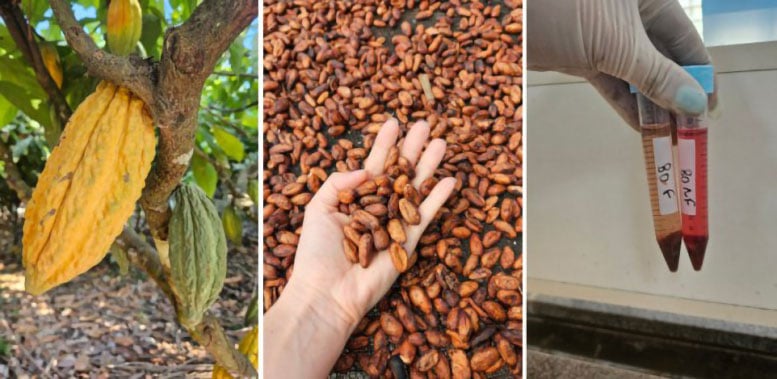
The study found that fermentation reduces sugar levels by more than 95 percent and cuts tannins, which cause bitterness, by nearly half. It also lowers phenolic compounds and anthocyanins, both known for their antioxidant properties. At the same time, fermentation boosts amino acids, increases antioxidant enzyme activity, and raises levels of minerals such as potassium and magnesium.
In contrast, unfermented cocoa retains more phosphorus and calcium, minerals that support bone strength and cardiovascular health.
"That's why we advocate for a combination of a fermented base to provide the brown color and velvety texture, while a percentage of unfermented beans would act as a boost of antioxidants and minerals, creating a balance between flavor and health," she explains.
Discovery of New Compounds and Cultivar Differences
For the first time, researchers identified glycine betaine and proline in cocoa beans. These compounds help protect plants from oxidative stress and may also act as strong antioxidants in the human body. "They function as true cellular protectors, which could transform Amazonian cocoa into a superfood," Mello highlights.
The results also showed clear differences among cocoa varieties. Clone CCN 51 maintained a consistent balance regardless of processing method. Clone EEOP 63 stood out for its high productivity. Meanwhile, EEOP 96 preserved elevated levels of phenolics and anthocyanins when unfermented, making it a promising option for products such as cocoa nibs, drink ingredients, and health-focused snacks.
"There's no single ideal clone that should be promoted in the region. On the contrary, the interest lies in combining different blends for each purpose. That's why this study on genetic selection and post-harvest management among Amazonian cocoa producers is so important," Traspadini concludes.
Reference: "Fermentation and clone selection modulate the biochemical and nutritional profile of cocoa beans grown in the southwestern Amazon" by Edilaine Istéfani Franklin Traspadini, Renato de Mello Prado, Eduarda Gonçalves Reis, Priscila Lupino Gratão, Paulo Guilherme Salvador Wadt, Sylviane Beck Ribeiro and Douglas Marcelo Pinheiro da Silva, 17 December 2025, Scientific Reports.
DOI: 10.1038/s41598-025-27795-z

News – Curated by Amanda Scott, Alias Group Creative
Follow her on Bluesky
Scientists Discover a Hidden Trigger That Keeps Inflammation Alive
Inflammation persists after proteins detach from immune receptors, revealing a potential target for autoimmune treatments. Since a Nobel Prize-winning discovery in the 1990s identified molecules called Toll-like Receptors as the guardians of the human [...]
A Virus Gives Itself Away the Moment It Attacks
Researchers have found the trigger behind a powerful bacterial defense against viruses. Viruses that prey on bacteria could become an increasingly important tool for treating bacterial infections, particularly as antibiotic resistance makes some infections [...]

Scientists Discover Aspirin May Slash Dementia Risk by 70% – but Only for Certain People
Aspirin was linked to a sharply lower dementia risk in some older adults, and their genes may hold the clue. A Monash University analysis found that older adults with a particular genetic profile had [...]
Inflammation May Awaken Dormant Cancer Cells Years After Treatment
The body’s response to inflammation may disturb cancer cells that have been lying silent for years, giving them an opportunity to grow again. Researchers at the Francis Crick Institute have found that gut inflammation [...]

Where do nanoparticles go once they enter the body?
New international best practice guidance, co-written at ANSTO, sets out how to measure where nanoparticles like titanium dioxide end up in the body and how long they remain. The guidance has been shared by [...]
Long-Acting HIV Shots Could Solve a Major Treatment Challenge for Young People
A major African trial suggests that changing how HIV treatment is delivered could significantly improve viral suppression in adolescents. Young people with HIV were more likely to keep the virus suppressed when they received [...]

WHO Factsheets – The top 10 causes of death
In 2023, the 10 leading causes of death accounted for 33 million deaths, or 54% of the total 61 million deaths worldwide. The top global causes of death, in order of total number of lives lost, [...]
Aging Cells May Be Hiding From the Immune System – Scientists Think They Know How
Your immune system is supposed to clear out damaged cells. Researchers may have found how some of them hide and linger as the body ages. Researchers led by Cedars-Sinai Health Sciences University have identified [...]

Your Voice May Reveal How Fast Your Brain Is Aging
Researchers have developed a machine-learning “speech clock” that estimates age from subtle patterns in how people speak and what they say. It is possible that people’s voices may contain certain signals of aging that [...]
Optogenetics Pioneers Win 2026 Nobel Prize in Physiology or Medicine
The 2026 Nobel Prize in Physiology or Medicine has been awarded to Peter Hegemann, Georg Nagel, and Karl Deisseroth for the development of optogenetics, a revolutionary technology that uses light to control individual neurons [...]

Molecular Manufacturing: The Future of Nanomedicine – From NanoappsMedical Inc.
This book explores the revolutionary potential of atomically precise manufacturing technologies to transform global healthcare, as well as practically every other sector across society. This forward-thinking volume examines how envisaged Factory@Home systems might enable the cost-effective [...]

What is ‘American Covid’ and how bad is it?
Cases of so-called ‘American Covid’ are on the rise in the UK. The strain is officially called XFG, or ‘Stratus’, and is the most common variant in North America, hence the name. It might soon [...]

Researcher at Russian plague laboratory dies of ‘unknown’ infection
Russian authorities have imposed "anti-epidemic measures" after a laboratory worker at an institute in Siberia dedicated to studying the plague and other infectious diseases died of a mysterious illness. The researcher, a 28-year-old female [...]

GHCE Concept
From the preface of the book Global Health Care Equivalency in the Age of Nanotechnology, Nanomedicine and Artificial Intelligence, Edited by Frank Boehm: Since the publication of my first book (Nanomedical Device and Systems [...]

A Surprising Brain Signal Could Explain Why Eating Less Protein Extends Lifespan
A new paper suggests that limiting protein intake triggers a coordinated response throughout the body that may help explain how protein restriction affects healthy aging. Animals respond to protein restriction, or reduced protein in [...]

Back and shoulder surgery is often worse than useless
Millions of operations should be scrapped SIX IN TEN Britons have surgery at some point. So do lots of Americans, at a cost of perhaps $500bn a year, a third of all spending on [...]