Stanford researchers have developed a microscope that can show how nanostructures interact inside living cells at the highest resolution achieved so far.
The view into living cells just got better.
Stanford researchers have merged two microscopy methods to build a unique instrument that can capture cell structures interacting in real time at an unprecedented resolution of 120 nanometers. It is the highest resolution yet achieved without fluorescent labels.
The technology, known as Interferometric Image Scanning Microscopy, or iISM, gives scientists a way to watch cellular structures in their broader environment, including how they react to invaders such as pathogens or to drugs. The advance is described in the journal Light: Science and Applications.
“This new microscope provides a fantastic new view into the cell, where you can see the tiny structures and machines in the cell moving, changing, and interacting without having to add fluorescence to observe them,” said senior author W.E. Moerner, the Harry S. Mosher Professor of Chemistry in Stanford’s School of Humanities and Sciences. “It’s a wonderful look into these complex little cellular boxes that drive our life.”
The abilities of iISM could support new discoveries across many areas of the life sciences, including research on disease mechanisms, drug development, and interactions between plants and microbes.
Although iISM does not reach the same resolution as some highly specialized microscopes, its label-free approach offers major benefits. Scientists can observe many cellular structures at the same time and follow them for longer periods. By comparison, fluorescence-based methods usually mark only a few selected structures at once. Fluorescent signals can also fade over time. In addition, the labels can be difficult to introduce and may sometimes alter the behavior of the structures being studied.
The iISM also works with much lower illumination power than similar high contrast label-free methods. That reduces the chance of light-related damage in living cells and makes it less likely that the imaging process will disturb the small, fragile structures under observation.
“Every method has its advantages and disadvantages, and we believe in a complementary implementation in the future,” Kueppers said. “If we use the strengths of fluorescence for molecular specificity and the strength of iISM for label-free context and dynamics, we can really start tackling questions that have been difficult to address before.”
Many ‘eyes’ on the same point
The iISM reaches higher resolution and sensitivity by combining the strengths of two microscopy approaches. That combination reflects the expertise of the two coauthors. Moerner, who received the 2014 Nobel Prize in chemistry for his work on super-resolution fluorescence microscopy, recruited Kueppers to Stanford because her doctoral research focused on “interferometric scattering microscopy.”
Scattering is the reason the sky appears blue. When light strikes small particles, as sunlight does when it passes through the atmosphere and encounters dust, water droplets, and other molecules, it changes direction and scatters. Particles in Earth’s atmosphere scatter short blue wavelengths more strongly than red wavelengths, making the sky look blue to human eyes.
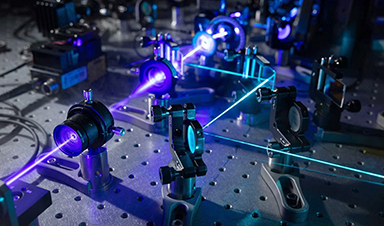
In an interferometric scattering microscope, a laser shines on a cell, and tiny structures inside the cell scatter some of that light. A second laser beam boosts the faint scattered light enough for detection, allowing small structures to be seen.
The central advance in iISM comes from pairing interferometric scattering with an adapted idea from next-generation confocal microscopes. Traditional confocal microscopes use a pinhole and a single detector to focus on target structures. More advanced versions use camera-based array detectors that capture many views of the same region.
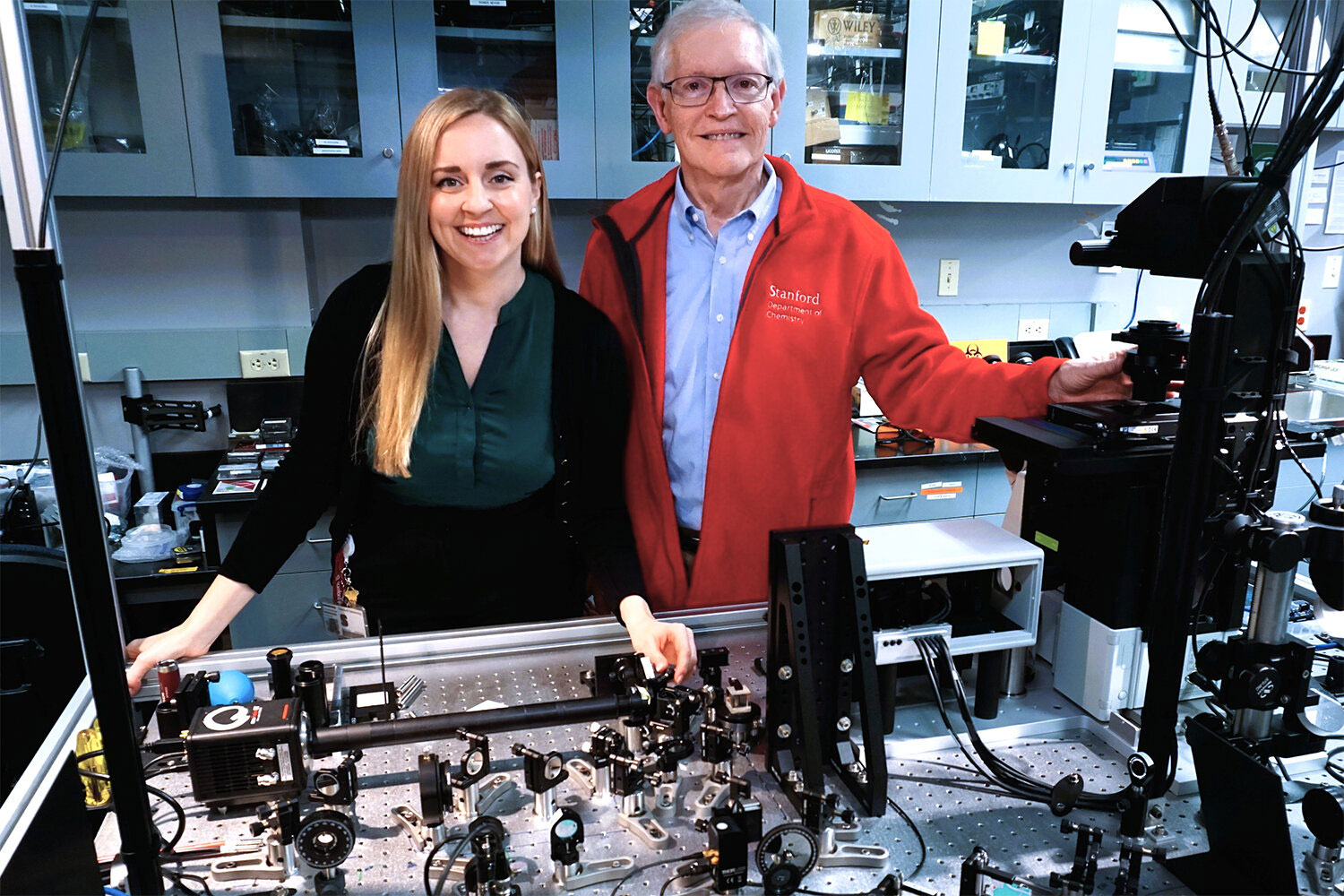
For iISM, the Stanford team used an array detector that collects more light than a pinhole and single detector system. This improves depth and precision. The concept is similar to how two human eyes gather information to separate foreground from background, except iISM uses tens to hundreds of views from an array detector rather than just two “eyes.” The researchers then created a method for combining those measurements into images with sharper detail and stronger contrast.
The result is a label-free microscope that can achieve about 120-nanometer resolution while using less laser power and preserving imaging speed. That means scientists can observe living cells for longer periods and with a gentler approach.
Wide vision for wide applications
Moerner and Kueppers are now working to improve the technology further and make it available to more scientists.
They have already begun three collaborations with other Stanford researchers. One project uses the microscope to watch interactions among plant cells, fungi, and bacteria in real time. Another uses iISM to observe how a cancer drug enters a cell. A third planned project will examine how red blood cells change shape when they encounter a malaria infection.
“This is not a niche technique,” Kueppers said. “It has broad applications, and we hope the life science community will be well served by it, leading to many new discoveries.”
Reference: “Interferometric Image Scanning Microscopy for label-free imaging at 120 nm lateral resolution inside live cells” by Michelle Küppers, and W. E. Moerner, 27 February 2026, Light: Science & Applications.
DOI: 10.1038/s41377-026-02210-y
This research received support from the U.S. National Institute of General Medical Sciences.

News – Curated by Amanda Scott, Alias Group Creative
Follow her on Bluesky

Scientists Discover Aspirin May Slash Dementia Risk by 70% – but Only for Certain People
Aspirin was linked to a sharply lower dementia risk in some older adults, and their genes may hold the clue. A Monash University analysis found that older adults with a particular genetic profile had [...]
Inflammation May Awaken Dormant Cancer Cells Years After Treatment
The body’s response to inflammation may disturb cancer cells that have been lying silent for years, giving them an opportunity to grow again. Researchers at the Francis Crick Institute have found that gut inflammation [...]

Where do nanoparticles go once they enter the body?
New international best practice guidance, co-written at ANSTO, sets out how to measure where nanoparticles like titanium dioxide end up in the body and how long they remain. The guidance has been shared by [...]
Long-Acting HIV Shots Could Solve a Major Treatment Challenge for Young People
A major African trial suggests that changing how HIV treatment is delivered could significantly improve viral suppression in adolescents. Young people with HIV were more likely to keep the virus suppressed when they received [...]

WHO Factsheets – The top 10 causes of death
In 2023, the 10 leading causes of death accounted for 33 million deaths, or 54% of the total 61 million deaths worldwide. The top global causes of death, in order of total number of lives lost, [...]
Aging Cells May Be Hiding From the Immune System – Scientists Think They Know How
Your immune system is supposed to clear out damaged cells. Researchers may have found how some of them hide and linger as the body ages. Researchers led by Cedars-Sinai Health Sciences University have identified [...]

Your Voice May Reveal How Fast Your Brain Is Aging
Researchers have developed a machine-learning “speech clock” that estimates age from subtle patterns in how people speak and what they say. It is possible that people’s voices may contain certain signals of aging that [...]

Optogenetics Pioneers Win 2026 Nobel Prize in Physiology or Medicine
The 2026 Nobel Prize in Physiology or Medicine has been awarded to Peter Hegemann, Georg Nagel, and Karl Deisseroth for the development of optogenetics, a revolutionary technology that uses light to control individual neurons [...]

Molecular Manufacturing: The Future of Nanomedicine – From NanoappsMedical Inc.
This book explores the revolutionary potential of atomically precise manufacturing technologies to transform global healthcare, as well as practically every other sector across society. This forward-thinking volume examines how envisaged Factory@Home systems might enable the cost-effective [...]

What is ‘American Covid’ and how bad is it?
Cases of so-called ‘American Covid’ are on the rise in the UK. The strain is officially called XFG, or ‘Stratus’, and is the most common variant in North America, hence the name. It might soon [...]
Researcher at Russian plague laboratory dies of ‘unknown’ infection
Russian authorities have imposed "anti-epidemic measures" after a laboratory worker at an institute in Siberia dedicated to studying the plague and other infectious diseases died of a mysterious illness. The researcher, a 28-year-old female [...]

GHCE Concept
From the preface of the book Global Health Care Equivalency in the Age of Nanotechnology, Nanomedicine and Artificial Intelligence, Edited by Frank Boehm: Since the publication of my first book (Nanomedical Device and Systems [...]

A Surprising Brain Signal Could Explain Why Eating Less Protein Extends Lifespan
A new paper suggests that limiting protein intake triggers a coordinated response throughout the body that may help explain how protein restriction affects healthy aging. Animals respond to protein restriction, or reduced protein in [...]

Back and shoulder surgery is often worse than useless
Millions of operations should be scrapped SIX IN TEN Britons have surgery at some point. So do lots of Americans, at a cost of perhaps $500bn a year, a third of all spending on [...]
Cocaine plays with mind, hijacks brain circuit, drives increasingly rigid and repetitive behavior
Researchers have found that cocaine hijacks brain circuit, which to drive increasingly rigid and repetitive behavior. The brain circuit that normally participates in selecting natural mouth and face movements, but which becomes disproportionately engaged [...]
Injectable nanodevices could provide effective treatment for drug-resistant glioblastoma
The brain cancer glioblastoma is one of the most aggressive and treatment-resistant cancers known to medicine, carrying a median survival of just 12-15 months, even with the best available care. Now, researchers at the [...]