Engineers have developed a passive evaporative cooling membrane that dramatically improves heat removal for electronics and data centers
Engineers at the University of California San Diego have created an innovative cooling system designed to greatly enhance the energy efficiency of data centers and high-performance electronic devices. This new approach relies on a specially engineered fiber membrane that naturally removes heat through evaporation. It provides an effective and energy-saving alternative to conventional cooling methods such as fans, heat sinks, and liquid pumps, while also potentially reducing the large amounts of water used by many existing systems.
The breakthrough is described in detail in a study published in the journal Joule.
As artificial intelligence (AI) and cloud computing continue to grow, so does the demand for data processing, and the heat that accompanies it. Cooling now represents as much as 40% of a data center's total energy consumption. If current growth continues, global energy demand for cooling could more than double by 2030.
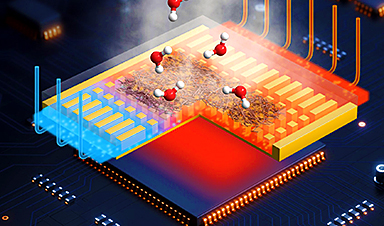
The newly developed evaporative cooling system may help slow this trend. It operates using an inexpensive fiber membrane made up of countless interconnected microscopic pores that draw cooling liquid across its surface through capillary action. When the liquid evaporates, it removes heat from the underlying electronics without the need for additional energy. The membrane is placed above microchannels that supply the liquid, allowing heat to dissipate efficiently from the components below.
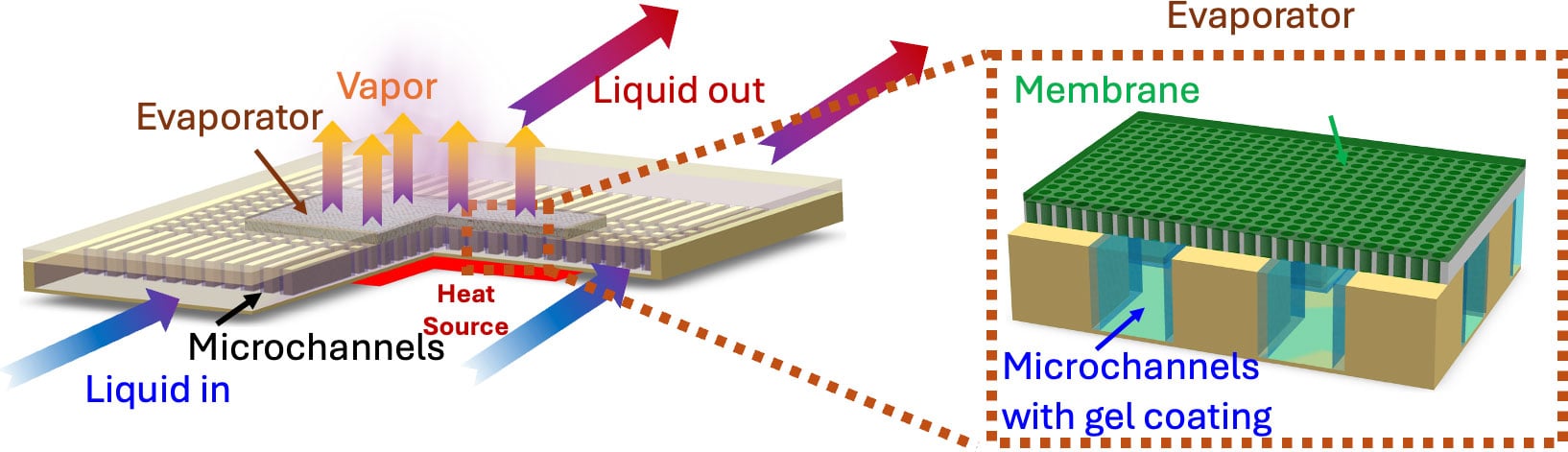
Harnessing Evaporation for Efficient Heat Dissipation
"Compared to traditional air or liquid cooling, evaporation can dissipate higher heat flux while using less energy," said Renkun Chen, professor in the Department of Mechanical and Aerospace Engineering at the UC San Diego Jacobs School of Engineering, who co-led the project with professors Shengqiang Cai and Abhishek Saha, both from the same department. Mechanical and aerospace engineering Ph.D. student Tianshi Feng and postdoctoral researcher Yu Pei, both members of Chen's research group, are co-first authors on the study.
Many applications currently rely on evaporation for cooling. Heat pipes in laptops and evaporators in air conditioners are some examples, explained Chen. But applying it effectively to high-power electronics has been a challenge.
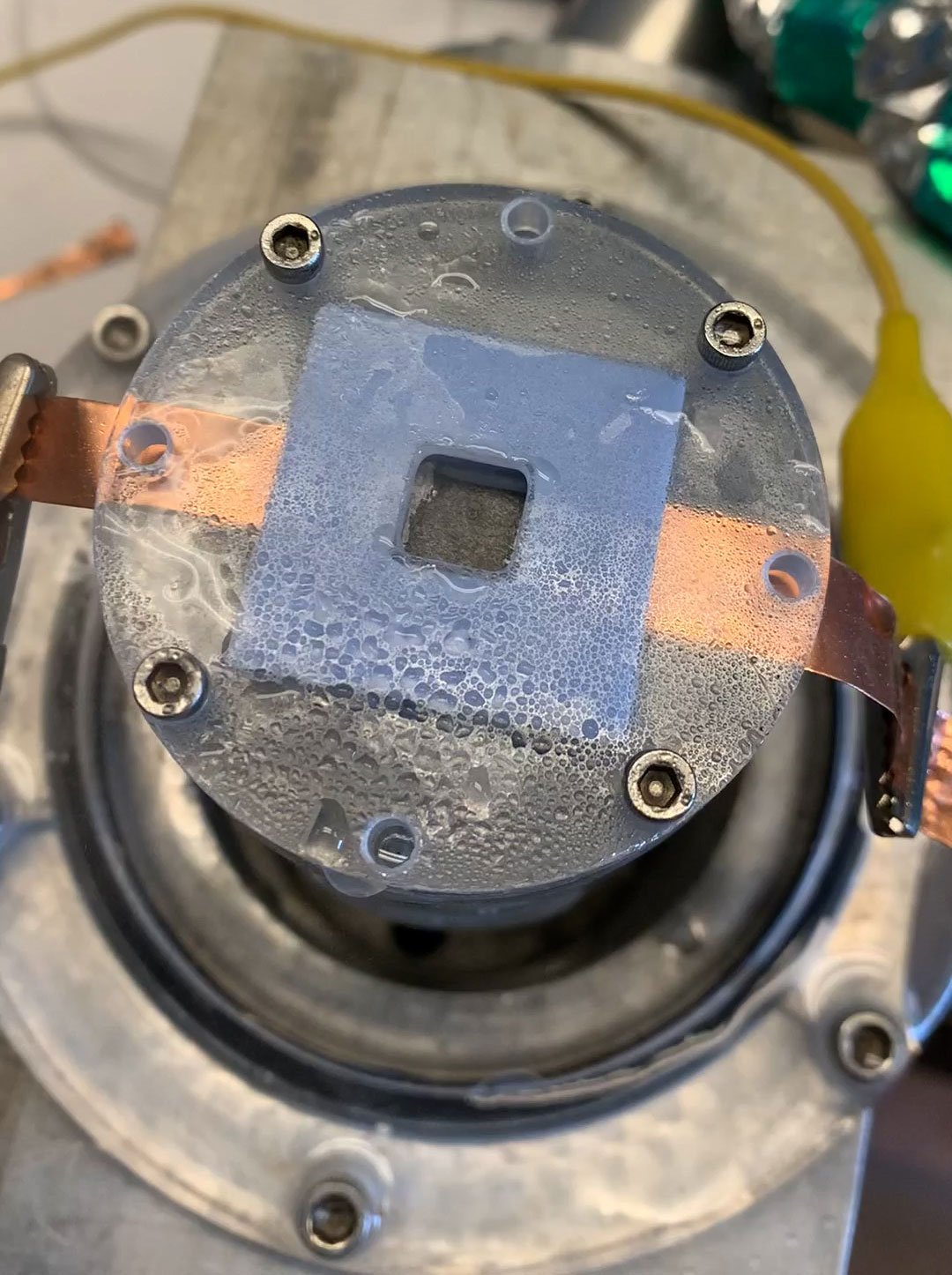
Previous attempts using porous membranes—which have large surface areas ideal for evaporation—failed because the pores were often either too small, causing clogging, or too large, leading to unwanted boiling.
"Here, we use porous fiber membranes with interconnected pores with the right size," said Chen. This design achieves efficient evaporation without those downsides.
Record-Breaking Performance and Future Potential
When tested across variable heat fluxes, the membrane achieved record-breaking performance. It managed heat fluxes exceeding 800 watts of heat per square centimeter—one of the highest levels ever recorded for this kind of cooling system. It also proved stable over multiple hours of operation.
"This success showcases the potential of reimagining materials for entirely new applications," said Chen. "These fiber membranes were originally designed for filtration, and no one had previously explored their use in evaporation. We recognized that their unique structural characteristics—interconnected pores and just the right pore size—could make them ideal for efficient evaporative cooling. What surprised us was that, with the right mechanical reinforcement, they not only withstood the high heat flux–they performed extremely well under it."
While the current results are promising, Chen says the technology is still operating well below its theoretical limit. The team is now working to refine the membrane and optimize performance. Next steps include integrating it into prototypes of cold plates, which are flat components that attach to chips like CPUs and GPUs to dissipate heat. The team is also launching a startup company to commercialize the technology.
Reference: "High-flux and stable thin-film evaporation from fiber membranes with interconnected pores" by Tianshi Feng, Yu Pei, Haowen Zhang, Brooklyn Asai, Gaoweiang Dong, Atharva Joshi, Abhishek Saha, Shengqiang Cai and Renkun Chen, 13 June 2025, Joule.
DOI: 10.1016/j.joule.2025.101975
This research was supported by the National Science Foundation (grants CMMI-1762560 and DMR-2005181). The work was performed in part at the San Diego Nanotechnology Infrastructure (SDNI) at UC San Diego, a member of the National Nanotechnology Coordinated Infrastructure, which is supported by the National Science Foundation (grant ECCS-2025752).
Disclosures: A patent related to this work was filed by the Regents of the University of California (PCT Application No. PCT/US24/46923.). The authors declare that they have no other competing interests.

News

NanoMedical Brain/Cloud Interface – Explorations and Implications. A new book from Frank Boehm
New book from Frank Boehm, NanoappsMedical Inc Founder: This book explores the future hypothetical possibility that the cerebral cortex of the human brain might be seamlessly, safely, and securely connected with the Cloud via [...]

Our books now available worldwide!
Online Sellers other than Amazon, Routledge, and IOPP Indigo Global Health Care Equivalency in the Age of Nanotechnology, Nanomedicine and Artifcial Intelligence Global Health Care Equivalency In The Age Of Nanotechnology, Nanomedicine And Artificial [...]
Ryugu asteroid samples contain all DNA and RNA building blocks, bolstering origin-of-life theories
All the essential ingredients to make the DNA and RNA underpinning life on Earth have been discovered in samples collected from the asteroid Ryugu, scientists said Monday. The discovery comes after these building blocks [...]

Is Berberine Really a “Natural Ozempic”?
Often labeled a “natural Ozempic,” berberine is widely discussed as a metabolic aid. Yet research suggests its influence may lie deeper. In recent years, berberine has gained significant attention as a supposed “natural way” [...]
Viagra Ingredient Shows Promise for Rare Childhood Brain Disease in Surprising Study
A rare childhood disease with no approved treatment may have an unexpected new therapeutic candidate. Sildenafil, the active ingredient also sold under the brand name Viagra, may help reduce symptoms in people with Leigh [...]
In a first for China, Neuracle’s implantable brain-computer interface wins approval
In a landmark development, Neuracle Medical Technology has secured the country’s first-ever approval for an implantable brain-computer interface (BCI) system designed to restore hand motor function in patients with spinal cord injuries, in a [...]
A Cambridge Lab Mistake Reveals a Powerful New Way to Modify Drug Molecules
A surprising lab discovery reveals a light-powered way to tweak complex drugs faster, cleaner, and later in development. Researchers at the University of Cambridge have created a new technique for altering complex drug molecules [...]
New book from NanoappsMedical Inc – Molecular Manufacturing: The Future of Nanomedicine
This book explores the revolutionary potential of atomically precise manufacturing technologies to transform global healthcare, as well as practically every other sector across society. This forward-thinking volume examines how envisaged Factory@Home systems might enable the cost-effective [...]

Scientists Discover Simple Saliva Test That Reveals Hidden Diabetes Risk
Researchers have identified a potential new way to assess metabolic health using saliva instead of blood. High insulin levels in the blood, known as hyperinsulinemia, can reveal metabolic problems long before obvious symptoms appear. It is [...]

One Nasal Spray Could Protect Against COVID, Flu, Pneumonia, and More
A single nasal spray vaccine may one day protect against viruses, pneumonia, and even allergies. For decades, scientists have dreamed of creating a universal vaccine capable of protecting against many different pathogens. The idea [...]
New AI Model Predicts Cancer Spread With Incredible Accuracy
Scientists have developed an AI system that analyzes complex gene-expression signatures to estimate the likelihood that a tumor will spread. Why do some tumors spread throughout the body while others remain confined to their [...]

Scientists Discover DNA “Flips” That Supercharge Evolution
In Lake Malawi, hundreds of species of cichlid fish have evolved with astonishing speed, offering scientists a rare opportunity to study how biodiversity arises. Researchers have identified segments of “flipped” DNA that may allow fish to adapt rapidly [...]

Scientists Discover Why Some COVID Survivors Still Can’t Taste Food Years Later
A new study provides the first direct biological evidence explaining why some people continue to experience taste loss long after recovering from COVID-19. Researchers have uncovered specific biological changes in taste buds that could help [...]

Catching COVID significantly raises the risk of developing kidney disease, researchers find
Catching Covid significantly raises the risk of developing deadly kidney disease, research has shown. The virus was found to increase the chances that patients will develop the incurable condition by around 50 per cent. [...]
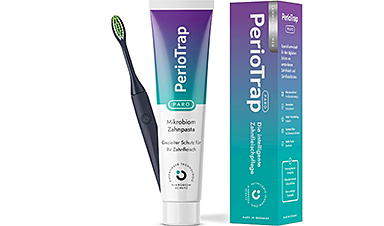
New Toothpaste Stops Gum Disease Without Harming Healthy Bacteria
Researchers have developed a targeted approach to combat periodontitis without disrupting the natural balance of the oral microbiome. The innovation could reshape how gum disease is treated while preserving beneficial bacteria. The human mouth [...]

Plastic Without End: Are We Polluting the Planet for Eternity?
The Kunming Montreal Global Biodiversity Framework calls for the elimination of plastic pollution by 2030. If that goal has been clearly set, why have meaningful measures that create real change still not been implemented? [...]