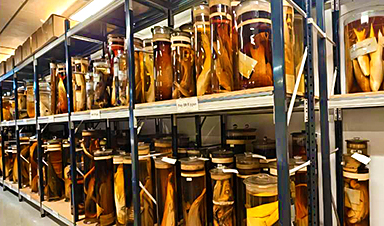
Scientists have successfully analyzed Charles Darwin’s original specimens from his HMS Beagle voyage (1831 to 1836) to the Galapagos Islands.
Remarkably, the specimens have been analyzed without opening their 200-year-old preservation jars.
Examining 46 historic specimens
The study examined 46 historic specimens at the Natural History Museum, London, including mammals, reptiles, fish, jellyfish, and shrimps collected by Darwin and other naturalists. The work is published in the journal ACS Omega.
It was found that traditional preservation methods differed by species and era.
Mammals and reptiles were typically fixed in formalin and stored in ethanol, while invertebrates might be kept in formalin, buffered solutions, or mixtures containing additives like glycerol.
80% of samples correctly identified
The technique correctly identified fluids in approximately 80% of cases tested, with partial identification in another 15%.
It also determined the types of glass or plastic containers used, providing insights into how storage methods have evolved over time.
The research was conducted by a collaboration between the Science and Technology Facilities Council (STFC), the Natural History Museum and Agilent Technologies.
Portable laser techniques
Researchers used a portable laser spectroscopy method called Spatially Offset Raman Spectroscopy (SORS) to peer through glass and identify the chemical composition of preservation fluids.
SORS performs chemical analysis by shining a laser light into a container and inspecting the changes in wavelength that occur when the light is reflected.
These changes indicate the presence of different chemical components within it.
SORS, originally developed at STFC’s Central Laser Facility, is the same technique which is used in airport scanners all over the world through Agilent Technologies.
Dr. Sara Mosca, STFC Central Laser Facility said, “Until now, understanding what preservation fluid is in each jar meant opening them, which risks evaporation, contamination, and exposing specimens to environmental damage. This technique allows us to monitor and care for these invaluable specimens without compromising their integrity.”
Impact for museums worldwide
There are over 100 million fluid-preserved specimens housed in museums worldwide.
For collection curators, knowing the exact composition of preservation fluids is essential for monitoring specimen condition.
The ability to analyze preservation fluids non-invasively offers conservators and curators a new tool for monitoring collection health and intervening before problems arise.
Transforming the study of natural history
Wren Montgomery, research technician at the Natural History Museum, says, “As part of NHM Unlocked, here at the Museum we can analyze jars containing specimens without opening and disturbing their integrity. This work is the next step in demonstrating the Museum’s commitment to transforming the study of natural history.
“Analyzing the storage conditions of precious specimens, and understanding the fluid in which they are kept, could have huge implications for how we care for collections and preserve them for future research for years to come.”
Publication details
Ana Blanco et al, In Situ Analysis of Historical Preservation Fluids in Sealed Containers with Spatially Offset Raman Spectroscopy, ACS Omega (2026). DOI: 10.1021/acsomega.5c09045
Journal information: ACS Omega
Provided by UK Research and Innovation

News
Scientists Discover Aspirin May Slash Dementia Risk by 70% – but Only for Certain People
Aspirin was linked to a sharply lower dementia risk in some older adults, and their genes may hold the clue. A Monash University analysis found that older adults with a particular genetic profile had [...]
Inflammation May Awaken Dormant Cancer Cells Years After Treatment
The body’s response to inflammation may disturb cancer cells that have been lying silent for years, giving them an opportunity to grow again. Researchers at the Francis Crick Institute have found that gut inflammation [...]

Where do nanoparticles go once they enter the body?
New international best practice guidance, co-written at ANSTO, sets out how to measure where nanoparticles like titanium dioxide end up in the body and how long they remain. The guidance has been shared by [...]
Long-Acting HIV Shots Could Solve a Major Treatment Challenge for Young People
A major African trial suggests that changing how HIV treatment is delivered could significantly improve viral suppression in adolescents. Young people with HIV were more likely to keep the virus suppressed when they received [...]

WHO Factsheets – The top 10 causes of death
In 2023, the 10 leading causes of death accounted for 33 million deaths, or 54% of the total 61 million deaths worldwide. The top global causes of death, in order of total number of lives lost, [...]
Aging Cells May Be Hiding From the Immune System – Scientists Think They Know How
Your immune system is supposed to clear out damaged cells. Researchers may have found how some of them hide and linger as the body ages. Researchers led by Cedars-Sinai Health Sciences University have identified [...]

Your Voice May Reveal How Fast Your Brain Is Aging
Researchers have developed a machine-learning “speech clock” that estimates age from subtle patterns in how people speak and what they say. It is possible that people’s voices may contain certain signals of aging that [...]
Optogenetics Pioneers Win 2026 Nobel Prize in Physiology or Medicine
The 2026 Nobel Prize in Physiology or Medicine has been awarded to Peter Hegemann, Georg Nagel, and Karl Deisseroth for the development of optogenetics, a revolutionary technology that uses light to control individual neurons [...]

Molecular Manufacturing: The Future of Nanomedicine – From NanoappsMedical Inc.
This book explores the revolutionary potential of atomically precise manufacturing technologies to transform global healthcare, as well as practically every other sector across society. This forward-thinking volume examines how envisaged Factory@Home systems might enable the cost-effective [...]

What is ‘American Covid’ and how bad is it?
Cases of so-called ‘American Covid’ are on the rise in the UK. The strain is officially called XFG, or ‘Stratus’, and is the most common variant in North America, hence the name. It might soon [...]
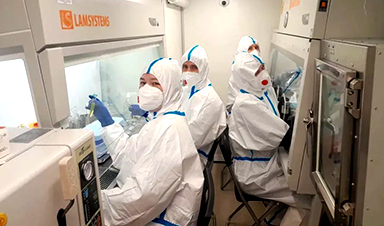
Researcher at Russian plague laboratory dies of ‘unknown’ infection
Russian authorities have imposed "anti-epidemic measures" after a laboratory worker at an institute in Siberia dedicated to studying the plague and other infectious diseases died of a mysterious illness. The researcher, a 28-year-old female [...]

GHCE Concept
From the preface of the book Global Health Care Equivalency in the Age of Nanotechnology, Nanomedicine and Artificial Intelligence, Edited by Frank Boehm: Since the publication of my first book (Nanomedical Device and Systems [...]

A Surprising Brain Signal Could Explain Why Eating Less Protein Extends Lifespan
A new paper suggests that limiting protein intake triggers a coordinated response throughout the body that may help explain how protein restriction affects healthy aging. Animals respond to protein restriction, or reduced protein in [...]

Back and shoulder surgery is often worse than useless
Millions of operations should be scrapped SIX IN TEN Britons have surgery at some point. So do lots of Americans, at a cost of perhaps $500bn a year, a third of all spending on [...]
Cocaine plays with mind, hijacks brain circuit, drives increasingly rigid and repetitive behavior
Researchers have found that cocaine hijacks brain circuit, which to drive increasingly rigid and repetitive behavior. The brain circuit that normally participates in selecting natural mouth and face movements, but which becomes disproportionately engaged [...]
Injectable nanodevices could provide effective treatment for drug-resistant glioblastoma
The brain cancer glioblastoma is one of the most aggressive and treatment-resistant cancers known to medicine, carrying a median survival of just 12-15 months, even with the best available care. Now, researchers at the [...]