A salt-grain-sized neural implant can record and transmit brain activity wirelessly for extended periods.
Researchers at Cornell University, working with collaborators, have created an extremely small neural implant that can sit on a grain of salt while wirelessly sending brain activity data from a living animal for more than a year.
The advance, reported in Nature Electronics, shows that microelectronic systems can operate at a scale far smaller than previously possible. This achievement opens the door to new approaches in long-term neural monitoring, bio-integrated sensors, and related technologies.
Shrinking neural implants to the extreme
The device, known as a microscale optoelectronic tetherless electrode, or MOTE, was developed under the joint leadership of Alyosha Molnar, a professor in the School of Electrical and Computer Engineering at Cornell, and Sunwoo Lee, an assistant professor at Nanyang Technological University.
Lee began working on the technology earlier as a postdoctoral researcher in Molnar's laboratory.
Wireless power and optical data transfer
The MOTE is powered by red and infrared laser light that can safely pass through brain tissue. It sends information back by emitting brief pulses of infrared light that carry encoded electrical signals from the brain.
A semiconductor diode made from aluminum gallium arsenide harvests the incoming light to power the circuit and also produces the outgoing signal. The system is supported by a low noise amplifier and an optical encoder, both built with the same semiconductor technology commonly used in modern microchips.
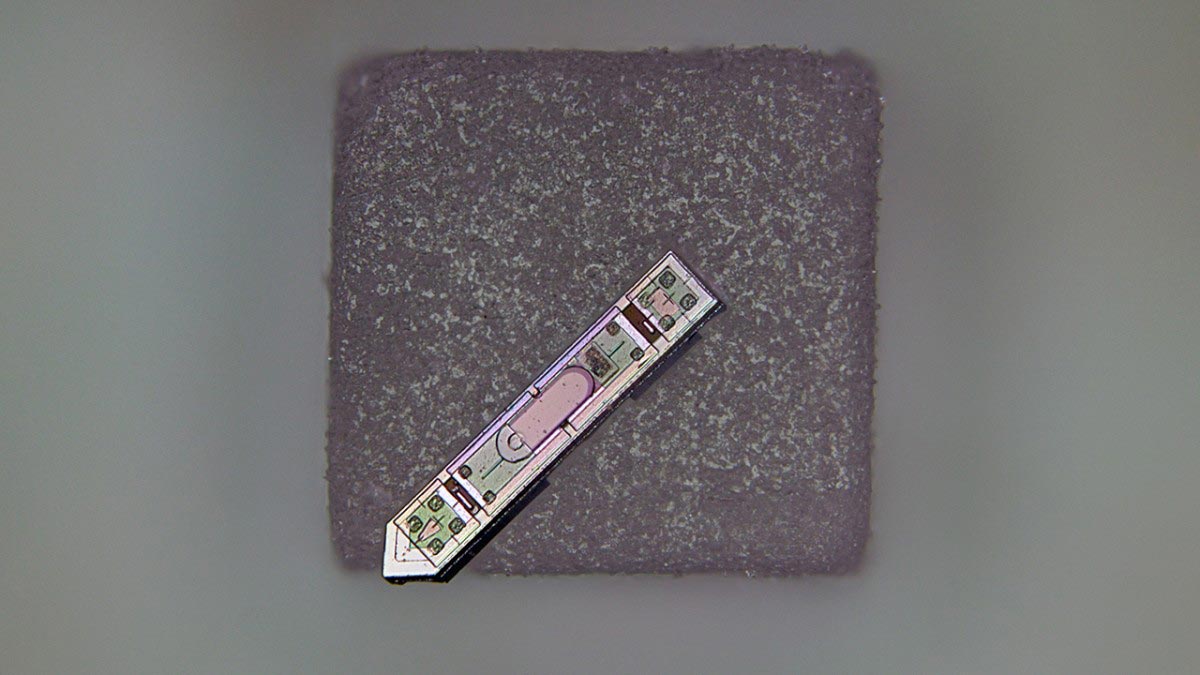
The MOTE is about 300 microns long and 70 microns wide.
"As far as we know, this is the smallest neural implant that will measure electrical activity in the brain and then report it out wirelessly," Molnar said. "By using pulse position modulation for the code – the same code used in optical communications for satellites, for example – we can use very, very little power to communicate and still successfully get the data back out optically."
New possibilities for brain and body monitoring
The researchers tested the MOTE first in cell cultures and then implanted it into mice's barrel cortex, the brain region that processes sensory information from whiskers. Over the course of a year, the implant successfully recorded spikes of electrical activity from neurons as well as broader patterns of synaptic activity – all while the mice remained healthy and active.
"One of the motivations for doing this is that traditional electrodes and optical fibers can irritate the brain," Molnar said. "The tissue moves around the implant and can trigger an immune response. Our goal was to make the device small enough to minimize that disruption while still capturing brain activity faster than imaging systems, and without the need to genetically modify the neurons for imaging."
Molnar said the MOTE's material composition could make it possible to collect electrical recordings from the brain during MRI scans, which is largely not feasible with current implants. The technology could also be adapted for use in other tissues, such as the spinal cord, and even paired with future innovations like opto-electronics embedded in artificial skull plates.
Molnar first conceived of the MOTE in 2001, but the research didn't gain momentum until he began discussing the idea about 10 years ago with members of Cornell Neurotech, a joint initiative between the College of Arts and Sciences and Cornell Engineering.
Reference: "A subnanolitre tetherless optoelectronic microsystem for chronic neural recording in awake mice" by Sunwoo Lee, Shahaboddin Ghajari, Sanaz Sadeghi, Yumin Zheng, Hind Zahr, Alejandro J. Cortese, Wenchao Gu, Kibaek Choe, Aaron Mok, Melanie Wallace, Rui Jiao, Chunyan Wu, Jesse C. Werth, Weiru Fan, Praneeth Mogalipuvvu, Ju Uhn Park, Shitong Zhao, Conrad Smart, Thomas A. Cleland, Melissa R. Warden, Jan Lammerding, Tianyu Wang, Jesse H. Goldberg, Paul L. McEuen, Chris Xu and Alyosha C. Molnar, 3 November 2025, Nature Electronics.
DOI: 10.1038/s41928-025-01484-1
The research was supported in part by the National Institutes of Health. Fabrication work was performed in part at the Cornell NanoScale Facility, which is supported by the National Science Foundation.

News

Largest-Ever Physics Survey Raises New Doubts About Our Model of the Universe
Physicists around the world remain deeply divided on key mysteries of the universe, from dark matter to quantum gravity. The standard cosmological model failed to gain majority support, and no leading theory dominated the [...]

Scientists Just Overturned a 100-Year-Old Belief About Bacteria in the Lungs
New findings raise questions about the role of microbes living in the lungs. More than 35 trillion bacteria live throughout the human body, forming microbiomes in the gut, mouth, lungs, skin, and urogenital tract. [...]

GHCE Concept
From the preface of the book Global Health Care Equivalency in the Age of Nanotechnology, Nanomedicine and Artificial Intelligence, Edited by Frank Boehm: Since the publication of my first book (Nanomedical Device and Systems [...]

Novartis, Ionis drug failure spurs questions
Pelacarsen didn’t protect heart health despite lowering levels of a protein particle, “Lp(a),” in a large clinical trial — a result with important implications for cardiovascular drug research. Dive Brief: An RNA drug from [...]

New injectable treatment helps the brain rebuild after stroke
Biomedical engineers at Duke University have created an injectable biomaterial that may help the brain recover from damage left behind by an ischemic stroke. In experiments with mice, the material transformed the cavity created [...]

Scientists Discover a Hidden “Immune Organ” Inside the Skull
Researchers discovered lymph node-like immune hubs inside skull bone marrow that appear to act as rapid-response centers for the brain. For decades, the brain was thought to operate largely apart from the immune system. [...]

Engineered tRNAs and lipid nanoparticles target nonsense mutation cystic fibrosis
Researchers have developed a potential new approach for treating a form of cystic fibrosis caused by so-called nonsense mutations, combining chemically modified transfer RNAs with lipid nanoparticles designed to deliver the therapy directly to [...]
New pancreatic cancer drug carries a $39,800 monthly list price
A groundbreaking treatment for one of the most common forms of pancreatic cancer has been approved in pill form by the FDA. Revolution Medicines’ oral tablet daraxonrasib, branded as Rasonque, reduced the risk of [...]

Researchers Have Discovered a New Way To Reduce Chronic Nerve Pain
A cancer-linked protein called BRAF may help drive chronic nerve pain, and existing cancer drugs targeting it reduced pain sensitivity in preclinical models. Chronic nerve pain can persist long after an injury and often [...]

Our books now available worldwide!
Online Sellers other than Amazon, Routledge, and IOPP Indigo Global Health Care Equivalency in the Age of Nanotechnology, Nanomedicine and Artifcial Intelligence Global Health Care Equivalency In The Age Of Nanotechnology, Nanomedicine And Artificial [...]

Quantum-Enabled Regenerative Health: Reimagining Wellness, Precision Health and Longevity Medicine
Introduction Healthcare is approaching a frontier where the quantum portfolio could influence not only how disease is diagnosed and treated, but how health itself is measured, modeled, predicted and preserved. Quantum computing, quantum simulation, [...]

FDA Clears First-of-Its-Kind Nonmedication Treatment for PTSD
The FDA has cleared a system that uses brain activity data to personalize magnetic stimulation for PTSD, adding a new nonmedication treatment option. Every day in the United States, approximately 17.5 veterans die by suicide, [...]

FDA approves breakthrough drug to treat advanced pancreatic cancer
The Food and Drug Administration (FDA) approved on Wednesday a drug that could extend the survival of those with metastatic pancreatic cancer. The drug, called daraxonrasib, will be sold under the brand name Rasonque [...]

AI Decodes a Hidden DNA Signal Linked to Disease-Causing Mutations
Machine learning identifies the likely “initiator” and enables new predictions about DNA mutations that can cause disease. Every human cell depends on tens of thousands of genes being switched on at the right time [...]

Pope Leo Urges Global Response to Congo’s Deadliest Ebola Outbreak
Pope Leo called for international action to address the Ebola outbreak in the Democratic Republic of Congo. The epidemic has claimed over 2,500 lives and is the nation's largest recorded outbreak. The Pope emphasized [...]

Is there a summer COVID-19 surge this year? Yep, it’s ramping up again
Hantavirus. Ebola. West Nile. Measles. And, of course, cyclospora — that stomach parasite making people miserable across the country. Americans have plenty to worry about this summer. But remember COVID-19? It may not be [...]