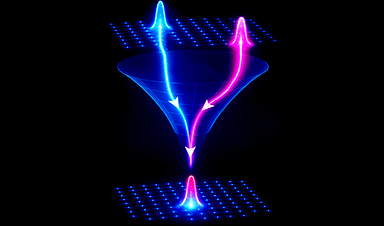
USC engineers have demonstrated a new kind of optical device that lets light organize its own route using the principles of thermodynamics.
Instead of relying on switches or digital control, the light finds its own path through the system. This approach could transform data transmission, computing, and communications by making optical technologies more natural and efficient.
Breakthrough in Optical Thermodynamics
Researchers at the Ming Hsieh Department of Electrical and Computer Engineering have achieved a major advance in photonics with the creation of the first optical device based on the emerging concept of optical thermodynamics.
Their study, published in Nature Photonics, presents a completely new method for directing light within nonlinear systems (systems that operate without switches, external control, or digital input). In this setup, light doesn't need to be steered or adjusted—it naturally travels through the device, following the basic laws of thermodynamics.
From Valves to Routers to Light
Routing is a common principle across many fields of engineering. In mechanical systems, a manifold valve controls which outlet a fluid flows through. In electronics, routers and network switches manage the flow of digital data, ensuring information from multiple inputs reaches the right destination. But directing light works differently and is far more difficult. Traditional optical routers depend on intricate arrays of switches and electronic circuits to control pathways, which makes the process complex and slows performance.
The photonics researchers at the USC Viterbi School of Engineering have discovered an entirely new approach. They describe it as being like a marble maze that organizes itself. Normally, you would have to lift barriers and guide the marble step by step to reach the right hole. In the USC team's design, the maze is structured so that wherever you drop the marble, it automatically rolls to its correct endpoint—no manual guidance required. In the same way, light in this device finds the right path on its own, driven purely by thermodynamic behavior.
Potential Industry Impact
This innovation could have significant effects beyond basic research. As computing and data systems approach the physical limits of electronic speed and efficiency, many companies (including chip developers like NVIDIA and others) are turning to optical interconnects as a faster, more energy-efficient alternative. By introducing a natural, self-organizing way to control light, the principles of optical thermodynamics could help advance this next generation of optical technology. The framework may also influence broader areas such as telecommunications, high-performance computing, and secure data transfer, opening the door to devices that are both more powerful and less complex.
How it Works: Chaos Tamed by Thermodynamics
Nonlinear multimode optical systems are often dismissed as chaotic and unpredictable. Their intricate interplay of modes has made them among the hardest systems to simulate—let alone design for practical use. Yet, precisely because they are not constrained by the rules of linear optics, they harbor rich and unexplored physical phenomena.
Recognizing that light in these systems undergoes a process akin to reaching thermal equilibrium—similar to how gases reach equilibrium through molecular collisions—the USC researchers developed a comprehensive theory of "optical thermodynamics." This framework captures how light behaves in nonlinear lattices using analogues of familiar thermodynamic processes such as expansion, compression, and even phase transitions.
A Device that Routes Light by Itself
The team's demonstration in Nature Photonics marks the first device designed with this new theory. Rather than actively steering the signal, the system is engineered so that the light routes itself.
The principle is directly inspired by thermodynamics. Just as a gas undergoing what's known as a Joule-Thomson expansion redistributes its pressure and temperature before naturally reaching thermal equilibrium, light in the USC device experiences a two-step process: first an optical analogue of expansion, then thermal equilibrium. The result is a self-organized flow of photons into the designated output channel—without any need for external switches.
Opening a New Frontier
By effectively turning chaos into predictability, optical thermodynamics opens the door to the creation of a new class of photonic devices that harness, rather than fight against, the complexity of nonlinear systems. "Beyond routing, this framework could also enable entirely new approaches to light management, with implications for information processing, communications, and the exploration of fundamental physics," said the study's lead author, Hediyeh M. Dinani, a PhD student in the Optics and Photonics Group lab at USC Viterbi.
The Steven and Kathryn Sample Chair in Engineering, and Professor of Electrical and Computer Engineering at USC Viterbi Demetrios Christodoulides added, "What was once viewed as an intractable challenge in optics has been reframed as a natural physical process—one that may redefine how engineers approach the control of light and other electromagnetic signals."
Reference: "Universal routing of light via optical thermodynamics" by Hediyeh M. Dinani, Georgios G. Pyrialakos, Abraham M. Berman Bradley, Monika Monika, Huizhong Ren, Mahmoud A. Selim, Ulf Peschel, Demetrios N. Christodoulides and Mercedeh Khajavikhan, 25 September 2025, Nature Photonics.
DOI: 10.1038/s41566-025-01756-4

News

After only a short training, people in a coma managed to send targeted signals
Researchers have succeeded in communicating with brain-injured patients who are unconscious. They see enormous potential in this for future treatments. Patients who lie motionless in bed after a severe brain injury and do not [...]
MIT Scientists Reprogram Immune Cells Inside the Body To Destroy Cancer
Natural killer cells reprogrammed inside mice eliminated lymphoma tumors and helped damaged livers heal, though whether this approach could help people with cancer or autoimmune disease remains unknown. To make a cancer treatment from [...]

Melanoma mRNA Vaccine Shows Promise in Preventing Disease Recurrence
Key takeaways: Phase 3 trial finds personalized intismeran plus pembrolizumab may better prevent high-risk melanoma recurrence after surgery The trial enrolled 1,137 patients and builds on phase 2 results showing about half the recurrence [...]
Scientists Discover a Powerful New Weapon Against a Dangerous Gut Infection
The promise of an experimental treatment for C. difficile gut infections lies partly in the bacteria it leaves alive, according to early laboratory and mouse research. Broad-spectrum antibiotics can disrupt the gut’s microbial community, [...]
Your Bones May Hold a Hidden Clue to Blood Cancer Survival
For people with blood cancers called myelodysplastic syndromes, osteoporosis may hold an overlooked clue to survival, a three-year observational study suggests. In blood cancers that develop in the bone marrow, an important clue to [...]

Researchers Discover What Reading for Pleasure May Be Doing to Your Brain
Reading for pleasure may offer surprising benefits for the brain, with research linking the habit to better mental health, stronger cognitive abilities, and a lower risk of dementia. Reading for pleasure may do far [...]
Scientists Discover a Hidden Trigger That Keeps Inflammation Alive
Inflammation persists after proteins detach from immune receptors, revealing a potential target for autoimmune treatments. Since a Nobel Prize-winning discovery in the 1990s identified molecules called Toll-like Receptors as the guardians of the human [...]
A Virus Gives Itself Away the Moment It Attacks
Researchers have found the trigger behind a powerful bacterial defense against viruses. Viruses that prey on bacteria could become an increasingly important tool for treating bacterial infections, particularly as antibiotic resistance makes some infections [...]

Scientists Discover Aspirin May Slash Dementia Risk by 70% – but Only for Certain People
Aspirin was linked to a sharply lower dementia risk in some older adults, and their genes may hold the clue. A Monash University analysis found that older adults with a particular genetic profile had [...]
Inflammation May Awaken Dormant Cancer Cells Years After Treatment
The body’s response to inflammation may disturb cancer cells that have been lying silent for years, giving them an opportunity to grow again. Researchers at the Francis Crick Institute have found that gut inflammation [...]
Where do nanoparticles go once they enter the body?
New international best practice guidance, co-written at ANSTO, sets out how to measure where nanoparticles like titanium dioxide end up in the body and how long they remain. The guidance has been shared by [...]

Long-Acting HIV Shots Could Solve a Major Treatment Challenge for Young People
A major African trial suggests that changing how HIV treatment is delivered could significantly improve viral suppression in adolescents. Young people with HIV were more likely to keep the virus suppressed when they received [...]

WHO Factsheets – The top 10 causes of death
In 2023, the 10 leading causes of death accounted for 33 million deaths, or 54% of the total 61 million deaths worldwide. The top global causes of death, in order of total number of lives lost, [...]
Aging Cells May Be Hiding From the Immune System – Scientists Think They Know How
Your immune system is supposed to clear out damaged cells. Researchers may have found how some of them hide and linger as the body ages. Researchers led by Cedars-Sinai Health Sciences University have identified [...]

Your Voice May Reveal How Fast Your Brain Is Aging
Researchers have developed a machine-learning “speech clock” that estimates age from subtle patterns in how people speak and what they say. It is possible that people’s voices may contain certain signals of aging that [...]

Optogenetics Pioneers Win 2026 Nobel Prize in Physiology or Medicine
The 2026 Nobel Prize in Physiology or Medicine has been awarded to Peter Hegemann, Georg Nagel, and Karl Deisseroth for the development of optogenetics, a revolutionary technology that uses light to control individual neurons [...]