Scientists can finally hear the brain's quietest messages—unlocking the hidden code behind how neurons think, decide, and remember.
Scientists have created a new protein that can capture the incoming chemical signals received by brain cells, not just the signals they send out. These incoming messages are carried by glutamate, a neurotransmitter that plays a central role in brain communication. Although glutamate activity is essential for how the brain functions, its signals are extremely subtle and fast, making them nearly impossible to observe until now.
This breakthrough allows researchers to record these faint chemical messages as they arrive at individual neurons, opening a new window into how the brain processes information.
Why this breakthrough matters
By detecting incoming signals, scientists can now explore how neurons actually compute information. Each neuron integrates thousands of inputs before producing an output, a process that underlies thinking, decision making, and memory. Being able to observe this process directly could help explain long-standing questions about how the brain works.
The discovery also has important implications for disease research. Abnormal glutamate signaling has been linked to conditions such as Alzheimer's disease, schizophrenia, autism, and epilepsy. Having tools that can track these signals more precisely may help researchers identify what goes wrong in these disorders.
Drug development could benefit as well. Pharmaceutical researchers can use these sensors to see how experimental treatments affect real synaptic activity, potentially speeding up the development of more effective therapies.

A new protein that listens to neurons
The protein, developed by scientists at the Allen Institute and HHMI's Janelia Research Campus, is a molecular "glutamate indicator" known as iGluSnFR4 (pronounced 'glue sniffer'). It is sensitive enough to detect the weakest incoming chemical signals exchanged between neurons.
By revealing when and where glutamate is released, iGluSnFR4 offers a new way to interpret the complex patterns of activity that support learning, memory, and emotion. Researchers can now observe neurons communicating inside the brain in real time, rather than inferring activity indirectly. The findings were recently published in Nature Methods and could significantly change how neural activity is measured and analyzed in neuroscience research.
How neurons communicate inside the brain
To appreciate the importance of this advance, it helps to understand how brain cells interact. Billions of neurons communicate by sending electrical pulses down long, branch-like structures called axons. When an electrical signal reaches the end of an axon, it cannot cross the tiny gap to the next cell, known as a synapse.
Instead, the signal triggers the release of chemical messengers called neurotransmitters into the synapse. Glutamate, the most common neurotransmitter in the brain, is especially important for memory, learning, and emotion. When glutamate reaches the next neuron, it can cause that cell to fire and pass the signal along.
This process resembles a chain reaction, but it is far more intricate. Each neuron receives input from thousands of others, and only specific combinations and patterns of those inputs determine whether the receiving neuron activates. With this new protein sensor, scientists can now identify which patterns of incoming signals lead to neuronal firing.

Capturing signals that were once invisible
Until now, observing these incoming signals in living brain tissue was nearly impossible. Earlier technologies were either too slow or not sensitive enough to measure activity at individual synapses. As a result, researchers could only see fragments of neural communication rather than the full exchange.
"It's like reading a book with all the words scrambled and not understanding the order of the words or how they're arranged," said Kaspar Podgorski, Ph.D., a lead author of the study and senior scientist at the Allen Institute. "I feel like what we're doing here is adding the connections between those neurons, and by doing that, we now understand the order of the words on the pages, and what they mean."
Before protein sensors like iGluSnFR4 existed, scientists were limited to recording outgoing signals from neurons. The incoming messages were too weak and brief to detect, leaving a major gap in understanding how brain cells communicate.
Filling a critical gap in neuroscience
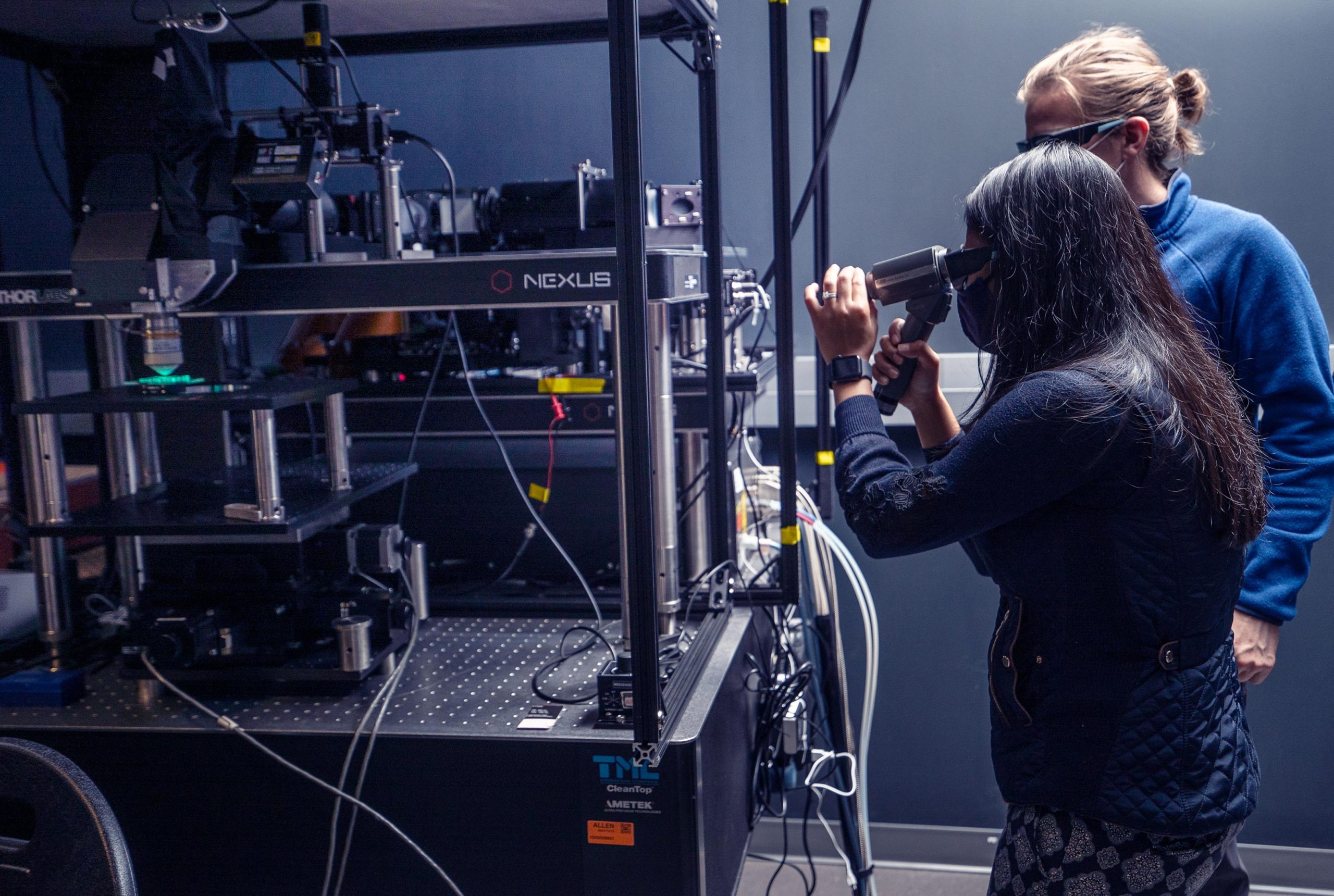
"Neuroscientists have pretty good ways of measuring structural connections between neurons, and in separate experiments, we can measure what some of the neurons in the brain are saying, but we haven't been good at combining these two kinds of information. It's hard to measure what neurons are saying to which other neurons," Podgorski said. "What we have invented here is a way of measuring information that comes into neurons from different sources, and that's been a critical part missing from neuroscience research."
Jeremy Hasseman, Ph.D., a scientist at HHMI's Janelia Research Campus, emphasized the collaborative effort behind the discovery. "The success of iGluSnFR4 stems from our close collaboration started at HHMI's Janelia Research Campus between the GENIE Project team and Kaspar's lab. That research has extended to the phenomenal in vivo characterization work done by the Allen Institute's Neural Dynamics group," he said. "This was a great example of collaboration across labs and institutes to enable new discoveries in neuroscience."
Opening the door to new discoveries
This advance removes a major obstacle in modern neuroscience by making it possible to directly observe how brain cells receive information. With iGluSnFR4 now available to researchers through Addgene, scientists have a powerful new tool to explore how the brain functions at its most fundamental level. As this technology is adopted more widely, it may help uncover answers to some of the brain's most enduring mysteries.
Reference: "Glutamate indicators with increased sensitivity and tailored deactivation rates" 23 December 2025, Nature Methods.
DOI: 10.1038/s41592-025-02965-z

News

Scientists Identify “Good” Bacteria That May Prevent Long COVID
According to the WHO, about 6% of people worldwide who get COVID-19, roughly 400 million people, later develop a long-lasting form of the illness. That shows the condition remains a significant public health challenge. In [...]

New book from Nanoappsmedical Inc. – Global Health Care Equivalency
A new book by Frank Boehm, NanoappsMedical Inc. Founder. This groundbreaking volume explores the vision of a Global Health Care Equivalency (GHCE) system powered by artificial intelligence and quantum computing technologies, operating on secure [...]
RNA Recycling Extends Lifespan
Summary: Researchers discovered a biological “trash disposal” mechanism that directly controls how fast we age. While circular RNA has long been known to accumulate in cells as we get older, this study proves for the [...]
Cancer’s Deadly Paradox: How Tumors Break Their Own DNA To Keep Growing
Cancer’s strongest gene switches push DNA into damaging overdrive, creating repeated breaks and repairs that may fuel tumor evolution while exposing possible therapeutic weak spots. A new study indicates that cancer can harm its own genetic [...]

NanoMedical Brain/Cloud Interface – Explorations and Implications. A new book from Frank Boehm
New book from Frank Boehm, NanoappsMedical Inc Founder: This book explores the future hypothetical possibility that the cerebral cortex of the human brain might be seamlessly, safely, and securely connected with the Cloud via [...]
Our books now available worldwide!
Online Sellers other than Amazon, Routledge, and IOPP Indigo Global Health Care Equivalency in the Age of Nanotechnology, Nanomedicine and Artifcial Intelligence Global Health Care Equivalency In The Age Of Nanotechnology, Nanomedicine And Artificial [...]
Ryugu asteroid samples contain all DNA and RNA building blocks, bolstering origin-of-life theories
All the essential ingredients to make the DNA and RNA underpinning life on Earth have been discovered in samples collected from the asteroid Ryugu, scientists said Monday. The discovery comes after these building blocks [...]

Is Berberine Really a “Natural Ozempic”?
Often labeled a “natural Ozempic,” berberine is widely discussed as a metabolic aid. Yet research suggests its influence may lie deeper. In recent years, berberine has gained significant attention as a supposed “natural way” [...]
Viagra Ingredient Shows Promise for Rare Childhood Brain Disease in Surprising Study
A rare childhood disease with no approved treatment may have an unexpected new therapeutic candidate. Sildenafil, the active ingredient also sold under the brand name Viagra, may help reduce symptoms in people with Leigh [...]

In a first for China, Neuracle’s implantable brain-computer interface wins approval
In a landmark development, Neuracle Medical Technology has secured the country’s first-ever approval for an implantable brain-computer interface (BCI) system designed to restore hand motor function in patients with spinal cord injuries, in a [...]
A Cambridge Lab Mistake Reveals a Powerful New Way to Modify Drug Molecules
A surprising lab discovery reveals a light-powered way to tweak complex drugs faster, cleaner, and later in development. Researchers at the University of Cambridge have created a new technique for altering complex drug molecules [...]

New book from NanoappsMedical Inc – Molecular Manufacturing: The Future of Nanomedicine
This book explores the revolutionary potential of atomically precise manufacturing technologies to transform global healthcare, as well as practically every other sector across society. This forward-thinking volume examines how envisaged Factory@Home systems might enable the cost-effective [...]

Scientists Discover Simple Saliva Test That Reveals Hidden Diabetes Risk
Researchers have identified a potential new way to assess metabolic health using saliva instead of blood. High insulin levels in the blood, known as hyperinsulinemia, can reveal metabolic problems long before obvious symptoms appear. It is [...]

One Nasal Spray Could Protect Against COVID, Flu, Pneumonia, and More
A single nasal spray vaccine may one day protect against viruses, pneumonia, and even allergies. For decades, scientists have dreamed of creating a universal vaccine capable of protecting against many different pathogens. The idea [...]
New AI Model Predicts Cancer Spread With Incredible Accuracy
Scientists have developed an AI system that analyzes complex gene-expression signatures to estimate the likelihood that a tumor will spread. Why do some tumors spread throughout the body while others remain confined to their [...]

Scientists Discover DNA “Flips” That Supercharge Evolution
In Lake Malawi, hundreds of species of cichlid fish have evolved with astonishing speed, offering scientists a rare opportunity to study how biodiversity arises. Researchers have identified segments of “flipped” DNA that may allow fish to adapt rapidly [...]