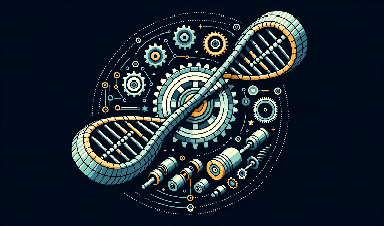
An international team of scientists has recently developed a novel type of nano engine made of DNA. It is driven by a clever mechanism and can perform pulsing movements. The researchers are now planning to fit it with a coupling and install it as a drive in complex nano machines. Their results have been published in the journal Nature Nanotechnology.
Šulc has used his group’s computer modeling tools to gain insights into design and operation of this leaf-spring nano engine. The structure is comprised of almost 14,000 nucleotides, which form the basic structural units of DNA.
“Being able to simulate motion in such a large nanostructure would be impossible without oxDNA, the computer model that our group uses for design and design of DNA nanostructures,” explains Šulc. “It is the first time that a chemically powered DNA nanotechnology motor has been successfully engineered. We are very excited that our research methods could help with studying it, and are looking forward to building even more complex nanodevices in the future.”
This novel type of engine is similar to a hand grip strength trainer that strengthens your grip when used regularly. However, the motor is around one million times smaller. Two handles are connected by a spring in a V-shaped structure.
In a hand grip strength trainer, you squeeze the handles together against the resistance of the spring. Once you release your grip, the spring pushes the handles back to their original position. “Our motor uses a very similar principle,” says professor Michael Famulok from the Life and Medical Sciences (LIMES) Institute at the University of Bonn. “But the handles are not pressed together but rather pulled together.”
The researchers have repurposed a mechanism without which there would be no plants or animals on Earth. Every cell is equipped with a sort of library. It contains the blueprints for all types of proteins that each cell needs to perform its function. If the cell wants to produce a certain type of protein, it orders a copy from the respective blueprint. This transcript is produced by the enzymes called RNA polymerases.
RNA polymerases drive the pulsing movements
The original blueprint consists of long strands of DNA. The RNA polymerases move along these strands and copy the stored information letter by letter.
“We took an RNA polymerase and attached it to one of the handles in our nanomachine,” explains Famulok, who is also a member of the transdisciplinary research areas “Life & Health” and “Matter” at the University of Bonn.
“In close proximity, we also strained a DNA strand between the two handles. The polymerase grabs on to this strand to copy it. It pulls itself along the strand and the non-transcribed section becomes increasingly smaller. This pulls the second handle bit by bit towards the first one, compressing the spring at the same time.”
The DNA strand between the handles contains a particular sequence of letters shortly before its end. This so-called termination sequence signals to the polymerase that it should let go of the DNA. The spring can now relax again and moves the handles apart. This brings the start sequence of the strand close to the polymerase and the molecular copier can start a new transcription process: The cycle then repeats.
“In this way, our nanomotor performs a pulsing action,” explains Mathias Centola from the research group headed by professor Famulok, who carried out a large proportion of the experiments.
An alphabet soup serves as fuel
This motor also needs energy just like any other type of motor. It is provided by the “alphabet soup” from which the polymerase produces the transcripts. Every one of these letters (in technical terminology: nucleotides) has a small tail consisting of three phosphate groups—a triphosphate.
In order to attach a new letter to an existing sentence, the polymerase has to remove two of these phosphate groups. This releases energy which it can use for linking the letters together. “Our motor thus uses nucleotide triphosphates as fuel,” says Famulok. “It can only continue to run when a sufficient number of them are available.”
The researchers were able to demonstrate that the motor can be easily combined with other structures. This should make it possible for it to, for example, wander across a surface—similar to an inchworm that pulls itself along a branch in its own characteristic style.
“We are also planning to produce a type of clutch that will allow us to only utilize the power of the motor at certain times and otherwise leave it to idle,” explains Famulok. In the long term, the motor could become the heart of a complex nanomachine. “However, there is still a lot of work to be done before we reach this stage.”
Šulc’s lab is highly interdisciplinary and applies broadly the methods of statistical physics and computational modeling to problems in chemistry, biology and nanotechnology. The group develops new multiscale models to study interactions between biomolecules, particularly in the context of design and simulations of DNA and RNA nanostructures and devices.
“Just as complex machines in our everyday use—planes, cars and chips in electronics—require sophisticated computer-aided design tools to make sure they perform a desired function, there is a pressing need to have access to such methods in the molecular sciences.”
Professor Tijana Rajh, director of the School of Molecular Sciences, said, “Petr Šulc and his group are doing extremely innovative molecular science, using the methods of computational chemistry and physics to study DNA and RNA molecules in the context of biology as well as nanotechnology. Our younger faculty members in the School of Molecular Sciences have an extraordinary record of achievement, and Professor Šulc is an exemplar in this regard.”
Bio-nanotechnology
DNA and RNA are the basic molecules of life. They fulfill many functions, including information storage and information transfer in living cells. They also have promising applications in the field of nanotechnology where designed DNA and RNA strands are used to assemble nanoscale structures and devices.
As Šulc explains, “It is a little bit like playing with Lego blocks except that each Lego block is only a few nanometers (a millionth of a millimeter) in size, and instead of putting each block into the place where it should go, you put them inside a box and shake it randomly until only the desired structure comes out.”
This process is called self-assembly, and Šulc and his colleagues use computational modeling and design software to come up with the building blocks that reliably assemble into the shape one wants at nanoscale resolution.
“The promising applications of this field include diagnostics, therapeutics, molecular robotics, and building of new materials,” says Šulc.
“My lab has developed the software to design these blocks, and we work closely with experimental groups at ASU as well as other universities in the U.S. and Europe. It is exciting seeing our methods used to design and characterize nanostructures of increasing complexity, as the field progresses and we achieve new advanced designs and successfully operate them at nanoscale.”
More information: A rhythmically pulsing leaf-spring DNA-origami nanoengine that drives a passive follower, Nature Nanotechnology (2023). DOI: 10.1038/s41565-023-01516-x. www.nature.com/articles/s41565-023-01516-x
Journal information: Nature Nanotechnology

News
Scientists Have Uncovered Previously Hidden Microbial Activity on Human Skin
The most abundant microbes on your skin may not be the ones doing most of the work. Human skin supports vast communities of bacteria, fungi, and viruses that can influence its protective barrier, immune [...]

Brazilian Tree Compounds Fight COVID-19 on Multiple Fronts
Scientists found compounds in a Brazilian tree that hit SARS-CoV-2 on multiple fronts, revealing a promising new lead in the search for COVID-19 treatments. Researchers have found that galloylquinic acids extracted from the leaves [...]
Cutting Two Amino Acids Slowed Prostate Cancer in Mice
A newly identified link between amino acid metabolism and cholesterol production may help prostate tumors adapt to hormone therapy. Prostate cancer can find ways around treatments designed to deprive tumors of the hormones they [...]

Largest-Ever Physics Survey Raises New Doubts About Our Model of the Universe
Physicists around the world remain deeply divided on key mysteries of the universe, from dark matter to quantum gravity. The standard cosmological model failed to gain majority support, and no leading theory dominated the [...]

Scientists Just Overturned a 100-Year-Old Belief About Bacteria in the Lungs
New findings raise questions about the role of microbes living in the lungs. More than 35 trillion bacteria live throughout the human body, forming microbiomes in the gut, mouth, lungs, skin, and urogenital tract. [...]

GHCE Concept
From the preface of the book Global Health Care Equivalency in the Age of Nanotechnology, Nanomedicine and Artificial Intelligence, Edited by Frank Boehm: Since the publication of my first book (Nanomedical Device and Systems [...]

Novartis, Ionis drug failure spurs questions
Pelacarsen didn’t protect heart health despite lowering levels of a protein particle, “Lp(a),” in a large clinical trial — a result with important implications for cardiovascular drug research. Dive Brief: An RNA drug from [...]

New injectable treatment helps the brain rebuild after stroke
Biomedical engineers at Duke University have created an injectable biomaterial that may help the brain recover from damage left behind by an ischemic stroke. In experiments with mice, the material transformed the cavity created [...]

Scientists Discover a Hidden “Immune Organ” Inside the Skull
Researchers discovered lymph node-like immune hubs inside skull bone marrow that appear to act as rapid-response centers for the brain. For decades, the brain was thought to operate largely apart from the immune system. [...]

Engineered tRNAs and lipid nanoparticles target nonsense mutation cystic fibrosis
Researchers have developed a potential new approach for treating a form of cystic fibrosis caused by so-called nonsense mutations, combining chemically modified transfer RNAs with lipid nanoparticles designed to deliver the therapy directly to [...]

New pancreatic cancer drug carries a $39,800 monthly list price
A groundbreaking treatment for one of the most common forms of pancreatic cancer has been approved in pill form by the FDA. Revolution Medicines’ oral tablet daraxonrasib, branded as Rasonque, reduced the risk of [...]
Researchers Have Discovered a New Way To Reduce Chronic Nerve Pain
A cancer-linked protein called BRAF may help drive chronic nerve pain, and existing cancer drugs targeting it reduced pain sensitivity in preclinical models. Chronic nerve pain can persist long after an injury and often [...]

Our books now available worldwide!
Online Sellers other than Amazon, Routledge, and IOPP Indigo Global Health Care Equivalency in the Age of Nanotechnology, Nanomedicine and Artifcial Intelligence Global Health Care Equivalency In The Age Of Nanotechnology, Nanomedicine And Artificial [...]

Quantum-Enabled Regenerative Health: Reimagining Wellness, Precision Health and Longevity Medicine
Introduction Healthcare is approaching a frontier where the quantum portfolio could influence not only how disease is diagnosed and treated, but how health itself is measured, modeled, predicted and preserved. Quantum computing, quantum simulation, [...]

FDA Clears First-of-Its-Kind Nonmedication Treatment for PTSD
The FDA has cleared a system that uses brain activity data to personalize magnetic stimulation for PTSD, adding a new nonmedication treatment option. Every day in the United States, approximately 17.5 veterans die by suicide, [...]

FDA approves breakthrough drug to treat advanced pancreatic cancer
The Food and Drug Administration (FDA) approved on Wednesday a drug that could extend the survival of those with metastatic pancreatic cancer. The drug, called daraxonrasib, will be sold under the brand name Rasonque [...]