Medical diagnostics expert, doctor's assistant, and cartographer are all fair titles for an artificial intelligence model developed by researchers at the Beckman Institute for Advanced Science and Technology.
Their new model accurately identifies tumors and diseases in medical images and is programmed to explain each diagnosis with a visual map. The tool's unique transparency allows doctors to easily follow its line of reasoning, double-check for accuracy, and explain the results to patients.
"The idea is to help catch cancer and disease in its earliest stages — like an X on a map — and understand how the decision was made. Our model will help streamline that process and make it easier on doctors and patients alike," said Sourya Sengupta, the study's lead author and a graduate research assistant at the Beckman Institute.
This research appeared in IEEE Transactions on Medical Imaging.
Cats and dogs and onions and ogres
First conceptualized in the 1950s, artificial intelligence — the concept that computers can learn to adapt, analyze, and problem-solve like humans do — has reached household recognition, due in part to ChatGPT and its extended family of easy-to-use tools.
Machine learning, or ML, is one of many methods researchers use to create artificially intelligent systems. ML is to AI what driver's education is to a 15-year-old: a controlled, supervised environment to practice decision-making, calibrating to new environments, and rerouting after a mistake or wrong turn.
Deep learning — machine learning's wiser and worldlier relative — can digest larger quantities of information to make more nuanced decisions. Deep learning models derive their decisive power from the closest computer simulations we have to the human brain: deep neural networks.
These networks — just like humans, onions, and ogres — have layers, which makes them tricky to navigate. The more thickly layered, or nonlinear, a network's intellectual thicket, the better it performs complex, human-like tasks.
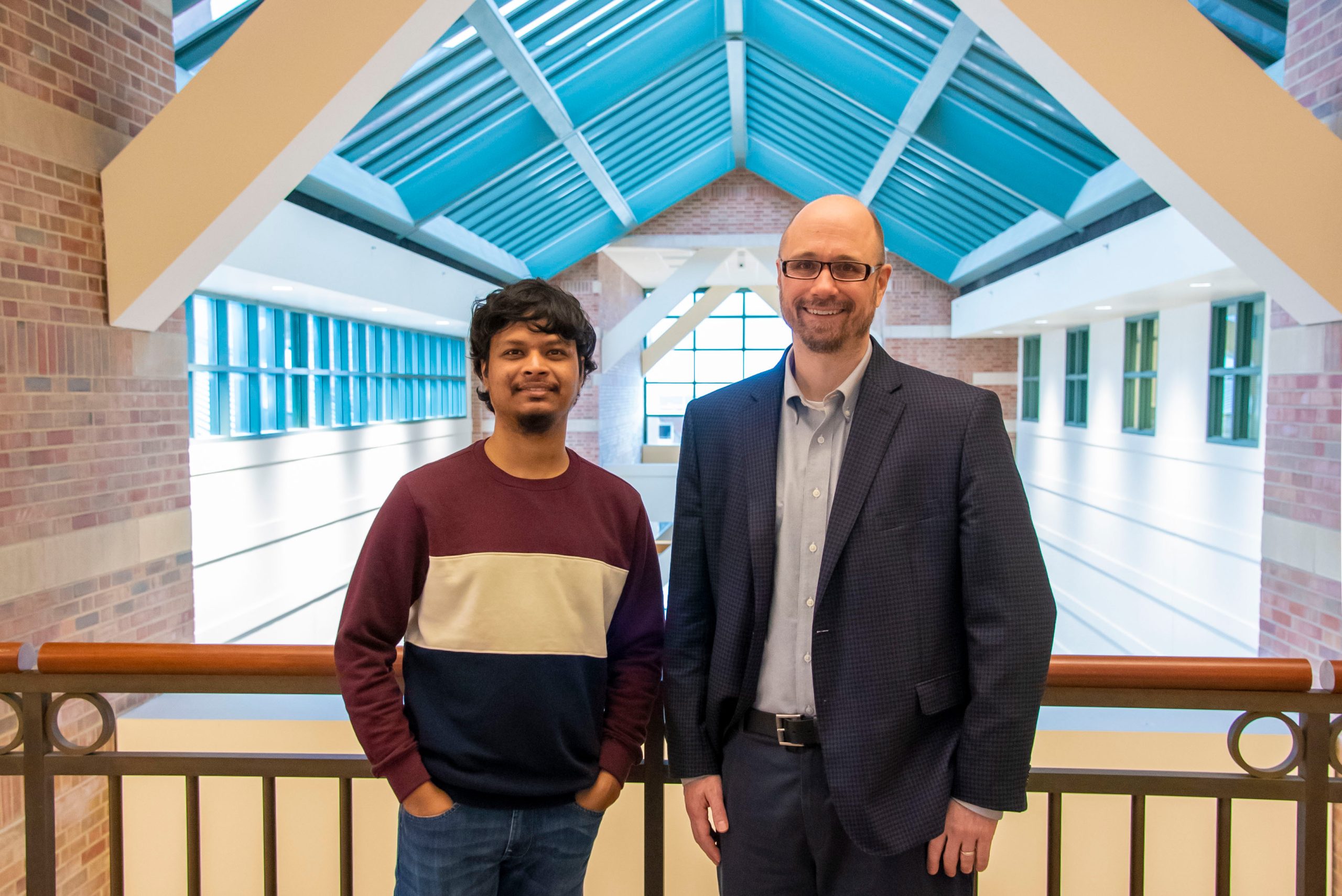
Researchers at the Beckman Institute led by Mark Anastasio (right) and Sourya Sengupta developed an artificial intelligence model that can accurately identify tumors and diseases in medical images. The tool draws a map to explain each diagnosis, helping doctors follow its line of reasoning, check for accuracy, and explain the results to patients. Credit: Jenna Kurtzweil, Beckman Institute Communications Office
Consider a neural network trained to differentiate between pictures of cats and pictures of dogs. The model learns by reviewing images in each category and filing away their distinguishing features (like size, color, and anatomy) for future reference. Eventually, the model learns to watch out for whiskers and cry Doberman at the first sign of a floppy tongue.
But deep neural networks are not infallible — much like overzealous toddlers, said Sengupta, who studies biomedical imaging in the University of Illinois Urbana-Champaign Department of Electrical and Computer Engineering.
"They get it right sometimes, maybe even most of the time, but it might not always be for the right reasons," he said. "I'm sure everyone knows a child who saw a brown, four-legged dog once and then thought that every brown, four-legged animal was a dog."
Sengupta's gripe? If you ask a toddler how they decided, they will probably tell you.
"But you can't ask a deep neural network how it arrived at an answer," he said.
The black box problem
Sleek, skilled, and speedy as they may be, deep neural networks struggle to master the seminal skill drilled into high school calculus students: showing their work. This is referred to as the black box problem of artificial intelligence, and it has baffled scientists for years.
On the surface, coaxing a confession from the reluctant network that mistook a Pomeranian for a cat does not seem unbelievably crucial. But the gravity of the black box sharpens as the images in question become more life-altering. For example: X-ray images from a mammogram that may indicate early signs of breast cancer.
The process of decoding medical images looks different in different regions of the world.
"In many developing countries, there is a scarcity of doctors and a long line of patients. AI can be helpful in these scenarios," Sengupta said.
When time and talent are in high demand, automated medical image screening can be deployed as an assistive tool — in no way replacing the skill and expertise of doctors, Sengupta said. Instead, an AI model can pre-scan medical images and flag those containing something unusual — like a tumor or early sign of disease, called a biomarker — for a doctor's review. This method saves time and can even improve the performance of the person tasked with reading the scan.
These models work well, but their bedside manner leaves much to be desired when, for example, a patient asks why an AI system flagged an image as containing (or not containing) a tumor.
Historically, researchers have answered questions like this with a slew of tools designed to decipher the black box from the outside in. Unfortunately, the researchers using them are often faced with a similar plight as the unfortunate eavesdropper, leaning against a locked door with an empty glass to their ear.
"It would be so much easier to simply open the door, walk inside the room, and listen to the conversation firsthand," Sengupta said.
To further complicate the matter, many variations of these interpretation tools exist. This means that any given black box may be interpreted in "plausible but different" ways, Sengupta said.
"And now the question is: which interpretation do you believe?" he said. "There is a chance that your choice will be influenced by your subjective bias, and therein lies the main problem with traditional methods."
Sengupta's solution? An entirely new type of AI model that interprets itself every time — that explains each decision instead of blandly reporting the binary of "tumor versus non-tumor," Sengupta said.
No water glass needed, in other words, because the door has disappeared.
Mapping the model
A yogi learning a new posture must practice it repeatedly. An AI model trained to tell cats from dogs studying countless images of both quadrupeds.
An AI model functioning as a doctor's assistant is raised on a diet of thousands of medical images, some with abnormalities and some without. When faced with something never-before-seen, it runs a quick analysis and spits out a number between 0 and 1. If the number is less than .5, the image is not assumed to contain a tumor; a numeral greater than .5 warrants a closer look.
Sengupta's new AI model mimics this setup with a twist: the model produces a value plus a visual map explaining its decision.
The map — referred to by the researchers as an equivalency map, or E-map for short — is essentially a transformed version of the original X-ray, mammogram, or other medical image medium. Like a paint-by-numbers canvas, each region of the E-map is assigned a number. The greater the value, the more medically interesting the region is for predicting the presence of an anomaly. The model sums up the values to arrive at its final figure, which then informs the diagnosis.
"For example, if the total sum is 1, and you have three values represented on the map — .5, .3, and .2 — a doctor can see exactly which areas on the map contributed more to that conclusion and investigate those more fully," Sengupta said.
This way, doctors can double-check how well the deep neural network is working — like a teacher checking the work on a student's math problem — and respond to patients' questions about the process.
"The result is a more transparent, trustable system between doctor and patient," Sengupta said.
X marks the spot
The researchers trained their model on three different disease diagnosis tasks including more than 20,000 total images.
First, the model reviewed simulated mammograms and learned to flag early signs of tumors. Second, it analyzed optical coherence tomography images of the retina, where it practiced identifying a buildup called Drusen that may be an early sign of macular degeneration. Third, the model studied chest X-rays and learned to detect cardiomegaly, a heart enlargement condition that can lead to disease.
Once the mapmaking model had been trained, the researchers compared its performance to existing black-box AI systems — the ones without a self-interpretation setting. The new model performed comparably to its counterparts in all three categories, with accuracy rates of 77.8% for mammograms, 99.1% for retinal OCT images, and 83% for chest X-rays compared to the existing 77.8%, 99.1%, and 83.33.%
These high accuracy rates are a product of the deep neural network, the non-linear layers of which mimic the nuance of human neurons.
To create such a complicated system, the researchers peeled the proverbial onion and drew inspiration from linear neural networks, which are simpler and easier to interpret.
"The question was: How can we leverage the concepts behind linear models to make non-linear deep neural networks also interpretable like this?" said principal investigator Mark Anastasio, a Beckman Institute researcher and the Donald Biggar Willet Professor and Head of the Illinois Department of Bioengineering. "This work is a classic example of how fundamental ideas can lead to some novel solutions for state-of-the-art AI models."
The researchers hope that future models will be able to detect and diagnose anomalies all over the body and even differentiate between them.
"I am excited about our tool's direct benefit to society, not only in terms of improving disease diagnoses but also improving trust and transparency between doctors and patients," Anastasio said.
Reference: "A Test Statistic Estimation-based Approach for Establishing Self-interpretable CNN-based Binary Classifiers" by Sourya Sengupta and Mark A. Anastasio, 1 January 2024, IEEE Transactions on Medical Imaging.
DOI: 10.1109/TMI.2023.3348699

News
Cancer’s Hidden Antioxidant Shield Helps It Escape the Immune System
Blocking an antioxidant protein that tumors use to suppress immune attacks improved cancer immunotherapy responses in mice. Cancer cells can release antioxidants that interfere with the immune cells trying to kill them. Researchers have [...]

Scientists Find a Berry Compound That Helps Muscle Cells Burn Fat
Pterostilbene, a compound found naturally in some foods, affects how skeletal muscles process fats by stabilizing a protein called PPARδ and increasing its signaling activity. Pterostilbene, a natural compound found in blueberries, grapes, and [...]
Two Hidden Forces Help Build the Human Brain Before Birth
Scientists have uncovered two surprising forces that help guide how the human brain forms before birth. Before birth, the human brain is shaped in large part by an unusual class of stem cells known [...]
Researchers Uncover a Hidden Trigger Behind Chronic Inflammation
The findings offer new insights that could help guide the development of future therapies. A protein called human resistin may help flip on one of the immune system’s most powerful inflammatory switches. Researchers at [...]
Scientists Have Uncovered Previously Hidden Microbial Activity on Human Skin
The most abundant microbes on your skin may not be the ones doing most of the work. Human skin supports vast communities of bacteria, fungi, and viruses that can influence its protective barrier, immune [...]
Brazilian Tree Compounds Fight COVID-19 on Multiple Fronts
Scientists found compounds in a Brazilian tree that hit SARS-CoV-2 on multiple fronts, revealing a promising new lead in the search for COVID-19 treatments. Researchers have found that galloylquinic acids extracted from the leaves [...]
Cutting Two Amino Acids Slowed Prostate Cancer in Mice
A newly identified link between amino acid metabolism and cholesterol production may help prostate tumors adapt to hormone therapy. Prostate cancer can find ways around treatments designed to deprive tumors of the hormones they [...]
Largest-Ever Physics Survey Raises New Doubts About Our Model of the Universe
Physicists around the world remain deeply divided on key mysteries of the universe, from dark matter to quantum gravity. The standard cosmological model failed to gain majority support, and no leading theory dominated the [...]
Scientists Just Overturned a 100-Year-Old Belief About Bacteria in the Lungs
New findings raise questions about the role of microbes living in the lungs. More than 35 trillion bacteria live throughout the human body, forming microbiomes in the gut, mouth, lungs, skin, and urogenital tract. [...]
GHCE Concept
From the preface of the book Global Health Care Equivalency in the Age of Nanotechnology, Nanomedicine and Artificial Intelligence, Edited by Frank Boehm: Since the publication of my first book (Nanomedical Device and Systems [...]
Novartis, Ionis drug failure spurs questions
Pelacarsen didn’t protect heart health despite lowering levels of a protein particle, “Lp(a),” in a large clinical trial — a result with important implications for cardiovascular drug research. Dive Brief: An RNA drug from [...]
New injectable treatment helps the brain rebuild after stroke
Biomedical engineers at Duke University have created an injectable biomaterial that may help the brain recover from damage left behind by an ischemic stroke. In experiments with mice, the material transformed the cavity created [...]
Scientists Discover a Hidden “Immune Organ” Inside the Skull
Researchers discovered lymph node-like immune hubs inside skull bone marrow that appear to act as rapid-response centers for the brain. For decades, the brain was thought to operate largely apart from the immune system. [...]
Engineered tRNAs and lipid nanoparticles target nonsense mutation cystic fibrosis
Researchers have developed a potential new approach for treating a form of cystic fibrosis caused by so-called nonsense mutations, combining chemically modified transfer RNAs with lipid nanoparticles designed to deliver the therapy directly to [...]
New pancreatic cancer drug carries a $39,800 monthly list price
A groundbreaking treatment for one of the most common forms of pancreatic cancer has been approved in pill form by the FDA. Revolution Medicines’ oral tablet daraxonrasib, branded as Rasonque, reduced the risk of [...]
Researchers Have Discovered a New Way To Reduce Chronic Nerve Pain
A cancer-linked protein called BRAF may help drive chronic nerve pain, and existing cancer drugs targeting it reduced pain sensitivity in preclinical models. Chronic nerve pain can persist long after an injury and often [...]