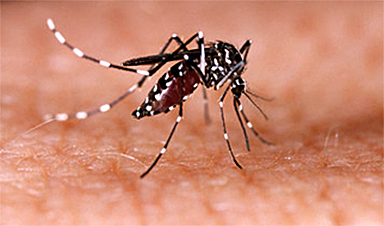
Mosquitoes kill more people each year than any other animal. In 2023, the blood-sucking insects infected a reported 263 million people with malaria, leading to nearly 600,000 deaths, 80% of which were children.
Recent efforts to block the transmission of malaria have been stalled because mosquitoes have adapted resistance to insecticides and the parasites within mosquitoes that cause malaria have become resistant to drugs. These setbacks have been amplified by the COVID-19 pandemic, which impeded ongoing anti-malarial efforts.
Now, researchers at the University of California San Diego, Johns Hopkins University, UC Berkeley and the University of São Paulo have developed a new method that genetically blocks mosquitoes from transmitting malaria.
Biologists Zhiqian Li and Ethan Bier from UC San Diego, and Yuemei Dong and George Dimopoulos from Johns Hopkins University, created a CRISPR-based gene-editing system that changes a single molecule within mosquitoes, a minuscule but effective change that stops the malaria-parasite transmission process. Genetically altered mosquitoes are still able to bite those with malaria and acquire parasites from their blood, but the parasites can no longer be spread to other people. The new system is designed to genetically spread the malaria resistance trait until entire populations of the insects no longer transfer the disease-causing parasites.
“Replacing a single amino acid in mosquitoes with another naturally occurring variant that prevents them from being infected with malarial parasites – and spreading that beneficial trait throughout a mosquito population – is a game-changer,” said Bier, a professor in the UC San Diego Department of Cell and Developmental Biology (School of Biological Sciences). “It’s hard to believe that this one tiny change has such a dramatic effect.”
The newly developed system uses CRISPR-Cas9 “scissors” and a guide RNA to make a genetic cut at a precise location within the mosquito’s genome. It then replaces the unwanted amino acid that transmits malaria with the beneficial version that does not.
The system targets a gene that produces a protein known as “FREP1” that helps mosquitoes develop and feed on blood when they bite. The new system switches an amino acid in FREP1 known as L224 with a genetic alternate, or allele, called Q224. Disease-causing parasites use L224 to swim to the insect’s salivary glands, where they are positioned to infect a person or animal.
Dimopoulos, a professor in the Department of Molecular Microbiology and Immunology and the Johns Hopkins Malaria Research Institute (Bloomberg School of Public Health), and his lab tested strains of Anopheles stephensi mosquitoes, the main vector of malaria transmission in Asia. They found that the L224-to-Q224 switch could effectively block two different types of malarial parasites from reaching the salivary glands, thereby preventing infection.
The beauty of this approach lies in leveraging a naturally occurring mosquito gene allele. With a single, precise tweak, we’ve turned it into a powerful shield that blocks multiple malaria parasite species and likely across diverse mosquito species and populations, paving the way for adaptable, real-world strategies to control this disease.”
George Dimopoulos, Johns Hopkins University
In a range of follow-on tests, the researchers found that although the genetic switch disrupted the parasite’s infection capabilities, the mosquitoes’ normal growth and reproduction remained unchanged. Mosquitoes carrying the newly inserted variant Q224 exhibited similar fitness to those with the original L224 amino acid, a key achievement since the FREP1 protein plays an important role in the biology of the mosquito, which is separate from its role in being exploited by malarial parasites.
Similar to a gene-drive, the researchers created a technique for mosquito offspring to genetically inherit the Q224 allele and spread it throughout their populations, halting the transmission of malaria parasites. This new “allelic-drive” follows a comparable system recently engineered in the Bier Lab that genetically reverses insecticide resistance in crop pests.
“In that prior study, we created a self-eliminating drive that converts a population of fruit flies from being resistant to insecticides back to its native insecticide-susceptible state. Then that genetic cassette just disappears, leaving only a re-wilded insect population,” said Bier. “A similar phantom drive system could convert mosquito populations to carrying the parasite-resistant FREP1Q variant.”
While the researchers demonstrated the effectiveness of the L224-to-Q224 switch, they don’t yet fully grasp why this change works so efficiently. Ongoing research into how the Q224 amino acid blocks the parasite’s infection transit route is underway.
“This breakthrough is the result of seamless teamwork and innovation across institutions,” said Dimopoulos. “Together, we’ve harnessed nature’s own genetic tools to turn mosquitoes into allies against malaria.”
Li, Z., et al. (2025). Driving a protective allele of the mosquito FREP1 gene to combat malaria. Nature. doi.org/10.1038/s41586-025-09283-6.

News

Cutting Two Amino Acids Slowed Prostate Cancer in Mice
A newly identified link between amino acid metabolism and cholesterol production may help prostate tumors adapt to hormone therapy. Prostate cancer can find ways around treatments designed to deprive tumors of the hormones they [...]

Largest-Ever Physics Survey Raises New Doubts About Our Model of the Universe
Physicists around the world remain deeply divided on key mysteries of the universe, from dark matter to quantum gravity. The standard cosmological model failed to gain majority support, and no leading theory dominated the [...]

Scientists Just Overturned a 100-Year-Old Belief About Bacteria in the Lungs
New findings raise questions about the role of microbes living in the lungs. More than 35 trillion bacteria live throughout the human body, forming microbiomes in the gut, mouth, lungs, skin, and urogenital tract. [...]

GHCE Concept
From the preface of the book Global Health Care Equivalency in the Age of Nanotechnology, Nanomedicine and Artificial Intelligence, Edited by Frank Boehm: Since the publication of my first book (Nanomedical Device and Systems [...]

Novartis, Ionis drug failure spurs questions
Pelacarsen didn’t protect heart health despite lowering levels of a protein particle, “Lp(a),” in a large clinical trial — a result with important implications for cardiovascular drug research. Dive Brief: An RNA drug from [...]

New injectable treatment helps the brain rebuild after stroke
Biomedical engineers at Duke University have created an injectable biomaterial that may help the brain recover from damage left behind by an ischemic stroke. In experiments with mice, the material transformed the cavity created [...]

Scientists Discover a Hidden “Immune Organ” Inside the Skull
Researchers discovered lymph node-like immune hubs inside skull bone marrow that appear to act as rapid-response centers for the brain. For decades, the brain was thought to operate largely apart from the immune system. [...]

Engineered tRNAs and lipid nanoparticles target nonsense mutation cystic fibrosis
Researchers have developed a potential new approach for treating a form of cystic fibrosis caused by so-called nonsense mutations, combining chemically modified transfer RNAs with lipid nanoparticles designed to deliver the therapy directly to [...]

New pancreatic cancer drug carries a $39,800 monthly list price
A groundbreaking treatment for one of the most common forms of pancreatic cancer has been approved in pill form by the FDA. Revolution Medicines’ oral tablet daraxonrasib, branded as Rasonque, reduced the risk of [...]

Researchers Have Discovered a New Way To Reduce Chronic Nerve Pain
A cancer-linked protein called BRAF may help drive chronic nerve pain, and existing cancer drugs targeting it reduced pain sensitivity in preclinical models. Chronic nerve pain can persist long after an injury and often [...]

Our books now available worldwide!
Online Sellers other than Amazon, Routledge, and IOPP Indigo Global Health Care Equivalency in the Age of Nanotechnology, Nanomedicine and Artifcial Intelligence Global Health Care Equivalency In The Age Of Nanotechnology, Nanomedicine And Artificial [...]

Quantum-Enabled Regenerative Health: Reimagining Wellness, Precision Health and Longevity Medicine
Introduction Healthcare is approaching a frontier where the quantum portfolio could influence not only how disease is diagnosed and treated, but how health itself is measured, modeled, predicted and preserved. Quantum computing, quantum simulation, [...]

FDA Clears First-of-Its-Kind Nonmedication Treatment for PTSD
The FDA has cleared a system that uses brain activity data to personalize magnetic stimulation for PTSD, adding a new nonmedication treatment option. Every day in the United States, approximately 17.5 veterans die by suicide, [...]

FDA approves breakthrough drug to treat advanced pancreatic cancer
The Food and Drug Administration (FDA) approved on Wednesday a drug that could extend the survival of those with metastatic pancreatic cancer. The drug, called daraxonrasib, will be sold under the brand name Rasonque [...]

AI Decodes a Hidden DNA Signal Linked to Disease-Causing Mutations
Machine learning identifies the likely “initiator” and enables new predictions about DNA mutations that can cause disease. Every human cell depends on tens of thousands of genes being switched on at the right time [...]

Pope Leo Urges Global Response to Congo’s Deadliest Ebola Outbreak
Pope Leo called for international action to address the Ebola outbreak in the Democratic Republic of Congo. The epidemic has claimed over 2,500 lives and is the nation's largest recorded outbreak. The Pope emphasized [...]