Blocking an enzyme’s production restored brain growth and healthy behaviors in mice engineered to develop Angelman syndrome, pointing to a possible treatment target.
Children with Angelman syndrome begin to show difficulties with thinking and movement at around 6 months of age. The rare condition occurs in approximately one in 20,000 births and is caused by the absence of a gene normally inherited from the mother. Researchers know which gene is missing, but they have struggled to explain why its absence causes these problems, making treatments elusive.
Research in mice now points to a chain of events that connects the missing gene to a stress response that interferes with brain growth. A team led by Jason Yi, PhD, an assistant professor of neuroscience at Washington University School of Medicine in St. Louis, traced that response to a buildup of a normally harmless enzyme. The study was published in Nature.
One missing gene, many excess proteins
The missing gene, UBE3A, produces an enzyme called ubiquitin ligase, which helps keep cells orderly by marking unneeded proteins for disposal. It is active throughout the brain and participates in 60 different cellular processes. Identifying which of those processes contribute to Angelman syndrome required narrowing that broad field of possibilities.
Yi and his colleagues developed modified cells in the laboratory with UBE3A deactivated, then looked for proteins that accumulated without it. They identified 23 candidate proteins whose levels increased. One stood out for its strong connection to ubiquitin ligase’s normal housekeeping function: asparagine synthetase, an enzyme that helps cells produce essential proteins.
A false alarm slows brain growth
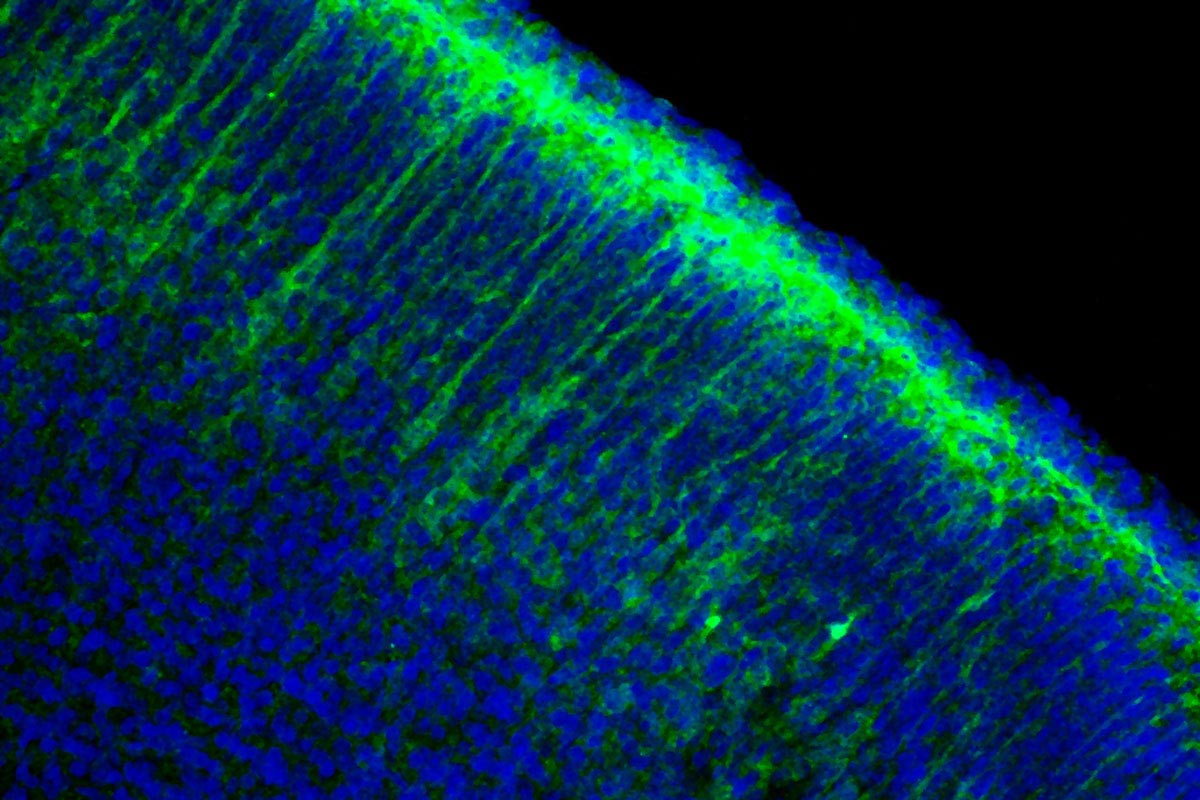
In mice genetically modified to develop Angelman syndrome, elevated levels of asparagine synthetase activated the brain’s stress response. Yet the enzyme does not interact with the usual triggers for that response, and its overabundance does not otherwise damage the cell. The consequences instead arise indirectly, as the stress response sharply reduces protein production and growth.
“The neurons are tricked into thinking that they’re in stress when they’re not — that’s bad because they will then not grow normally,” Yi said, noting that most children with Angelman syndrome have smaller brains than their peers of the same age. “It’s a reaction from the brain trying to conserve resources to protect itself. It does suggest that there is a dysregulation in the brain we might be able to correct.”
An enzyme offers a possible treatment target
Blocking the production of asparagine synthetase restored normal brain growth and healthy behaviors in the mice. The team had corrected a later step in the biological sequence set off by the missing gene, allowing healthy development to resume.
The study is the first to link an increase in asparagine synthetase to a neurological condition. It adds to evidence that an imbalance in proteins can contribute to neurodevelopmental disorders by triggering stress responses, even when the proteins themselves are not directly damaging cells.
Yi said medications could potentially target the stress response triggered by asparagine synthetase, but much remains to be learned before work on a possible treatment can begin. His team is investigating precisely why the enzyme activates that response, where in the brain the response is most active, and when during development medical interventions would be most effective.
“We still don’t know a whole lot about the disease,” said Yi. “We haven’t been able to identify all of the things that the missing gene is doing and rescue the things that it is not doing in Angelman’s syndrome. But I think our data are the most complete so far to begin answering those questions.”
Reference: “Persistent neuronal stress signalling underlies Angelman syndrome phenotypes” by Kwang-Soo Kim, Cory Gardner, Alissa Cullen, Jalin A. Stelzer, Kevin Cho, Ashish Sharma, Mati T. Nemera, Travis Law, Huma Naz, Guoyan Zhao, Harrison W. Gabel, Gary J. Patti, Erik S. Musiek, Tae-Hyuk Ahn and Jason J. Yi, 21 October 2026, Nature.
DOI: 10.1038/s41586-026-11165-4

News – Curated by Amanda Scott, Alias Group Creative
Follow her on Bluesky
A Single Enzyme Could Hold the Key to Treating a Devastating Brain Disorder
Blocking an enzyme’s production restored brain growth and healthy behaviors in mice engineered to develop Angelman syndrome, pointing to a possible treatment target. Children with Angelman syndrome begin to show difficulties with thinking and [...]

Scientists Develop a Clever New Way To Kill Cancer Cells From the Inside
Scientists have developed an experimental strategy that exploits a chemical byproduct of cancer cells to produce anticancer drugs directly inside them. Scientists in Japan have developed an experimental method that uses a chemical produced [...]

Our books are available worldwide!
Online Sellers other than Amazon, Routledge, and IOPP Indigo Global Health Care Equivalency in the Age of Nanotechnology, Nanomedicine and Artifcial Intelligence Global Health Care Equivalency In The Age Of Nanotechnology, Nanomedicine And Artificial [...]

After only a short training, people in a coma managed to send targeted signals
Researchers have succeeded in communicating with brain-injured patients who are unconscious. They see enormous potential in this for future treatments. Patients who lie motionless in bed after a severe brain injury and do not [...]
MIT Scientists Reprogram Immune Cells Inside the Body To Destroy Cancer
Natural killer cells reprogrammed inside mice eliminated lymphoma tumors and helped damaged livers heal, though whether this approach could help people with cancer or autoimmune disease remains unknown. To make a cancer treatment from [...]

Melanoma mRNA Vaccine Shows Promise in Preventing Disease Recurrence
Key takeaways: Phase 3 trial finds personalized intismeran plus pembrolizumab may better prevent high-risk melanoma recurrence after surgery The trial enrolled 1,137 patients and builds on phase 2 results showing about half the recurrence [...]

Scientists Discover a Powerful New Weapon Against a Dangerous Gut Infection
The promise of an experimental treatment for C. difficile gut infections lies partly in the bacteria it leaves alive, according to early laboratory and mouse research. Broad-spectrum antibiotics can disrupt the gut’s microbial community, [...]
Your Bones May Hold a Hidden Clue to Blood Cancer Survival
For people with blood cancers called myelodysplastic syndromes, osteoporosis may hold an overlooked clue to survival, a three-year observational study suggests. In blood cancers that develop in the bone marrow, an important clue to [...]

Researchers Discover What Reading for Pleasure May Be Doing to Your Brain
Reading for pleasure may offer surprising benefits for the brain, with research linking the habit to better mental health, stronger cognitive abilities, and a lower risk of dementia. Reading for pleasure may do far [...]
Scientists Discover a Hidden Trigger That Keeps Inflammation Alive
Inflammation persists after proteins detach from immune receptors, revealing a potential target for autoimmune treatments. Since a Nobel Prize-winning discovery in the 1990s identified molecules called Toll-like Receptors as the guardians of the human [...]
A Virus Gives Itself Away the Moment It Attacks
Researchers have found the trigger behind a powerful bacterial defense against viruses. Viruses that prey on bacteria could become an increasingly important tool for treating bacterial infections, particularly as antibiotic resistance makes some infections [...]

Scientists Discover Aspirin May Slash Dementia Risk by 70% – but Only for Certain People
Aspirin was linked to a sharply lower dementia risk in some older adults, and their genes may hold the clue. A Monash University analysis found that older adults with a particular genetic profile had [...]
Inflammation May Awaken Dormant Cancer Cells Years After Treatment
The body’s response to inflammation may disturb cancer cells that have been lying silent for years, giving them an opportunity to grow again. Researchers at the Francis Crick Institute have found that gut inflammation [...]

Where do nanoparticles go once they enter the body?
New international best practice guidance, co-written at ANSTO, sets out how to measure where nanoparticles like titanium dioxide end up in the body and how long they remain. The guidance has been shared by [...]
Long-Acting HIV Shots Could Solve a Major Treatment Challenge for Young People
A major African trial suggests that changing how HIV treatment is delivered could significantly improve viral suppression in adolescents. Young people with HIV were more likely to keep the virus suppressed when they received [...]

WHO Factsheets – The top 10 causes of death
In 2023, the 10 leading causes of death accounted for 33 million deaths, or 54% of the total 61 million deaths worldwide. The top global causes of death, in order of total number of lives lost, [...]