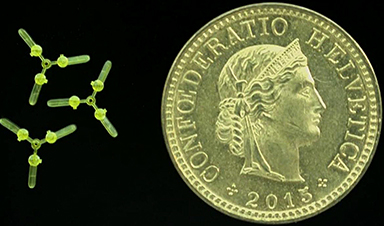
At the EPFL, micro-drones have been developed that can be moved without a motor or battery.No motors, no batteries, no electronics on board, just small cavities that convert sound waves into thrust: this is the surprising propulsion technology for drones, developed at the Laboratory for Micro-Biorobotic Systems (Microbs) at the Swiss Federal Institute of Technology Lausanne (EPFL). It was recently presented in the journal Science Advances.
The principle is simple: the movement is generated by sounds. “By choosing the frequency, we can control the movements of a micro-object,” explains the director of the laboratory, Selman Sakar, to Radio and Television of Italian-speaking Switzerland (RSI).
The applications of acoustic microrobotics are diverse. Sakar sees the most promising in the medical field: “You could build a tiny structure, such as a drug carrier to be swallowed or injected into the body, and then control it with sound waves.”
The Drone in the Lungs
So far, the use of sound-controlled microrobots has been investigated primarily in liquid environments such as blood vessels. EPFL’s robots work in the air and open up interesting research prospects, for example in the lungs. Although its use in patients is still a long way off, there are already collaborations with the University Hospitals of Geneva and Lausanne.
To move the drones using sound, the researchers used the so-called Helmholtz resonance. Behind this name is the phenomenon known to everyone, which was first investigated by the German scientist Hermann von Helmholtz: When you blow gently through the neck of an empty bottle, not only is a sound produced, but the air trapped in the bottle is made to vibrate.
Selman Sakar’s team has recreated this principle – using so-called resonators. They look like small ampoules. “Their shape determines the tone at which the air inside begins to vibrate,” explains the expert. “When that happens, the air is pushed out of the throat and the structure moves in the opposite direction, a bit like a rocket.”
Ultrasound as an Energy Source
To demonstrate the principle, Sakar’s team has built two types of microaircraft. The first combines three resonators on an ultra-light structure and weighs about 150 micrograms, or 0.15 milligrams. The downward-facing openings create the rays that lift it. The second weighs 184 micrograms and uses the resonators to spin a rotor with small blades that can reach 13,000 revolutions per minute.
The energy is supplied by an external device that generates an ultrasound of 40,000 hertz, beyond the human hearing threshold. The robot is thus freed from components that are difficult to miniaturize, starting with the battery. However, the energy supply remains indispensable: it is transferred from the system that generates the acoustic field to the aircraft.
The researchers observed the take-off and hovering in the air under laboratory conditions. But for these objects to be controlled along complex routes, further developments are needed. The system tested so far operates at a single frequency and still offers limited maneuverability.
RSI, Prima Ora, 10/21/2026, 6:00 p.m.; noes

News – Curated by Amanda Scott, Alias Group Creative
Follow her on Bluesky
Micro-drones fly through the body thanks to ultrasound
At the EPFL, micro-drones have been developed that can be moved without a motor or battery.No motors, no batteries, no electronics on board, just small cavities that convert sound waves into thrust: this is [...]
A Single Enzyme Could Hold the Key to Treating a Devastating Brain Disorder
Blocking an enzyme’s production restored brain growth and healthy behaviors in mice engineered to develop Angelman syndrome, pointing to a possible treatment target. Children with Angelman syndrome begin to show difficulties with thinking and [...]

Scientists Develop a Clever New Way To Kill Cancer Cells From the Inside
Scientists have developed an experimental strategy that exploits a chemical byproduct of cancer cells to produce anticancer drugs directly inside them. Scientists in Japan have developed an experimental method that uses a chemical produced [...]

Our books are available worldwide!
Online Sellers other than Amazon, Routledge, and IOPP Indigo Global Health Care Equivalency in the Age of Nanotechnology, Nanomedicine and Artifcial Intelligence Global Health Care Equivalency In The Age Of Nanotechnology, Nanomedicine And Artificial [...]

After only a short training, people in a coma managed to send targeted signals
Researchers have succeeded in communicating with brain-injured patients who are unconscious. They see enormous potential in this for future treatments. Patients who lie motionless in bed after a severe brain injury and do not [...]

MIT Scientists Reprogram Immune Cells Inside the Body To Destroy Cancer
Natural killer cells reprogrammed inside mice eliminated lymphoma tumors and helped damaged livers heal, though whether this approach could help people with cancer or autoimmune disease remains unknown. To make a cancer treatment from [...]

Melanoma mRNA Vaccine Shows Promise in Preventing Disease Recurrence
Key takeaways: Phase 3 trial finds personalized intismeran plus pembrolizumab may better prevent high-risk melanoma recurrence after surgery The trial enrolled 1,137 patients and builds on phase 2 results showing about half the recurrence [...]

Scientists Discover a Powerful New Weapon Against a Dangerous Gut Infection
The promise of an experimental treatment for C. difficile gut infections lies partly in the bacteria it leaves alive, according to early laboratory and mouse research. Broad-spectrum antibiotics can disrupt the gut’s microbial community, [...]

Your Bones May Hold a Hidden Clue to Blood Cancer Survival
For people with blood cancers called myelodysplastic syndromes, osteoporosis may hold an overlooked clue to survival, a three-year observational study suggests. In blood cancers that develop in the bone marrow, an important clue to [...]

Researchers Discover What Reading for Pleasure May Be Doing to Your Brain
Reading for pleasure may offer surprising benefits for the brain, with research linking the habit to better mental health, stronger cognitive abilities, and a lower risk of dementia. Reading for pleasure may do far [...]

Scientists Discover a Hidden Trigger That Keeps Inflammation Alive
Inflammation persists after proteins detach from immune receptors, revealing a potential target for autoimmune treatments. Since a Nobel Prize-winning discovery in the 1990s identified molecules called Toll-like Receptors as the guardians of the human [...]

A Virus Gives Itself Away the Moment It Attacks
Researchers have found the trigger behind a powerful bacterial defense against viruses. Viruses that prey on bacteria could become an increasingly important tool for treating bacterial infections, particularly as antibiotic resistance makes some infections [...]

Scientists Discover Aspirin May Slash Dementia Risk by 70% – but Only for Certain People
Aspirin was linked to a sharply lower dementia risk in some older adults, and their genes may hold the clue. A Monash University analysis found that older adults with a particular genetic profile had [...]

Inflammation May Awaken Dormant Cancer Cells Years After Treatment
The body’s response to inflammation may disturb cancer cells that have been lying silent for years, giving them an opportunity to grow again. Researchers at the Francis Crick Institute have found that gut inflammation [...]

Where do nanoparticles go once they enter the body?
New international best practice guidance, co-written at ANSTO, sets out how to measure where nanoparticles like titanium dioxide end up in the body and how long they remain. The guidance has been shared by [...]

Long-Acting HIV Shots Could Solve a Major Treatment Challenge for Young People
A major African trial suggests that changing how HIV treatment is delivered could significantly improve viral suppression in adolescents. Young people with HIV were more likely to keep the virus suppressed when they received [...]