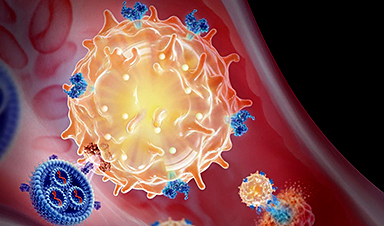
Natural killer cells reprogrammed inside mice eliminated lymphoma tumors and helped damaged livers heal, though whether this approach could help people with cancer or autoimmune disease remains unknown.
To make a cancer treatment from a patient’s T cells, doctors first collect a blood sample and send it to a laboratory. There, these immune cells are isolated and engineered to carry chimeric antigen receptors, or CARs, proteins that recognize a chosen target, such as a cancer protein. Once enough modified cells have been produced, they are shipped back to the hospital and infused into the patient. When a CAR detects its target, it activates the T cell to destroy the cell carrying it.
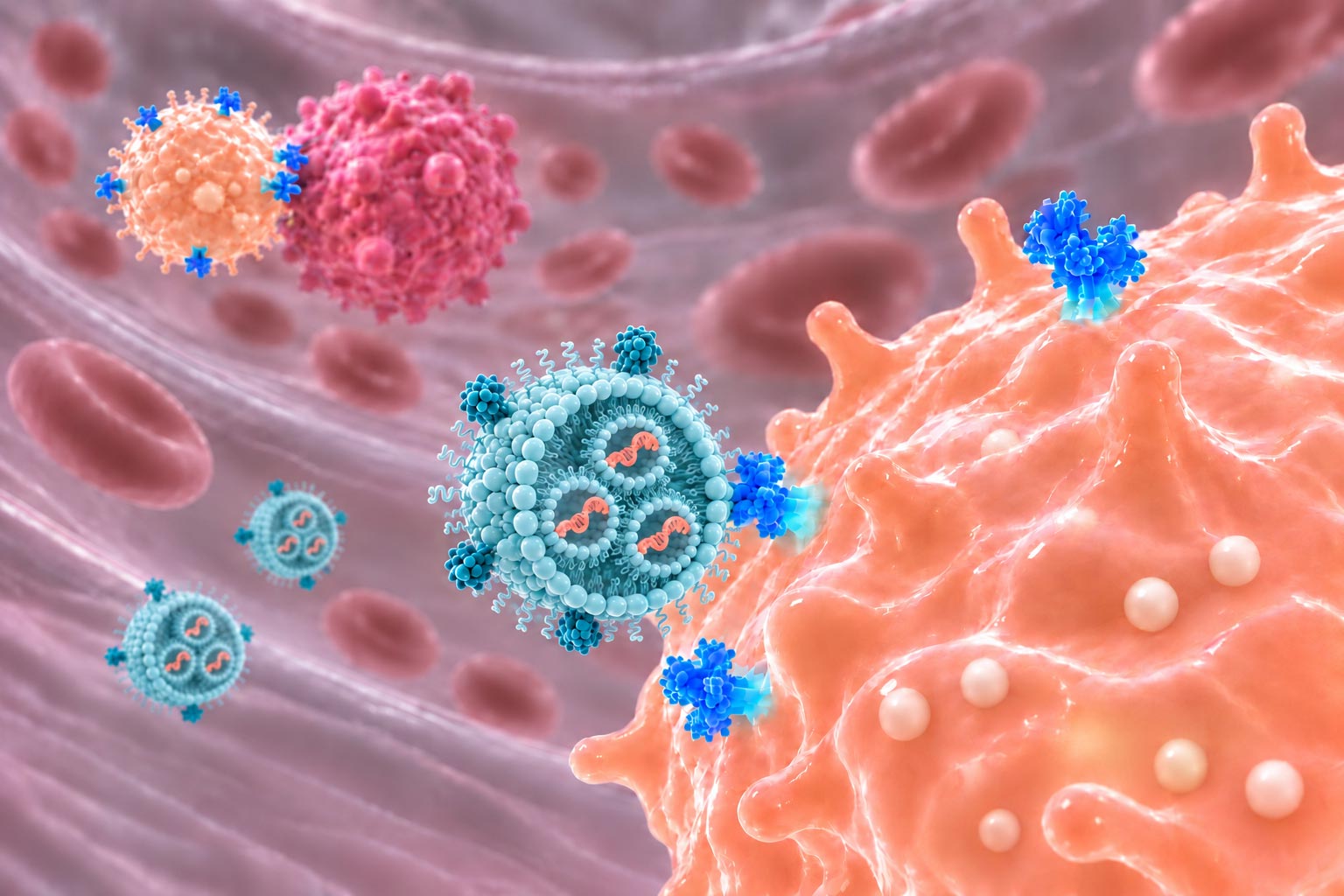
Producing similar treatments from natural killer (NK) cells poses many of the same manufacturing challenges, adding time and expense. MIT engineers have now developed a way to reprogram NK cells inside the body, without removing them for laboratory engineering. In experiments in mice, their approach successfully reprogrammed about 80 percent of the targeted NK cells. The study was published in Nature Biotechnology.
Over the past decade, the U.S. Food and Drug Administration has approved seven CAR T-cell cancer treatments. These therapies have had considerable success against blood cancers, primarily those originating in B cells, including several types of leukemia, lymphoma, and multiple myeloma. No CAR NK-cell therapies are currently FDA-approved, although many researchers are developing them for cancer and autoimmune disorders.
Nanoparticles program NK cells inside the body
“The manufacturing challenges with CAR NK cells are significant. The idea here is you can deliver a nanoparticle that will modify your own NK cells with a CAR construct and teach them to attack tumor cells,” says Daniel Anderson, the study’s senior author, a professor in MIT’s Department of Chemical Engineering, and a member of MIT’s Koch Institute for Integrative Cancer Research and Institute for Medical Engineering and Science.
To deliver those instructions, the team designed lipid nanoparticles, tiny particles made from fatty molecules, that carry messenger RNA. The mRNA encodes a CAR protein that the receiving cell can make. Antibody fragments coating the particles bind to receptors on the surface of NK cells, helping direct the payload to the intended cells. This allows the engineering to happen “in vivo,” meaning inside the body.
The CAR encoded by the mRNA can be chosen according to the intended target. For example, the instructions could produce a receptor that recognizes CD19, a protein found on B cells, or CD3, a protein found on T cells, including autoreactive T cells that mistakenly attack the body’s own tissues.
“If a patient can just get an infusion of nanoparticles, it would dramatically simplify the process and reduce costs,” Anderson says.
When T cells attack each other
Using NK cells also addresses a difficulty that arises when engineered T cells are used against T-cell diseases. A CAR designed to recognize T-cell proteins may lead the engineered T cells to kill one another along with the diseased cells. NK cells can target T cells without that problem.
“NK cells can treat these T cell malignancies — not only T cell cancer, but also T cell autoimmune diseases,” says MIT postdoc Yuang Chen, who is a lead author of the study alongside MIT graduate students Julia Monkovic and Haseeb Mughal.
Tumor clearance and liver healing in mice
The researchers tested the approach against T-cell lymphoma in humanized mice. These animals receive transfusions of human blood cells, temporarily giving them a human-like immune system. After five injections of the reprogramming nanoparticles, the tumors were eradicated. The result was similar to treatment with CAR NK cells made through the conventional process of removing NK cells, reprogramming them outside the body, and returning them to the mice.
The same delivery strategy could also equip NK cells to attack autoreactive T cells. To test that possibility, the team studied mice with autoimmune hepatitis, in which T cells attack liver cells called hepatocytes. After a single injection of the nanoparticles, the autoreactive T cells were destroyed, and liver damage healed.
The experiments also extended beyond diseases involving dysfunctional T cells. In a mouse model of an aggressive form of melanoma, three of five mice went into complete remission after receiving nanoparticles that reprogrammed their NK cells to target the cancer cells.
“This study is an excellent example of the power of nano delivery systems and their ability to potentially treat cancer and other diseases,” says study coauthor Robert Langer, the David H. Koch Institute Professor at MIT.
The researchers hope that engineered NK cells could eventually be used to treat other autoimmune disorders caused by dysfunctional T cells, including multiple sclerosis and rheumatoid arthritis.
Reference: “In vivo engineering of CAR natural killer cells for immunotherapy using ligand-directed lipid nanoparticles” by Yuang Chen, Julia Monkovic, Haseeb Mughal, Binlong Chen, Elina Thadhani, Patrick McMullen, Ava Self, Yuxuan Chen, Yizong Hu, Samuel Detmer, Min Chen, Anna Lapteva, Ria Kamat, Ashley Vernon, Robert Langer and Daniel G. Anderson, 13 October 2026, Nature Biotechnology.
DOI: 10.1038/s41587-026-03310-1
The research was funded by Sanofi, the Marble Center for Cancer Nanomedicine, and a Koch Institute Support (core) Grant from the National Cancer Institute.

News – Curated by Amanda Scott, Alias Group Creative
Follow her on Bluesky
MIT Scientists Reprogram Immune Cells Inside the Body To Destroy Cancer
Natural killer cells reprogrammed inside mice eliminated lymphoma tumors and helped damaged livers heal, though whether this approach could help people with cancer or autoimmune disease remains unknown. To make a cancer treatment from [...]

Melanoma mRNA Vaccine Shows Promise in Preventing Disease Recurrence
Key takeaways: Phase 3 trial finds personalized intismeran plus pembrolizumab may better prevent high-risk melanoma recurrence after surgery The trial enrolled 1,137 patients and builds on phase 2 results showing about half the recurrence [...]

Scientists Discover a Powerful New Weapon Against a Dangerous Gut Infection
The promise of an experimental treatment for C. difficile gut infections lies partly in the bacteria it leaves alive, according to early laboratory and mouse research. Broad-spectrum antibiotics can disrupt the gut’s microbial community, [...]
Your Bones May Hold a Hidden Clue to Blood Cancer Survival
For people with blood cancers called myelodysplastic syndromes, osteoporosis may hold an overlooked clue to survival, a three-year observational study suggests. In blood cancers that develop in the bone marrow, an important clue to [...]

Researchers Discover What Reading for Pleasure May Be Doing to Your Brain
Reading for pleasure may offer surprising benefits for the brain, with research linking the habit to better mental health, stronger cognitive abilities, and a lower risk of dementia. Reading for pleasure may do far [...]
Scientists Discover a Hidden Trigger That Keeps Inflammation Alive
Inflammation persists after proteins detach from immune receptors, revealing a potential target for autoimmune treatments. Since a Nobel Prize-winning discovery in the 1990s identified molecules called Toll-like Receptors as the guardians of the human [...]
A Virus Gives Itself Away the Moment It Attacks
Researchers have found the trigger behind a powerful bacterial defense against viruses. Viruses that prey on bacteria could become an increasingly important tool for treating bacterial infections, particularly as antibiotic resistance makes some infections [...]

Scientists Discover Aspirin May Slash Dementia Risk by 70% – but Only for Certain People
Aspirin was linked to a sharply lower dementia risk in some older adults, and their genes may hold the clue. A Monash University analysis found that older adults with a particular genetic profile had [...]
Inflammation May Awaken Dormant Cancer Cells Years After Treatment
The body’s response to inflammation may disturb cancer cells that have been lying silent for years, giving them an opportunity to grow again. Researchers at the Francis Crick Institute have found that gut inflammation [...]
Where do nanoparticles go once they enter the body?
New international best practice guidance, co-written at ANSTO, sets out how to measure where nanoparticles like titanium dioxide end up in the body and how long they remain. The guidance has been shared by [...]
Long-Acting HIV Shots Could Solve a Major Treatment Challenge for Young People
A major African trial suggests that changing how HIV treatment is delivered could significantly improve viral suppression in adolescents. Young people with HIV were more likely to keep the virus suppressed when they received [...]

WHO Factsheets – The top 10 causes of death
In 2023, the 10 leading causes of death accounted for 33 million deaths, or 54% of the total 61 million deaths worldwide. The top global causes of death, in order of total number of lives lost, [...]
Aging Cells May Be Hiding From the Immune System – Scientists Think They Know How
Your immune system is supposed to clear out damaged cells. Researchers may have found how some of them hide and linger as the body ages. Researchers led by Cedars-Sinai Health Sciences University have identified [...]

Your Voice May Reveal How Fast Your Brain Is Aging
Researchers have developed a machine-learning “speech clock” that estimates age from subtle patterns in how people speak and what they say. It is possible that people’s voices may contain certain signals of aging that [...]
Optogenetics Pioneers Win 2026 Nobel Prize in Physiology or Medicine
The 2026 Nobel Prize in Physiology or Medicine has been awarded to Peter Hegemann, Georg Nagel, and Karl Deisseroth for the development of optogenetics, a revolutionary technology that uses light to control individual neurons [...]
Molecular Manufacturing: The Future of Nanomedicine – From NanoappsMedical Inc.
This book explores the revolutionary potential of atomically precise manufacturing technologies to transform global healthcare, as well as practically every other sector across society. This forward-thinking volume examines how envisaged Factory@Home systems might enable the cost-effective [...]