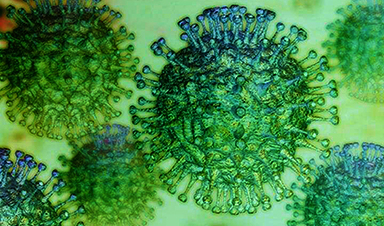
Two emerging pathogens with animal origins—influenza D virus and canine coronavirus—have so far been quietly flying under the radar, but researchers warn conditions are ripe for the viruses to spread more widely among humans. If surveillance and diagnostics continue to lag, influenza D virus and canine coronavirus have real potential to trigger outbreaks, writes a team of infectious disease experts and authors.
The work appears in Emerging Infectious Diseases.
“Our review of the literature indicates these two viruses pose respiratory disease threats to humans, yet little has been done to respond to or prevent infection from these viruses,” said co-author John Lednicky, Ph.D., a research professor in the Department of Environmental and Global Health at the University of Florida’s College of Public Health and Health Professions.
“If these viruses evolve the capacity to easily transmit person to person, they may be able to cause epidemics or pandemics since most people won’t have immunity to them.”
Since its discovery in 2011, influenza D virus has been associated with infections in pigs and cows, but it has also been found in many other livestock and wildlife species, including poultry, deer, giraffes, and kangaroos. Influenza D virus is believed to contribute to bovine respiratory disease, estimated to cost the U.S. cattle industry $1 billion a year.
The authors’ previous studies of cattle workers in Colorado and Florida found that up to 97% of people working with herds carry influenza D virus antibodies, suggesting the workers had been exposed to the virus. So far, these infections are known to be subclinical, meaning they have not caused symptoms of illness. However, scientists say influenza D virus bears the hallmarks of a virus primed to rapidly evolve. Indeed, a strain of influenza D recently isolated in China has developed the capacity for human-to-human transmission.
“So far, influenza D virus has not been associated with serious infections in humans,” said Lednicky, a member of UF’s Emerging Pathogens Institute. “However, canine coronavirus has, but diagnostic tests are not routinely performed for the virus, so the extent to which the virus affects the population at large is not known.”
Canine coronavirus (CCoV) can cause gastrointestinal illness in dogs, and is not the same virus as SARS-CoV-2, the virus that causes COVID-19. Documented canine coronavirus infections in humans, while still rare, have been linked to pneumonia hospitalizations in Southeast Asia.
In a 2021 study led by Lednicky, a UF team isolated a canine coronavirus from a medical team member who had traveled from Florida to Haiti in 2017 and later experienced mild fever and malaise. The team named the strain HuCCoV_Z19Haiti.
Scientists led by Gregory Gray, M.D., director of the One Health Research and Training Laboratory at the University of Texas Medical Branch, reported the discovery of a new canine coronavirus strain, CCoV-HuPn-2018, in 2021. The strain had been isolated from a child hospitalized in Malaysia and was nearly identical to the coronavirus discovered by the UF team.
Since then, CCoV-HuPn-2018 has been found in people with respiratory illness living in Thailand, Vietnam, and in the state of Arkansas, demonstrating that this strain of canine coronavirus is already circulating across continents.
These recent influenza D virus and canine coronavirus discoveries underscore a familiar lesson from recent pandemics: Without proper preparation, a virus that quickly gains efficient human-to-human transmissibility can easily turn into a large-scale human epidemic. To prevent such a scenario, the scientists say better virus monitoring, more reliable tests, treatments, and possible vaccines are needed.
“Our knowledge of the viruses’ epidemiology and clinical manifestations is limited to a modest number of research studies,” the authors wrote. “Even so, the limited data regarding these novel, newly detected viruses indicate that they are a major threat to public health.”
Publication details
Gregory C. Gray et al, Emerging Respiratory Virus Threats from Influenza D and Canine Coronavirus HuPn-2018, Emerging Infectious Diseases (2026). DOI: 10.3201/eid3201.251764
Journal information: Emerging Infectious Diseases

News

Is Berberine Really a “Natural Ozempic”?
Often labeled a “natural Ozempic,” berberine is widely discussed as a metabolic aid. Yet research suggests its influence may lie deeper. In recent years, berberine has gained significant attention as a supposed “natural way” [...]
Viagra Ingredient Shows Promise for Rare Childhood Brain Disease in Surprising Study
A rare childhood disease with no approved treatment may have an unexpected new therapeutic candidate. Sildenafil, the active ingredient also sold under the brand name Viagra, may help reduce symptoms in people with Leigh [...]

In a first for China, Neuracle’s implantable brain-computer interface wins approval
In a landmark development, Neuracle Medical Technology has secured the country’s first-ever approval for an implantable brain-computer interface (BCI) system designed to restore hand motor function in patients with spinal cord injuries, in a [...]

A Cambridge Lab Mistake Reveals a Powerful New Way to Modify Drug Molecules
A surprising lab discovery reveals a light-powered way to tweak complex drugs faster, cleaner, and later in development. Researchers at the University of Cambridge have created a new technique for altering complex drug molecules [...]

New book from NanoappsMedical Inc – Molecular Manufacturing: The Future of Nanomedicine
This book explores the revolutionary potential of atomically precise manufacturing technologies to transform global healthcare, as well as practically every other sector across society. This forward-thinking volume examines how envisaged Factory@Home systems might enable the cost-effective [...]

Scientists Discover Simple Saliva Test That Reveals Hidden Diabetes Risk
Researchers have identified a potential new way to assess metabolic health using saliva instead of blood. High insulin levels in the blood, known as hyperinsulinemia, can reveal metabolic problems long before obvious symptoms appear. It is [...]

One Nasal Spray Could Protect Against COVID, Flu, Pneumonia, and More
A single nasal spray vaccine may one day protect against viruses, pneumonia, and even allergies. For decades, scientists have dreamed of creating a universal vaccine capable of protecting against many different pathogens. The idea [...]
New AI Model Predicts Cancer Spread With Incredible Accuracy
Scientists have developed an AI system that analyzes complex gene-expression signatures to estimate the likelihood that a tumor will spread. Why do some tumors spread throughout the body while others remain confined to their [...]

Scientists Discover DNA “Flips” That Supercharge Evolution
In Lake Malawi, hundreds of species of cichlid fish have evolved with astonishing speed, offering scientists a rare opportunity to study how biodiversity arises. Researchers have identified segments of “flipped” DNA that may allow fish to adapt rapidly [...]

Our books now available worldwide!
Online Sellers other than Amazon, Routledge, and IOPP Indigo Global Health Care Equivalency in the Age of Nanotechnology, Nanomedicine and Artifcial Intelligence Global Health Care Equivalency In The Age Of Nanotechnology, Nanomedicine And Artificial [...]

Scientists Discover Why Some COVID Survivors Still Can’t Taste Food Years Later
A new study provides the first direct biological evidence explaining why some people continue to experience taste loss long after recovering from COVID-19. Researchers have uncovered specific biological changes in taste buds that could help [...]

Catching COVID significantly raises the risk of developing kidney disease, researchers find
Catching Covid significantly raises the risk of developing deadly kidney disease, research has shown. The virus was found to increase the chances that patients will develop the incurable condition by around 50 per cent. [...]

New Toothpaste Stops Gum Disease Without Harming Healthy Bacteria
Researchers have developed a targeted approach to combat periodontitis without disrupting the natural balance of the oral microbiome. The innovation could reshape how gum disease is treated while preserving beneficial bacteria. The human mouth [...]

Plastic Without End: Are We Polluting the Planet for Eternity?
The Kunming Montreal Global Biodiversity Framework calls for the elimination of plastic pollution by 2030. If that goal has been clearly set, why have meaningful measures that create real change still not been implemented? [...]
Scientists Rewire Natural Killer Cells To Attack Cancer Faster and Harder
Researchers tested new CAR designs in NK-92 cells and found the modified cells killed tumor cells more effectively, showing stronger anti-cancer activity. Researchers at the Ribeirão Preto Blood Center and the Center for Cell-Based [...]

New “Cellular” Target Could Transform How We Treat Alzheimer’s Disease
A new study from researchers highlights an unexpected player in Alzheimer’s disease: aging astrocytes. Senescent astrocytes have been identified as a major contributor to Alzheimer’s progression. The cells lose protective functions and fuel inflammation, particularly in [...]