The brain does not need its sophisticated cortex to interpret the visual world. A new study published in PLOS Biology demonstrates that a much older structure, the superior colliculus, contains the necessary circuitry to perform the fundamental computations that allow us to distinguish objects from the background and detect which stimuli are relevant in space.
This work reveals that these ancestral circuits, present in the brains of all vertebrates, can generate center–surround interactions independently: a key visual principle that enables the brain to detect contrasts, edges, and salient features in the environment.
“For decades it was thought that these computations were exclusive to the visual cortex, but we have shown that the superior colliculus, a much older structure in evolutionary terms, can also perform them autonomously,” explains Andreas Kardamakis, head of the Neural Circuits in Vision for Action laboratory at the Institute for Neurosciences (IN), a joint center of the Spanish National Research Council (CSIC) and the Miguel Hernández University (UMH) of Elche, and principal investigator of the study.
“This means that the ability to analyze what we see and decide what deserves our attention is not a recent invention of the human brain, but a mechanism that appeared more than half a billion years ago.”
A ‘radar’ in the brain that prioritizes what matters
The superior colliculus acts as a kind of biological radar, receiving direct input from the retina and, before information reaches the cerebral cortex, in order to determine which stimuli in the environment are most relevant. When something moves, shines, or suddenly appears in the visual field, this structure is the first to respond and to direct the gaze towards that point.
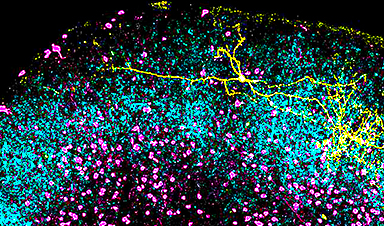
The study combines several cutting-edge experimental techniques, including patterned optogenetics, electrophysiology, and computational modeling, to investigate how neurons are organized and communicate within the superior colliculus.
By using light to activate specific retinal projections in the colliculus and record responses in mouse brain slices, the team observed that the superior colliculus can generate a suppression of the central stimulus when the surrounding area is activated, a hallmark pattern of center–surround interactions and a mechanism backed by cell-type-specific transynaptic mapping and large-scale modeling.
“We have seen that the superior colliculus not only transmits visual information but also processes and filters it actively, reducing the response to uniform stimuli and enhancing contrasts,” says Kuisong Song, co-first author of the paper. “This demonstrates that the ability to select or prioritize visual information is embedded in the oldest subcortical circuits of the brain.”
The results suggest that the function of highlighting what captures our attention does not depend solely on higher cortical areas but is deeply rooted in mechanisms common to all vertebrates.
Evolutionary and cognitive implications
These findings challenge the classical view that complex visual operations are the exclusive domain of the cortex. Instead, they point to a more distributed and hierarchical organization of the brain, where ancient structures not only relay information but also carry out essential computations for survival, such as detecting predators, tracking prey, or avoiding obstacles.
“Understanding how these ancestral structures contribute to visual attention also helps us understand what happens when these mechanisms fail,” Kardamakis notes.
“Disorders such as attention deficit, sensory hypersensitivity, or some forms of traumatic brain injury may partly originate from imbalances between cortical communication and these fundamental circuits.”
His team is now extending these findings to in vivo models to investigate how the superior colliculus shapes visual attention and regulates distractions during goal-directed behavior.
Understanding how visual distractors are transformed into behavioral responses is essential for revealing underlying pathophysiological mechanisms, particularly in an era increasingly driven by visual technology.
This study is the result of a broad international collaboration involving the Karolinska Institutet, the KTH Royal Institute of Technology (both in Sweden), and the Massachusetts Institute of Technology (MIT, U.S.). It also includes the participation of Teresa Femenía, researcher at the IN CSIC-UMH, who made a key contribution to the experimental development of the study.
A shared evolutionary framework for visual attention
In line with this work, Andreas Kardamakis and Giovanni Usseglio have published a chapter in the Evolution of Nervous Systems series, which expands the comparative and evolutionary perspective of these subcortical visual circuits.
In this chapter, the authors review how structures homologous to the superior colliculus, found in fish, amphibians, reptiles, birds, and mammals, share a common functional principle: the integration of sensory and motor information to orient attention and gaze.
The chapter highlights that this brain architecture, preserved for over 500 million years of evolution, forms the common foundation upon which the cortex later developed its higher cognitive functions.
“Evolution did not replace these ancient systems; it built upon them,” says Kardamakis, and adds, “We still rely on the same basic hardware to decide where to look and what to ignore.”
More information: Peng Cui et al, Recurrent circuits encode de novo visual center-surround computations in the mouse superior colliculus, PLOS Biology (2025). DOI: 10.1371/journal.pbio.3003414
Journal information: PLoS Biology
Provided by Miguel Hernandez University of Elche

News
Cancer’s Hidden Antioxidant Shield Helps It Escape the Immune System
Blocking an antioxidant protein that tumors use to suppress immune attacks improved cancer immunotherapy responses in mice. Cancer cells can release antioxidants that interfere with the immune cells trying to kill them. Researchers have [...]

Scientists Find a Berry Compound That Helps Muscle Cells Burn Fat
Pterostilbene, a compound found naturally in some foods, affects how skeletal muscles process fats by stabilizing a protein called PPARδ and increasing its signaling activity. Pterostilbene, a natural compound found in blueberries, grapes, and [...]

Two Hidden Forces Help Build the Human Brain Before Birth
Scientists have uncovered two surprising forces that help guide how the human brain forms before birth. Before birth, the human brain is shaped in large part by an unusual class of stem cells known [...]

Researchers Uncover a Hidden Trigger Behind Chronic Inflammation
The findings offer new insights that could help guide the development of future therapies. A protein called human resistin may help flip on one of the immune system’s most powerful inflammatory switches. Researchers at [...]

Scientists Have Uncovered Previously Hidden Microbial Activity on Human Skin
The most abundant microbes on your skin may not be the ones doing most of the work. Human skin supports vast communities of bacteria, fungi, and viruses that can influence its protective barrier, immune [...]
Brazilian Tree Compounds Fight COVID-19 on Multiple Fronts
Scientists found compounds in a Brazilian tree that hit SARS-CoV-2 on multiple fronts, revealing a promising new lead in the search for COVID-19 treatments. Researchers have found that galloylquinic acids extracted from the leaves [...]

Cutting Two Amino Acids Slowed Prostate Cancer in Mice
A newly identified link between amino acid metabolism and cholesterol production may help prostate tumors adapt to hormone therapy. Prostate cancer can find ways around treatments designed to deprive tumors of the hormones they [...]

Largest-Ever Physics Survey Raises New Doubts About Our Model of the Universe
Physicists around the world remain deeply divided on key mysteries of the universe, from dark matter to quantum gravity. The standard cosmological model failed to gain majority support, and no leading theory dominated the [...]

Scientists Just Overturned a 100-Year-Old Belief About Bacteria in the Lungs
New findings raise questions about the role of microbes living in the lungs. More than 35 trillion bacteria live throughout the human body, forming microbiomes in the gut, mouth, lungs, skin, and urogenital tract. [...]

GHCE Concept
From the preface of the book Global Health Care Equivalency in the Age of Nanotechnology, Nanomedicine and Artificial Intelligence, Edited by Frank Boehm: Since the publication of my first book (Nanomedical Device and Systems [...]

Novartis, Ionis drug failure spurs questions
Pelacarsen didn’t protect heart health despite lowering levels of a protein particle, “Lp(a),” in a large clinical trial — a result with important implications for cardiovascular drug research. Dive Brief: An RNA drug from [...]
New injectable treatment helps the brain rebuild after stroke
Biomedical engineers at Duke University have created an injectable biomaterial that may help the brain recover from damage left behind by an ischemic stroke. In experiments with mice, the material transformed the cavity created [...]

Scientists Discover a Hidden “Immune Organ” Inside the Skull
Researchers discovered lymph node-like immune hubs inside skull bone marrow that appear to act as rapid-response centers for the brain. For decades, the brain was thought to operate largely apart from the immune system. [...]

Engineered tRNAs and lipid nanoparticles target nonsense mutation cystic fibrosis
Researchers have developed a potential new approach for treating a form of cystic fibrosis caused by so-called nonsense mutations, combining chemically modified transfer RNAs with lipid nanoparticles designed to deliver the therapy directly to [...]

New pancreatic cancer drug carries a $39,800 monthly list price
A groundbreaking treatment for one of the most common forms of pancreatic cancer has been approved in pill form by the FDA. Revolution Medicines’ oral tablet daraxonrasib, branded as Rasonque, reduced the risk of [...]
Researchers Have Discovered a New Way To Reduce Chronic Nerve Pain
A cancer-linked protein called BRAF may help drive chronic nerve pain, and existing cancer drugs targeting it reduced pain sensitivity in preclinical models. Chronic nerve pain can persist long after an injury and often [...]