A salt-grain-sized neural implant can record and transmit brain activity wirelessly for extended periods.
Researchers at Cornell University, working with collaborators, have created an extremely small neural implant that can sit on a grain of salt while wirelessly sending brain activity data from a living animal for more than a year.
The advance, reported in Nature Electronics, shows that microelectronic systems can operate at a scale far smaller than previously possible. This achievement opens the door to new approaches in long-term neural monitoring, bio-integrated sensors, and related technologies.
Shrinking neural implants to the extreme
The device, known as a microscale optoelectronic tetherless electrode, or MOTE, was developed under the joint leadership of Alyosha Molnar, a professor in the School of Electrical and Computer Engineering at Cornell, and Sunwoo Lee, an assistant professor at Nanyang Technological University.
Lee began working on the technology earlier as a postdoctoral researcher in Molnar's laboratory.
Wireless power and optical data transfer
The MOTE is powered by red and infrared laser light that can safely pass through brain tissue. It sends information back by emitting brief pulses of infrared light that carry encoded electrical signals from the brain.
A semiconductor diode made from aluminum gallium arsenide harvests the incoming light to power the circuit and also produces the outgoing signal. The system is supported by a low noise amplifier and an optical encoder, both built with the same semiconductor technology commonly used in modern microchips.
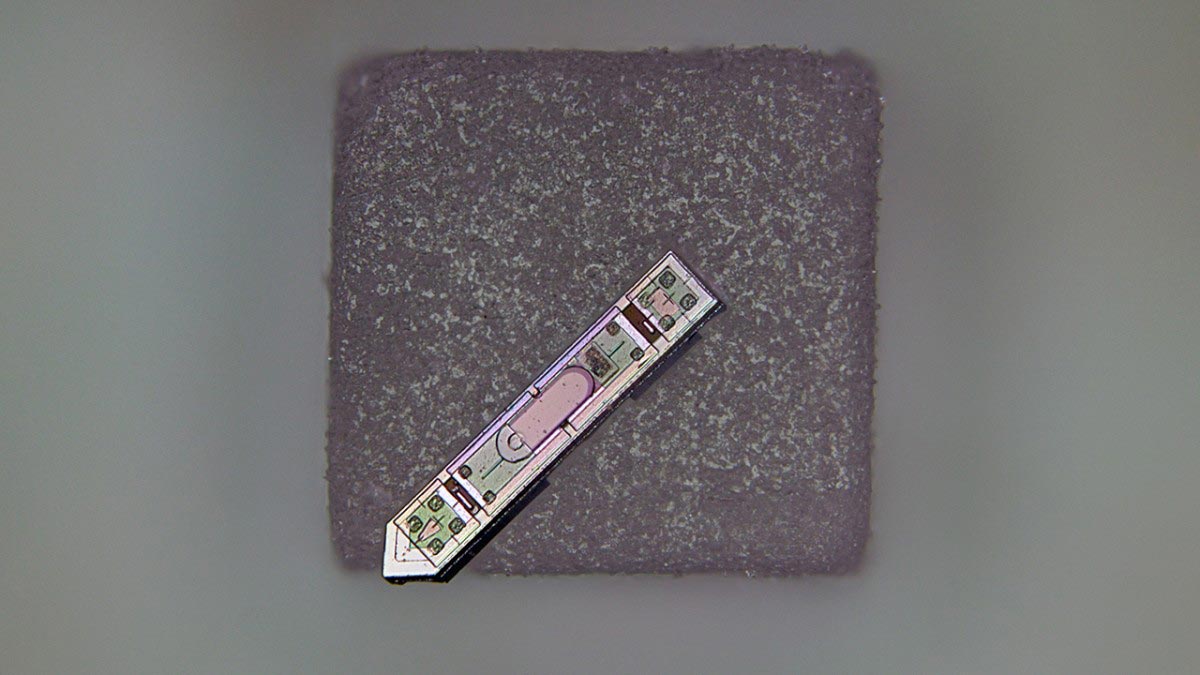
The MOTE is about 300 microns long and 70 microns wide.
"As far as we know, this is the smallest neural implant that will measure electrical activity in the brain and then report it out wirelessly," Molnar said. "By using pulse position modulation for the code – the same code used in optical communications for satellites, for example – we can use very, very little power to communicate and still successfully get the data back out optically."
New possibilities for brain and body monitoring
The researchers tested the MOTE first in cell cultures and then implanted it into mice's barrel cortex, the brain region that processes sensory information from whiskers. Over the course of a year, the implant successfully recorded spikes of electrical activity from neurons as well as broader patterns of synaptic activity – all while the mice remained healthy and active.
"One of the motivations for doing this is that traditional electrodes and optical fibers can irritate the brain," Molnar said. "The tissue moves around the implant and can trigger an immune response. Our goal was to make the device small enough to minimize that disruption while still capturing brain activity faster than imaging systems, and without the need to genetically modify the neurons for imaging."
Molnar said the MOTE's material composition could make it possible to collect electrical recordings from the brain during MRI scans, which is largely not feasible with current implants. The technology could also be adapted for use in other tissues, such as the spinal cord, and even paired with future innovations like opto-electronics embedded in artificial skull plates.
Molnar first conceived of the MOTE in 2001, but the research didn't gain momentum until he began discussing the idea about 10 years ago with members of Cornell Neurotech, a joint initiative between the College of Arts and Sciences and Cornell Engineering.
Reference: "A subnanolitre tetherless optoelectronic microsystem for chronic neural recording in awake mice" by Sunwoo Lee, Shahaboddin Ghajari, Sanaz Sadeghi, Yumin Zheng, Hind Zahr, Alejandro J. Cortese, Wenchao Gu, Kibaek Choe, Aaron Mok, Melanie Wallace, Rui Jiao, Chunyan Wu, Jesse C. Werth, Weiru Fan, Praneeth Mogalipuvvu, Ju Uhn Park, Shitong Zhao, Conrad Smart, Thomas A. Cleland, Melissa R. Warden, Jan Lammerding, Tianyu Wang, Jesse H. Goldberg, Paul L. McEuen, Chris Xu and Alyosha C. Molnar, 3 November 2025, Nature Electronics.
DOI: 10.1038/s41928-025-01484-1
The research was supported in part by the National Institutes of Health. Fabrication work was performed in part at the Cornell NanoScale Facility, which is supported by the National Science Foundation.

News
Viagra Ingredient Shows Promise for Rare Childhood Brain Disease in Surprising Study
A rare childhood disease with no approved treatment may have an unexpected new therapeutic candidate. Sildenafil, the active ingredient also sold under the brand name Viagra, may help reduce symptoms in people with Leigh [...]

In a first for China, Neuracle’s implantable brain-computer interface wins approval
In a landmark development, Neuracle Medical Technology has secured the country’s first-ever approval for an implantable brain-computer interface (BCI) system designed to restore hand motor function in patients with spinal cord injuries, in a [...]
A Cambridge Lab Mistake Reveals a Powerful New Way to Modify Drug Molecules
A surprising lab discovery reveals a light-powered way to tweak complex drugs faster, cleaner, and later in development. Researchers at the University of Cambridge have created a new technique for altering complex drug molecules [...]

New book from NanoappsMedical Inc – Molecular Manufacturing: The Future of Nanomedicine
This book explores the revolutionary potential of atomically precise manufacturing technologies to transform global healthcare, as well as practically every other sector across society. This forward-thinking volume examines how envisaged Factory@Home systems might enable the cost-effective [...]

Scientists Discover Simple Saliva Test That Reveals Hidden Diabetes Risk
Researchers have identified a potential new way to assess metabolic health using saliva instead of blood. High insulin levels in the blood, known as hyperinsulinemia, can reveal metabolic problems long before obvious symptoms appear. It is [...]

One Nasal Spray Could Protect Against COVID, Flu, Pneumonia, and More
A single nasal spray vaccine may one day protect against viruses, pneumonia, and even allergies. For decades, scientists have dreamed of creating a universal vaccine capable of protecting against many different pathogens. The idea [...]
New AI Model Predicts Cancer Spread With Incredible Accuracy
Scientists have developed an AI system that analyzes complex gene-expression signatures to estimate the likelihood that a tumor will spread. Why do some tumors spread throughout the body while others remain confined to their [...]

Scientists Discover DNA “Flips” That Supercharge Evolution
In Lake Malawi, hundreds of species of cichlid fish have evolved with astonishing speed, offering scientists a rare opportunity to study how biodiversity arises. Researchers have identified segments of “flipped” DNA that may allow fish to adapt rapidly [...]
Our books now available worldwide!
Online Sellers other than Amazon, Routledge, and IOPP Indigo Global Health Care Equivalency in the Age of Nanotechnology, Nanomedicine and Artifcial Intelligence Global Health Care Equivalency In The Age Of Nanotechnology, Nanomedicine And Artificial [...]

Scientists Discover Why Some COVID Survivors Still Can’t Taste Food Years Later
A new study provides the first direct biological evidence explaining why some people continue to experience taste loss long after recovering from COVID-19. Researchers have uncovered specific biological changes in taste buds that could help [...]

Catching COVID significantly raises the risk of developing kidney disease, researchers find
Catching Covid significantly raises the risk of developing deadly kidney disease, research has shown. The virus was found to increase the chances that patients will develop the incurable condition by around 50 per cent. [...]
New Toothpaste Stops Gum Disease Without Harming Healthy Bacteria
Researchers have developed a targeted approach to combat periodontitis without disrupting the natural balance of the oral microbiome. The innovation could reshape how gum disease is treated while preserving beneficial bacteria. The human mouth [...]

Plastic Without End: Are We Polluting the Planet for Eternity?
The Kunming Montreal Global Biodiversity Framework calls for the elimination of plastic pollution by 2030. If that goal has been clearly set, why have meaningful measures that create real change still not been implemented? [...]
Scientists Rewire Natural Killer Cells To Attack Cancer Faster and Harder
Researchers tested new CAR designs in NK-92 cells and found the modified cells killed tumor cells more effectively, showing stronger anti-cancer activity. Researchers at the Ribeirão Preto Blood Center and the Center for Cell-Based [...]
New “Cellular” Target Could Transform How We Treat Alzheimer’s Disease
A new study from researchers highlights an unexpected player in Alzheimer’s disease: aging astrocytes. Senescent astrocytes have been identified as a major contributor to Alzheimer’s progression. The cells lose protective functions and fuel inflammation, particularly in [...]

Treating a Common Dental Infection… Effects That Extend Far Beyond the Mouth
Successful root canal treatment may help lower inflammation associated with heart disease and improve blood sugar and cholesterol levels. Treating an infected tooth with a successful root canal procedure may do more than relieve [...]