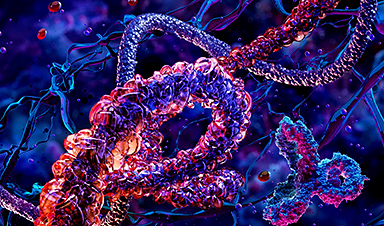
Researchers used advanced microscopy to uncover important protein structures.
For the first time, two important protein structures in the human body are being visualized, thanks in part to cutting-edge technology at the University of Cincinnati’s Center for Advanced Structural Biology. This breakthrough could lead to the development of more effective therapeutics.
The research, conducted by a team of structural biologists at UC, was published in the Proceedings of the National Academy of Sciences (PNAS).
This is the first publication from the Seegar Lab at UC. Tom Seegar, PhD, Ohio Eminent Scholar and assistant professor in the Department of Molecular and Cellular Biosciences in the College of Medicine, is the corresponding author.
The study’s first authors are Joe Maciag, PhD, a research scientist in the Seegar Lab, and Conner Slone, a graduate student assistant in the same lab.
For the first time, they are visualizing the physical, atomic structure of two protein complexes, observing how they interact, how their functions change, and how this process drives inflammatory signaling.
“If you can see something, you can figure out how it works,” said Seegar. “We are figuring out what this enzyme looks like and how it’s regulated.”
What they saw
The Seegar Lab used advanced cryogenic electron microscopy to reveal the structure of the ADAM17 enzyme bound to its regulator protein, iRhom2, and identified key features essential for its activity. They also pinpointed the critical interaction within the ADAM17-iRhom2 complex that governs how protein substrates are processed.
Scientists have long known that ADAM17 is a vital enzyme found in all cells, playing a key role in development and immune system regulation. It becomes dysregulated in chronic inflammatory diseases and has been linked to conditions such as rheumatoid arthritis, cancer, and Covid-19.

Researchers are now studying how ADAM17 communicates with other proteins involved in immune response and tissue repair. “We know in some cancers and rheumatoid arthritis, way too much signaling is occurring,” said Maciag. “But some treatments create too many side effects, worse than the disease itself.”
Maciag explained that the team is exploring ways to target iRhom2 for more precise therapeutic approaches. They have already identified structural features inside the cell, called the “re-entry loop” of iRhom2, that transmit information from the cell’s interior to its exterior. These structures are essential for ADAM17 to function outside the cell and had not been well understood until now.
Seegar emphasized the human impact. “This work provides a foundation for designing therapies targeting ADAM17-related diseases, offering new strategies to address critical health conditions,” he said.
New research core facility
The ADAM17-iRhom2 Complex contains the first protein structures coming out of UC’s Center for Advanced Structural Biology, established in 2022.
“We are indebted to UC,” said Seegar. “Our work wouldn’t be possible without this research core facility.”
The cryogenic electron microscopy technology being used has transformed structural biology. The center’s focal point is its transmission electron microscope (TEM), which is ideally suited for screening cryo-EM samples and allows researchers to see complex proteins without leaving UC’s campus.
“It’s a privilege to have this microscope in house, and it’s exciting to use it to solve these structures,” said Maciag. “It’s important to our field of cellular biology and will help drive research forward and how we approach our understanding of inflammation in known disease states.”
The Seegar Lab used UC’s Advanced Research Computing Center (ARC) for data processing, allowing them to keep their data, used to create a 3D model of the ADAM17-iRhom2 Complex, on campus as well.
Moving forward, Seegar’s lab plans to research iRhom2 more closely.
“These adapter proteins are not well understood,” said Slone. “Our research will be in understanding them and will be driven by specificity. Ideally, controlling these will allow researchers to control disease states.”
Reference: “Structural insights into the activation and inhibition of the ADAM17–iRhom2 complex” by Joseph J. Maciag, Conner E. Slone, Hala F. Alnajjar, Maria F. Rich, Bryce Guion, Igal Ifergan, Carl P. Blobel and Tom C. M. Seegar, 13 June 2025, Proceedings of the National Academy of Sciences.
DOI: 10.1073/pnas.2500732122
The study was funded by the National Institute of General Medicine Sciences and with support from a University of Cincinnati Research Innovation/Pilot Grant.

News
MIT Scientists Reprogram Immune Cells Inside the Body To Destroy Cancer
Natural killer cells reprogrammed inside mice eliminated lymphoma tumors and helped damaged livers heal, though whether this approach could help people with cancer or autoimmune disease remains unknown. To make a cancer treatment from [...]

Melanoma mRNA Vaccine Shows Promise in Preventing Disease Recurrence
Key takeaways: Phase 3 trial finds personalized intismeran plus pembrolizumab may better prevent high-risk melanoma recurrence after surgery The trial enrolled 1,137 patients and builds on phase 2 results showing about half the recurrence [...]
Scientists Discover a Powerful New Weapon Against a Dangerous Gut Infection
The promise of an experimental treatment for C. difficile gut infections lies partly in the bacteria it leaves alive, according to early laboratory and mouse research. Broad-spectrum antibiotics can disrupt the gut’s microbial community, [...]
Your Bones May Hold a Hidden Clue to Blood Cancer Survival
For people with blood cancers called myelodysplastic syndromes, osteoporosis may hold an overlooked clue to survival, a three-year observational study suggests. In blood cancers that develop in the bone marrow, an important clue to [...]

Researchers Discover What Reading for Pleasure May Be Doing to Your Brain
Reading for pleasure may offer surprising benefits for the brain, with research linking the habit to better mental health, stronger cognitive abilities, and a lower risk of dementia. Reading for pleasure may do far [...]
Scientists Discover a Hidden Trigger That Keeps Inflammation Alive
Inflammation persists after proteins detach from immune receptors, revealing a potential target for autoimmune treatments. Since a Nobel Prize-winning discovery in the 1990s identified molecules called Toll-like Receptors as the guardians of the human [...]
A Virus Gives Itself Away the Moment It Attacks
Researchers have found the trigger behind a powerful bacterial defense against viruses. Viruses that prey on bacteria could become an increasingly important tool for treating bacterial infections, particularly as antibiotic resistance makes some infections [...]
Scientists Discover Aspirin May Slash Dementia Risk by 70% – but Only for Certain People
Aspirin was linked to a sharply lower dementia risk in some older adults, and their genes may hold the clue. A Monash University analysis found that older adults with a particular genetic profile had [...]
Inflammation May Awaken Dormant Cancer Cells Years After Treatment
The body’s response to inflammation may disturb cancer cells that have been lying silent for years, giving them an opportunity to grow again. Researchers at the Francis Crick Institute have found that gut inflammation [...]

Where do nanoparticles go once they enter the body?
New international best practice guidance, co-written at ANSTO, sets out how to measure where nanoparticles like titanium dioxide end up in the body and how long they remain. The guidance has been shared by [...]
Long-Acting HIV Shots Could Solve a Major Treatment Challenge for Young People
A major African trial suggests that changing how HIV treatment is delivered could significantly improve viral suppression in adolescents. Young people with HIV were more likely to keep the virus suppressed when they received [...]

WHO Factsheets – The top 10 causes of death
In 2023, the 10 leading causes of death accounted for 33 million deaths, or 54% of the total 61 million deaths worldwide. The top global causes of death, in order of total number of lives lost, [...]
Aging Cells May Be Hiding From the Immune System – Scientists Think They Know How
Your immune system is supposed to clear out damaged cells. Researchers may have found how some of them hide and linger as the body ages. Researchers led by Cedars-Sinai Health Sciences University have identified [...]

Your Voice May Reveal How Fast Your Brain Is Aging
Researchers have developed a machine-learning “speech clock” that estimates age from subtle patterns in how people speak and what they say. It is possible that people’s voices may contain certain signals of aging that [...]
Optogenetics Pioneers Win 2026 Nobel Prize in Physiology or Medicine
The 2026 Nobel Prize in Physiology or Medicine has been awarded to Peter Hegemann, Georg Nagel, and Karl Deisseroth for the development of optogenetics, a revolutionary technology that uses light to control individual neurons [...]
Molecular Manufacturing: The Future of Nanomedicine – From NanoappsMedical Inc.
This book explores the revolutionary potential of atomically precise manufacturing technologies to transform global healthcare, as well as practically every other sector across society. This forward-thinking volume examines how envisaged Factory@Home systems might enable the cost-effective [...]