KAIST scientists have created a fast-acting, stable powder hemostat that stops bleeding in one second and could significantly improve survival in combat and emergency medicine.
Severe blood loss remains the primary cause of death from combat injuries. To address this challenge, a research team at KAIST that included an active duty Army Major set out to develop a faster and more reliable way to stop bleeding.
Their work led to a next-generation powder-type hemostatic agent that can halt bleeding within one second when sprayed directly onto a wound, offering a potential breakthrough for saving lives on the battlefield.
A spray-on solution in seconds
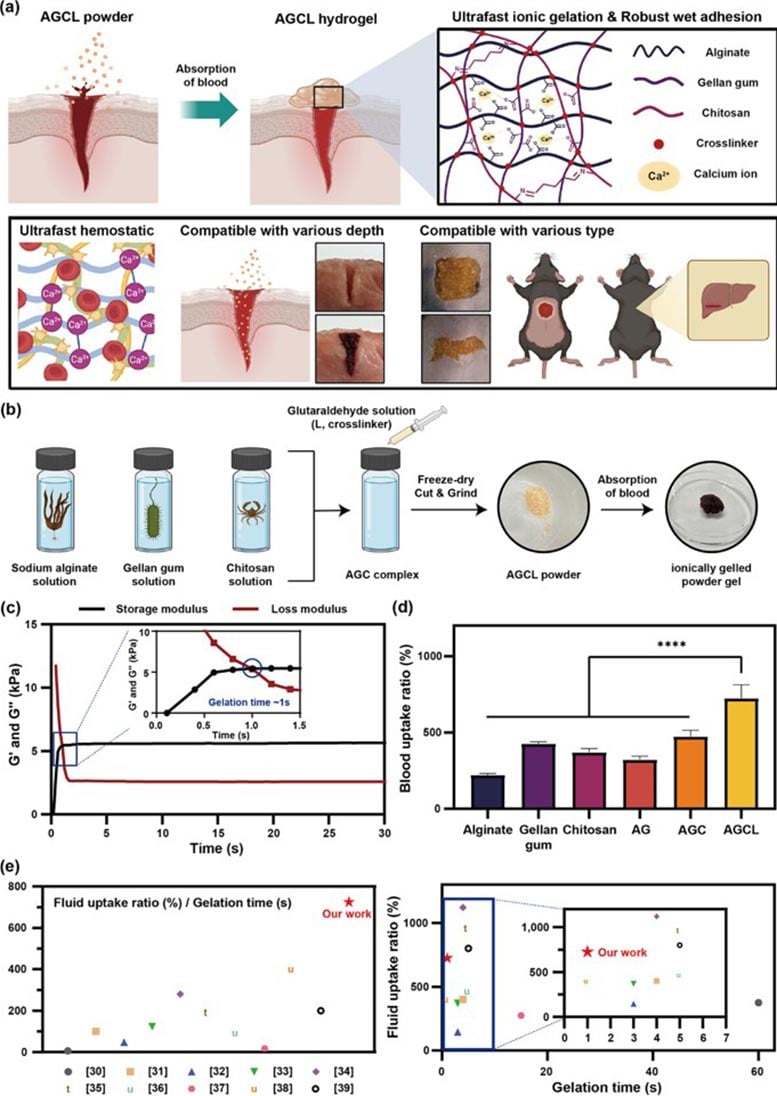
On December 29th, KAIST announced that a joint team led by Professor Steve Park of the Department of Materials Science and Engineering and Professor Sangyong Jon of the Department of Biological Sciences had created a powder based hemostatic agent that rapidly forms a strong hydrogel barrier. When applied to an injured area, the material transforms within about one second, sealing the wound almost immediately.
The researchers designed the technology with real combat conditions in mind, and the direct involvement of an Army Major helped ensure its practical readiness. The agent hardens instantly even in harsh environments such as battlefields and disaster zones, and its stability during storage allows it to be deployed quickly for emergency treatment.
Why existing hemostats fall short
Traditional patch-type hemostatic products commonly used in medicine struggle to treat deep or irregular wounds because of their flat shape. These materials are also sensitive to heat and moisture, which limits how easily they can be stored and used in demanding settings.
To overcome these limitations, the KAIST team developed the hemostatic agent in a powder form that can be applied to wounds of many shapes and sizes, including those that are deep or uneven. A single formulation can be used across a wide range of injury types, improving flexibility in emergency care.
Existing powder hemostatic agents had limits in hemostatic capability as they functioned by physically absorbing blood to form a barrier. To solve this problem, the research team focused on the ionic reactions within the blood.
The 'AGCL powder' developed this time has a structure that combines biocompatible natural materials such as Alginate and Gellan Gum (which react with calcium for ultra-fast gelation and physical sealing) and Chitosan (which bonds with blood components to enhance chemical and biological hemostasis). It reacts with cations such as calcium in the blood to turn into a gel state in one second, instantly sealing the wound.
Strength, safety, and regeneration
Furthermore, by forming a three-dimensional structure inside the powder, it can absorb blood amounting to more than 7 times its own weight (725%). Due to this, it quickly blocks blood flow even in high-pressure and excessive bleeding situations, and showed superior sealing performance compared to commercial hemostatic agents with a high adhesive strength of over '40kPa', a level of pressure that can withstand being pressed strongly by hand.
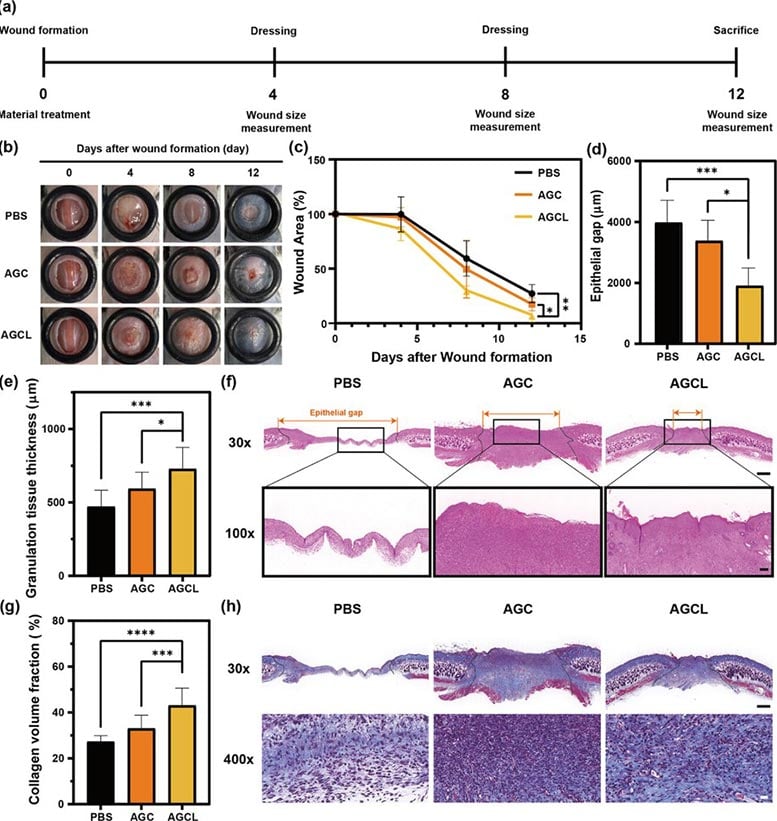
AGCL powder is composed entirely of naturally derived materials, showing a hemolysis rate of less than 3%, a cell viability rate of over 99%, and an antibacterial effect of 99.9%, making it safe even when in contact with blood. In animal experiments, excellent tissue regeneration effects such as rapid wound recovery and promotion of blood vessel and collagen regeneration were confirmed.
Proven performance under stress
In surgical liver injury experiments, the amount of bleeding and hemostasis time were significantly reduced compared to commercial hemostatic agents, and liver function recovered to normal levels two weeks after surgery. No abnormal findings were observed in systemic toxicity evaluations.
In particular, this hemostatic agent maintains its performance for two years even in room temperature and high humidity environments, possessing the advantage of being ready for immediate use in harsh environments such as military operation sites or disaster areas.
From defense research to civilian care
Although this research is an advanced new material technology developed with national defense purposes in mind, it has great potential for application throughout emergency medicine, including disaster sites, developing countries, and medically underserved areas.

It is evaluated as a representative spin-off case where national defense science and technology expanded to the private sector, as it is capable of everything from emergency treatment on the battlefield to internal surgical hemostasis.
Spin-off case: Expanding or transferring national defense science and technology for use in the private sector. Examples include computers, GPS, microwave ovens, etc.
This study was recognized for its scientific innovation and national defense utility simultaneously, winning the 2025 KAIST Q-Day President's Award and the Minister of National Defense Award at the 2024 KAIST-KNDU National Defense Academic Conference.
Ph.D candidate Kyusoon Park (Army Major), who participated in the research, stated, "The core of modern warfare is minimizing the loss of human life," and added, "I started the research with a sense of mission to save even one more soldier." He continued, "I hope this technology will be used as a life-saving technology in both national defense and private medical fields."
Reference: "An Ionic Gelation Powder for Ultrafast Hemostasis and Accelerated Wound Healing" by Youngju Son, Kyusoon Pak, Taehoon Lee, Monica Celine Prayogo, Jinyoung Choi, Sukkyung Kang, Minjoo Kang, Byungkook Oh, Sang Yu Sun, Sanha Kim, Sung Gap Im, Sangyong Jon and Steve Park, 28 October 2025, Advanced Functional Materials.
DOI: 10.1002/adfm.202523910
Support of the National Research Foundation of Korea (NRF).

News

WHO Factsheets – The top 10 causes of death
In 2023, the 10 leading causes of death accounted for 33 million deaths, or 54% of the total 61 million deaths worldwide. The top global causes of death, in order of total number of lives lost, [...]
Aging Cells May Be Hiding From the Immune System – Scientists Think They Know How
Your immune system is supposed to clear out damaged cells. Researchers may have found how some of them hide and linger as the body ages. Researchers led by Cedars-Sinai Health Sciences University have identified [...]

Your Voice May Reveal How Fast Your Brain Is Aging
Researchers have developed a machine-learning “speech clock” that estimates age from subtle patterns in how people speak and what they say. It is possible that people’s voices may contain certain signals of aging that [...]
Optogenetics Pioneers Win 2026 Nobel Prize in Physiology or Medicine
The 2026 Nobel Prize in Physiology or Medicine has been awarded to Peter Hegemann, Georg Nagel, and Karl Deisseroth for the development of optogenetics, a revolutionary technology that uses light to control individual neurons [...]
Molecular Manufacturing: The Future of Nanomedicine – From NanoappsMedical Inc.
This book explores the revolutionary potential of atomically precise manufacturing technologies to transform global healthcare, as well as practically every other sector across society. This forward-thinking volume examines how envisaged Factory@Home systems might enable the cost-effective [...]

What is ‘American Covid’ and how bad is it?
Cases of so-called ‘American Covid’ are on the rise in the UK. The strain is officially called XFG, or ‘Stratus’, and is the most common variant in North America, hence the name. It might soon [...]
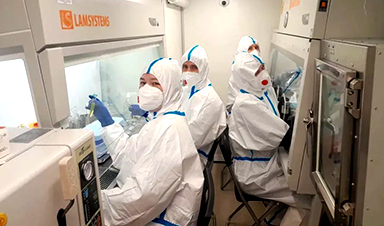
Researcher at Russian plague laboratory dies of ‘unknown’ infection
Russian authorities have imposed "anti-epidemic measures" after a laboratory worker at an institute in Siberia dedicated to studying the plague and other infectious diseases died of a mysterious illness. The researcher, a 28-year-old female [...]
GHCE Concept
From the preface of the book Global Health Care Equivalency in the Age of Nanotechnology, Nanomedicine and Artificial Intelligence, Edited by Frank Boehm: Since the publication of my first book (Nanomedical Device and Systems [...]
A Surprising Brain Signal Could Explain Why Eating Less Protein Extends Lifespan
A new paper suggests that limiting protein intake triggers a coordinated response throughout the body that may help explain how protein restriction affects healthy aging. Animals respond to protein restriction, or reduced protein in [...]

Back and shoulder surgery is often worse than useless
Millions of operations should be scrapped SIX IN TEN Britons have surgery at some point. So do lots of Americans, at a cost of perhaps $500bn a year, a third of all spending on [...]
Cocaine plays with mind, hijacks brain circuit, drives increasingly rigid and repetitive behavior
Researchers have found that cocaine hijacks brain circuit, which to drive increasingly rigid and repetitive behavior. The brain circuit that normally participates in selecting natural mouth and face movements, but which becomes disproportionately engaged [...]
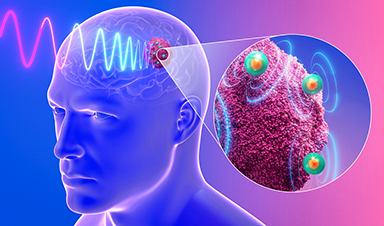
Injectable nanodevices could provide effective treatment for drug-resistant glioblastoma
The brain cancer glioblastoma is one of the most aggressive and treatment-resistant cancers known to medicine, carrying a median survival of just 12-15 months, even with the best available care. Now, researchers at the [...]
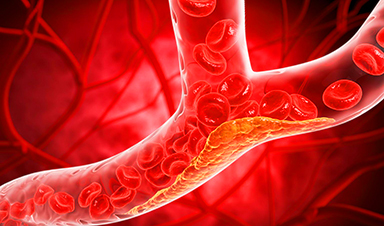
New Treatment Cuts “Bad” Cholesterol in Half for a Full Year
A single infusion of an experimental CRISPR-Cas9 therapy was reported to safely lower LDL cholesterol by 52.5% and triglycerides by 47.8%, as measured 12 months after treatment. What if one infusion could keep cholesterol [...]
Too Much RNA Can Drain a Cell’s Energy, Scientists Discover
A virus may cripple a cell’s power supply simply by producing too much of a molecule the cell needs to survive. New research from the Texas A&M College of Veterinary Medicine and Biomedical Sciences [...]
West African scientists warn of weakening health systems and urge stronger outbreak detection
LOME, Togo (AP) — West African laboratory scientists called on governments Friday to strengthen capacity to detect disease outbreaks to avoid another major outbreak, saying health systems across the region are becoming weaker. Participants [...]

A Little-Known Protein Could Point to a New Way To Treat Alzheimer’s
A study suggests that increasing SORLA protein levels could help treat Alzheimer’s disease and other disorders involving tau protein. Increasing SORLA, a protein with a protective role in the brain, helped mice withstand damage [...]