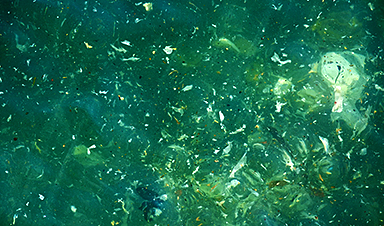
Nanoplastics—particles smaller than a human hair—can pass through cell walls and enter the food web. New research suggest 27 million metric tons of nanoplastics are spread across just the top layer of the North Atlantic
By Katharine Sanderson & Nature magazine
Pollution
Marine plastic litter tends to grab headlines, with images of suffocating seabirds or bottles washing up along coastlines. Increasingly, researchers have been finding tiny microplastic fragments across all environments, from the most densely populated cities to pristine mountaintops, as well as in human tissue including the brain and placenta. A study published today reveals yet another hidden source of this deadly waste: nanometre-scale particles are literally everywhere, says co-author Dušan Materić, an environmental analytical chemist at the Helmholtz Centre for Environmental Research in Leipzig, Germany.
Materić and his colleagues sampled water at three depths representative of different environments in the North Atlantic Ocean. Throughout the water column, they found three types of nanoplastic: polyethylene terephthalate (PET), polystyrene (PS) and polyvinylchloride (PVC). These were present at average concentrations of 18 milligrams per metre cubed, which translates to 27 million tonnes of nanoplastics spread across just the top layer of the temperate to subtropical North Atlantic. “Nanoplastics make up the dominant fraction of marine plastic pollution,” Materić says. In the entire world’s oceans, it is estimated that there are around 3 million tonnes of floating plastic pollution — excluding nanoplastics.
What are plastic nanoparticles and how different are they from microplastics?
The tiniest of pieces of plastic, nanoplastics are defined by the researchers as having a diameter of less than one micrometre (one one-thousandth of a metre). Microplastics are between one micrometre and 5 millimetres across. At the smaller scale of nanoplastics, materials behave differently. Materić and his colleagues found that the particles were distributed throughout the water column, rather than settling to the bottom. The movement of the nanoplastic particles was dominated not by gravity, but by the random movement called Brownian motion, and by collisions with water molecules.
How did the team find the nanoplastics?
The scientists took water samples during a November 2020 cruise on research vessel Pelagia, which is owned by the Royal Netherlands Institute of Sea Research in Texel. They sampled at 12 locations: 5 in the system of circular currents called the North Atlantic subtropical gyre; 4 in the open ocean; and 3 from coastal areas on the European continental shelf. At each location, they gathered samples at depths of 10 metres and 1,000 metres below the surface, and then 30 metres off the ocean bottom.
The nanoplastics were detected using a technology called thermal-desorption proton-transfer-reaction mass spectrometry. “We faced multiple challenges,” says Materić, including the need to remove contaminants other than nanoplastics. Each 10-millilitre sample was run through a filter with micrometre pores to clear out microplastics. Samples were then slowly heated, releasing any organic matter and allowing the remaining plastics to be identified.
Not all was as expected. “We faced a big mystery,” says Materić. One major class of plastics, polyethylene (PE), was missing from the data, even though fragments almost certainly enter the ocean. The fragments probably transform into something else, or might fall to the sea bed, says Materić. “This suggests that PE nanoplastic cycling in the ocean environment follows some unusual pathway — either rapid chemical alteration or mineralization, or fast sinking.”
Should we be surprised that nanoplastics are an overlooked source of plastics pollution? Should we be worried?
“This does not come as a surprise to me, as I have been aware of the extent and magnitude of the problem for some time,” says Tony Walker, an environmental scientist at Dalhousie University in Halifax, Canada. “Nanoplastics, unlike microplastics, are able to pass through cell walls, meaning that they are already incorporated into the ocean phytoplankton which serve as the base of the marine food web and are able to be transferred through the marine food web,” he explains.
The ubiquitousness of nanoplastics means they should be taken seriously, says Materić. “Given their toxicological potential, they may represent the most problematic plastic size fraction for ocean life,” he says. Walker agrees: “This should be a wake-up call to all of us,” he says. “The extent to which nanoplastics can infiltrate every ecosystem and living cell on the planet is even far worse than what we already know about microplastics and larger plastic pollution.”
What can be done to mitigate the pollution?
The next and likely final round of negotiations for a legally binding United Nations treaty on plastics pollution will kick off in August in Geneva, Switzerland. On the table is a limit on future plastic manufacture, but this is being resisted by some countries, including those that rely on oil and gas exports to power their economies.
“One of the best strategies to mitigate future nanoplastics pollution or release into the environment is to cap plastic production,” says Walker. “Turn off the tap.”

News
How Immune Dysregulation Contributes to Psychiatric Disorders
Introduction Growing evidence suggests that disruptions in immune function may play an important role in the development and progression of psychiatric disorders. However, immune mechanisms probably contribute more strongly in some patients than others, [...]
Electrostatic Discharge Boosts Triboelectric Nanogenerator Current and Enables DC Output
Controlled electrical discharges could enable triboelectric nanogenerators to achieve higher peak currents, extending nano-enabled energy harvesting into chemical processing and self-powered sensing. Paper: Electrostatic discharge as a breakthrough strategy for triboelectric nanogenerators. A new review [...]
Swiss laboratory uses old drugs against rare diseases
Researchers at the University of Geneva are combing through collections of approved drugs to find new therapies for rare diseases – with some success. This approach is gaining traction around the world, while pharmaceutical [...]
Nanozyme Aptasensors Show Promise for Faster Food, Health, and Environmental Testing
By pairing robust artificial enzymes with highly selective aptamers, nanozyme aptasensors could help detect disease biomarkers, pathogens, and contaminants faster, but the review shows that real-world deployment still depends on overcoming matrix interference, biofouling, [...]
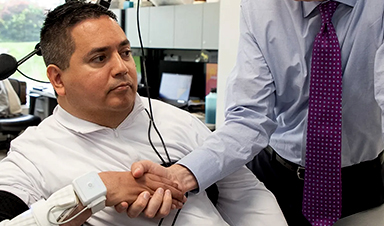
Paralyzed Man Feels Sensation Again With Brain Stimulation Device
Aneuroprosthetic system has allowed a man with paralysis to grasp and lift objects and feel touch again. The device helped 42-year-old Keith Thomas of Massapequa, New York, who was paralyzed from the chest down [...]
Global Cancer Cases Could Surge 67% by 2050, New Report Warns
New data reveal major geographic disparities and highlight the urgent need for global action on prevention, early detection, and equitable access to treatment. For roughly one in five people worldwide, cancer will become part [...]
A Deadly Ebola-Like Virus Is Spreading. Are We Ready?
BU virologist Nancy Sullivan says the Bundibugyo outbreak in the Democratic Republic of the Congo underscores the need for broader outbreak preparedness. The death of a nurse marked the moment health officials recognized that [...]
Why Most Animal Viruses Never Become Human Pandemics
From receptor mismatch to risky human-animal interfaces, this article explains why spillover is common but true pandemic emergence remains rare. Introduction Humans are constantly exposed to animal viruses through farming, wildlife contact, and the [...]
Stem cell organoids repair heart microvessels in coronary artery disease models
A Stanford University team has shown that vascular organoids derived from human stem cells can repair the heart’s microvessel network in pigs with ischaemic heart disease – a proof-of-concept advancement that could open new therapeutic [...]

Goodbye GP waiting rooms, hello prevention at home
Prevention is suddenly everywhere in NHS reform. The recent £340m community pharmacy deal is moving more services onto the high street. Community Diagnostic Centres are being expanded, and the Neighbourhood Health Framework sets out [...]
Ebola control is weakened by mistrust and cultural insensitivity
Effective response depends on cooperation with communities and frontline workers, writes Zaeem ul Haq The current Bundibugyo Ebola outbreak in the Democratic Republic of the Congo (DRC) and Uganda is exposing dangerous gaps in [...]
Building the Brain Requires Millions of Dangerous DNA Breaks
Scientists discovered that building a healthy brain involves an unexpected step: young neurons routinely break and rapidly repair their own DNA. As the brain develops, newly formed nerve cells must travel through tightly packed tissue [...]

One Tiny Change May Explain How Viruses Jump From Bats to Humans
Scientists found that one tiny genetic change may determine whether a bat virus stays in bats or becomes a human threat. Most infectious disease outbreaks begin when a virus or other pathogen crosses from animals into [...]

Scientists Discover 250+ Genes That Could Lead to New Ways To Prevent Melanoma
The world’s largest study of mole genetics identified hundreds of genes tied to melanoma risk, uncovering potential new drug targets and paving the way for more accurate melanoma screening and prevention. Researchers at QIMR [...]
Breakthrough Diabetes Treatment Reprograms the Immune System
An engineered stem cell therapy reversed new-onset Type 1 diabetes in mice by shifting the immune system away from attacking insulin-producing cells. For more than a century, people with Type 1 diabetes have relied [...]
Taking the world’s temperature: WHO chief spotlights global health emergencies
Taking the world’s temperature on pressing health matters, WHO Director-General Tedros Adhanom Ghebreyesus provided the latest on current global challenges - and successes when it comes to international cooperation. “The outbreaks of hantavirus, Ebola and Marburg all show [...]