Summary: A new study demonstrates that primary brain tumors (gliomas) are particularly receptive to targeted drug delivery using focused ultrasound (FUS) combined with microbubbles.
The team developed a high-resolution MRI protocol to track blood-brain barrier (BBB) opening and molecular transport inside the tumor microenvironment. The research allays long-standing clinical concerns that mutated tumor vasculature would impede sound-wave-mediated drug delivery.
Instead, FUS performance was maintained, and in some cases enhanced, within glioma tissue, with researchers identifying an optimal “Goldilocks” therapeutic molecule size range for efficient drug uptake into tumor cells.
Key Facts
- Enhanced Barrier Permeation: Rather than showing resistance due to chaotic tumor vasculature, glioma tissue demonstrated equal or superior receptivity to focused-ultrasound-mediated blood-brain barrier opening compared to healthy brain tissue.
- Novel MRI Tracking Integration: The researchers integrated a high-resolution MRI imaging approach directly with focused ultrasound to track intra-tumoral drug accumulation dynamics with precise spatial clarity.
- Molecular Size “Goldilocks” Window: Delivery efficiency varied directly by molecular payload size: medium-sized drug molecules accumulated significantly more efficiently than either very small or oversized drug compounds.
- Non-Invasive Precision Delivery: Microbubble-assisted FUS utilizes low-frequency acoustic waves to transiently and reversibly open the blood-brain barrier without requiring surgical incision or craniotomy.
- Translational Infrastructure: The addition of an Insightec MRI-guided focused ultrasound system at UVA will accelerate the translation of these findings toward clinical trials involving glioblastoma immunotherapies and gene therapies.
Source: UVA Health
In a promising sign for the potential of focused sound waves to improve care for brain tumors, UVA Health researchers have determined that tumors called gliomas may be even more receptive to targeted drug delivery than normal brain tissue.
While the research is still in its early stages, the findings help allay concerns that brain tumors might have properties that would make them stubbornly resistant to the cutting-edge approach. The UVA scientists are using tiny “microbubbles” that are activated by sound waves to open the brain’s natural protective barrier, known as the “blood-brain barrier,” so that drugs can enter exactly where needed.
Inside brain tumors, cancer cells mutate the structure of the blood-brain barrier and its function becomes unpredictable. In turn, this raises questions about how effectively focused ultrasound can deliver therapies in the brain tumor environment and what sizes of drug molecules can be delivered most effectively. The new research from UVA Health’s Focused Ultrasound Cancer Immunotherapy Center provides important insights on both fronts.
“To address the central question, Dr. Wilson Miller worked with my graduate student, Matthew Hoch, to develop an MRI approach that would allow us to make drug-delivery measurements with unprecedented resolution. This approach had not been integrated with focused ultrasound before,” said researcher Richard J. Price, PhD, the center’s co-director. “The outcome is exciting because it means that focused ultrasound delivery performance is not expected to diminish in brain tumors. In fact, it may even be enhanced for some types of therapeutics”
Better Brain Cancer Treatments
Gliomas are the most common primary brain tumors in adults. This group include glioblastomas, the deadliest form of brain cancer. While there are treatments that can extend survival and improve quality of life, glioblastomas are almost always fatal within 5 to 10 years, so new and better treatments are needed desperately. More than 10,000 people in the United States alone die from glioblastomas every year.
Part of the difficulty in treating glioblastoma is getting drugs through the brain’s natural defenses. The blood-brain barrier exists for an important reason: It keeps harmful germs and toxins out. So doctors have proceeded cautiously in trying to open the gates for fear of letting in dangerous invaders.
Focused ultrasound, however, is now letting doctors open the barrier extremely precisely and extremely briefly, so that beneficial drugs can slip inside unaccompanied by unwanted companions. Price’s approach would use low-frequency sound waves to send tiny drug molecules spinning directly into tumor cells. This is done without the need for cutting into the skull.
In addition to indicating that gliomas in lab mice are vulnerable to the approach, Price’s latest research sheds light on the sizes of molecules that would be most effective. He and his collaborators identified a “Goldilocks” size range where the molecules worked best.
Very small molecules delivered the medicine less efficiently than larger ones, but very large molecules were less effective than the medium-sized ones. (This is relative, of course – all the molecules are far, far smaller than can be seen with the naked eye.)
The great promise of focused ultrasound to improve immunotherapy’s ability to treat cancer prompted UVA in 2022 to launch its Focused Ultrasound Cancer Immunotherapy Center – the world’s first center devoted specifically to that purpose.
Now UVA is bolstering its research tools with the addition of a cutting-edge MRI-guided focused ultrasound system for drug delivery to the brain. The system, by Insightec, comes equipped with an advanced magnetic-resonance imaging unit that provides astonishing views inside the brain. This will let the researchers better understand exactly what happens as they use sound waves to drive drug molecules into tumors.
“This new MRI-guided focused ultrasound system gives our researchers the ability to both deliver treatment and monitor its effects with exceptional precision,” said UVA Health’s James Stone, MD, PhD. “That combination will accelerate our understanding of how to optimize drug delivery for brain tumors and help move promising therapies closer to clinical care.”
“We have a deep commitment at UVA to advancing care for patients here and across the world through important research like this,” said Colin P. Derdeyn, MD, interim dean of the UVA School of Medicine. “We continue to be a leader in focused ultrasound research through the efforts of our outstanding investigators, federal funding for their work, and our collaborations with industry.”
While more research needs to be done, the promising results bode well for the efforts by UVA Cancer Center and UVA’s Paul and Diane Manning Institute of Biotechnology to develop new options for patients with brain cancers. (UVA’s Manning Institute has been launched specifically to fast-track new treatments and cures for the most challenging diseases to benefit patients across Virginia and beyond.)
“I am hopeful this research illustrates how advanced MR imaging methods can be used to improve focused ultrasound delivery treatments in the clinic,” Price said. “In particular, it’s exciting to think about how these technologies could be combined with future gene therapies, from Manning Institute investigators and companies, aimed at treating brain tumors.”
Findings Published
Price and his collaborators have published their results in the scientific journal Radiology. The research team consisted of Matthew R. Hoch, Victoria R. Breza, G. Wilson Miller and Price. Price is part of UVA’s Department of Biomedical Engineering, a joint program of the School of Medicine and School of Engineering and Applied Science, as well as part of the School of Medicine’s Department of Radiology and Medical Imaging.
Funding: UVA’s research was supported by the National Institutes of Health, grants R01EB030409, R01EB030744, R21NS118278 and R01CA226899, and by the UVA Focused Ultrasound Cancer Immunotherapy Center.

News – Curated by Amanda Scott, Alias Group Creative
Follow her on Bluesky
Cutting Two Amino Acids Slowed Prostate Cancer in Mice
A newly identified link between amino acid metabolism and cholesterol production may help prostate tumors adapt to hormone therapy. Prostate cancer can find ways around treatments designed to deprive tumors of the hormones they [...]

Largest-Ever Physics Survey Raises New Doubts About Our Model of the Universe
Physicists around the world remain deeply divided on key mysteries of the universe, from dark matter to quantum gravity. The standard cosmological model failed to gain majority support, and no leading theory dominated the [...]

Scientists Just Overturned a 100-Year-Old Belief About Bacteria in the Lungs
New findings raise questions about the role of microbes living in the lungs. More than 35 trillion bacteria live throughout the human body, forming microbiomes in the gut, mouth, lungs, skin, and urogenital tract. [...]

GHCE Concept
From the preface of the book Global Health Care Equivalency in the Age of Nanotechnology, Nanomedicine and Artificial Intelligence, Edited by Frank Boehm: Since the publication of my first book (Nanomedical Device and Systems [...]

Novartis, Ionis drug failure spurs questions
Pelacarsen didn’t protect heart health despite lowering levels of a protein particle, “Lp(a),” in a large clinical trial — a result with important implications for cardiovascular drug research. Dive Brief: An RNA drug from [...]
New injectable treatment helps the brain rebuild after stroke
Biomedical engineers at Duke University have created an injectable biomaterial that may help the brain recover from damage left behind by an ischemic stroke. In experiments with mice, the material transformed the cavity created [...]

Scientists Discover a Hidden “Immune Organ” Inside the Skull
Researchers discovered lymph node-like immune hubs inside skull bone marrow that appear to act as rapid-response centers for the brain. For decades, the brain was thought to operate largely apart from the immune system. [...]

Engineered tRNAs and lipid nanoparticles target nonsense mutation cystic fibrosis
Researchers have developed a potential new approach for treating a form of cystic fibrosis caused by so-called nonsense mutations, combining chemically modified transfer RNAs with lipid nanoparticles designed to deliver the therapy directly to [...]
New pancreatic cancer drug carries a $39,800 monthly list price
A groundbreaking treatment for one of the most common forms of pancreatic cancer has been approved in pill form by the FDA. Revolution Medicines’ oral tablet daraxonrasib, branded as Rasonque, reduced the risk of [...]
Researchers Have Discovered a New Way To Reduce Chronic Nerve Pain
A cancer-linked protein called BRAF may help drive chronic nerve pain, and existing cancer drugs targeting it reduced pain sensitivity in preclinical models. Chronic nerve pain can persist long after an injury and often [...]
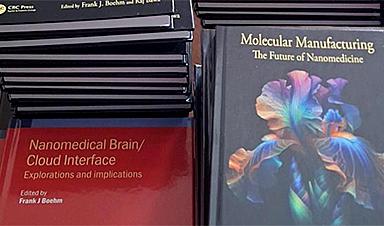
Our books now available worldwide!
Online Sellers other than Amazon, Routledge, and IOPP Indigo Global Health Care Equivalency in the Age of Nanotechnology, Nanomedicine and Artifcial Intelligence Global Health Care Equivalency In The Age Of Nanotechnology, Nanomedicine And Artificial [...]

Quantum-Enabled Regenerative Health: Reimagining Wellness, Precision Health and Longevity Medicine
Introduction Healthcare is approaching a frontier where the quantum portfolio could influence not only how disease is diagnosed and treated, but how health itself is measured, modeled, predicted and preserved. Quantum computing, quantum simulation, [...]

FDA Clears First-of-Its-Kind Nonmedication Treatment for PTSD
The FDA has cleared a system that uses brain activity data to personalize magnetic stimulation for PTSD, adding a new nonmedication treatment option. Every day in the United States, approximately 17.5 veterans die by suicide, [...]
FDA approves breakthrough drug to treat advanced pancreatic cancer
The Food and Drug Administration (FDA) approved on Wednesday a drug that could extend the survival of those with metastatic pancreatic cancer. The drug, called daraxonrasib, will be sold under the brand name Rasonque [...]

AI Decodes a Hidden DNA Signal Linked to Disease-Causing Mutations
Machine learning identifies the likely “initiator” and enables new predictions about DNA mutations that can cause disease. Every human cell depends on tens of thousands of genes being switched on at the right time [...]

Pope Leo Urges Global Response to Congo’s Deadliest Ebola Outbreak
Pope Leo called for international action to address the Ebola outbreak in the Democratic Republic of Congo. The epidemic has claimed over 2,500 lives and is the nation's largest recorded outbreak. The Pope emphasized [...]