Researchers have developed a potential new approach for treating a form of cystic fibrosis caused by so-called nonsense mutations, combining chemically modified transfer RNAs with lipid nanoparticles designed to deliver the therapy directly to the lungs.
The study, led by Jingan Chen and colleagues, found that the treatment restored production of functional cystic fibrosis transmembrane conductance regulator (CFTR) protein in bronchial epithelial cells, mouse models and patient-derived cystic fibrosis organoids.
The results of the study point to a possible way of correcting the consequences of certain genetic mutations at the protein-production stage rather than attempting to replace or permanently edit the underlying DNA.
“Translating these effects to the amelioration of respiratory function in cystic fibrosis patients will require further work, including characterisation of side effects, especially given dose-dependent inflammation noted both by [the current study] in mice and in prior animal studies of inhaled [lipid nanoparticle] delivery,” write Myerson and Weissman in the Perspective.
What is a suppressor tRNA?
Transfer RNAs, or tRNAs, normally help translate mRNA into proteins. Each tRNA carries a particular amino acid and recognises the corresponding three-letter sequence, or codon, in mRNA.
Suppressor tRNAs (sup-tRNAs) are engineered to recognise premature stop codons instead. By changing their anticodons, researchers can make them insert an amino acid at the premature stop signal and allow translation to continue.
The concept is attractive because it could potentially address multiple genetic diseases caused by nonsense mutations using a common therapeutic strategy.
But getting from that concept to an effective medicine is difficult. Sup-tRNAs need to reach the right cells, remain functional for long enough and avoid triggering unwanted immune responses. They also need to read through the premature stop signal efficiently without disrupting normal protein production.
The problem with nonsense mutations
To understand why the approach matters, it helps to look at what a nonsense mutation actually does.
A nonsense mutation introduces a premature stop signal into the mRNA. Instead of continuing to build the protein, the cell stops translation too early. The resulting protein is often shortened and unable to perform its normal function.
Nonsense mutations are estimated to account for around 11 percent of human genetic disorders, making them an important target for drug discovery.
The challenge is therefore not necessarily to replace the entire gene. In principle, if researchers can persuade the cell to read through the premature stop signal, it may be possible to restore production of the full-length protein.
Why chemically modify the tRNA?
Chen and colleagues sought to address several of these problems by chemically modifying the sup-tRNAs.
The modified tRNAs also remained functionally active for longer and reduced activation of innate immune responses.
These properties are important from a drug-discovery perspective. An experimental therapy can demonstrate an impressive biological effect in a laboratory dish yet still fail as a potential medicine if the molecule is unstable, poorly delivered or recognised as foreign by the immune system.
Getting the therapy to the lungs
The second half of the strategy involves delivery.
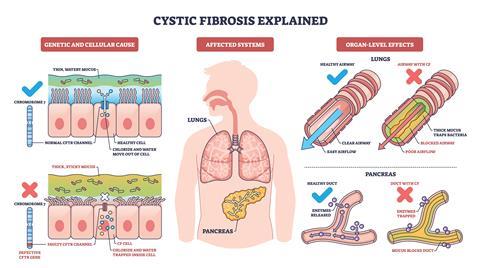
Rather than administering the engineered tRNAs systemically, the researchers packaged them in lipid nanoparticles (LNPs) designed for inhaled delivery to the lungs.
For cystic fibrosis, the lungs are an especially logical target because respiratory disease is a major driver of illness. Direct inhalation could potentially concentrate treatment where it is needed while reducing systemic exposure.
In the study, the researchers tested their approach across several increasingly relevant models. They used bronchial epithelial cells, mouse models and organoids derived from people with cystic fibrosis.
How this fits into the wider field
RNA-based approaches have already demonstrated that genetic information can be therapeutically altered or exploited without making a permanent change to the genome. Sup-tRNAs offer a particularly interesting proposition because the same basic strategy could potentially be adapted to different nonsense mutations and different genetic diseases.
That does not mean the approach will automatically work across patients. The specific premature stop codon, surrounding genetic sequence, required amino acid and level of protein restoration could all influence the outcome.
What happens next?
The immediate priority is establishing whether the promising laboratory and animal results translate into meaningful benefits in living organisms and ultimately in people.
Safety will be particularly important. The dose-dependent inflammation highlighted by Myerson and Weissman will need to be investigated alongside the durability of treatment, distribution of the nanoparticles and the potential for repeated inhaled dosing.
The study is therefore best viewed not as a treatment ready for patients but as a proof of concept for a potentially versatile class of genetic medicines.

News – Curated by Amanda Scott, Alias Group Creative
Follow her on Bluesky
Scientists Discover a Hidden Trigger That Keeps Inflammation Alive
Inflammation persists after proteins detach from immune receptors, revealing a potential target for autoimmune treatments. Since a Nobel Prize-winning discovery in the 1990s identified molecules called Toll-like Receptors as the guardians of the human [...]
A Virus Gives Itself Away the Moment It Attacks
Researchers have found the trigger behind a powerful bacterial defense against viruses. Viruses that prey on bacteria could become an increasingly important tool for treating bacterial infections, particularly as antibiotic resistance makes some infections [...]

Scientists Discover Aspirin May Slash Dementia Risk by 70% – but Only for Certain People
Aspirin was linked to a sharply lower dementia risk in some older adults, and their genes may hold the clue. A Monash University analysis found that older adults with a particular genetic profile had [...]
Inflammation May Awaken Dormant Cancer Cells Years After Treatment
The body’s response to inflammation may disturb cancer cells that have been lying silent for years, giving them an opportunity to grow again. Researchers at the Francis Crick Institute have found that gut inflammation [...]

Where do nanoparticles go once they enter the body?
New international best practice guidance, co-written at ANSTO, sets out how to measure where nanoparticles like titanium dioxide end up in the body and how long they remain. The guidance has been shared by [...]
Long-Acting HIV Shots Could Solve a Major Treatment Challenge for Young People
A major African trial suggests that changing how HIV treatment is delivered could significantly improve viral suppression in adolescents. Young people with HIV were more likely to keep the virus suppressed when they received [...]

WHO Factsheets – The top 10 causes of death
In 2023, the 10 leading causes of death accounted for 33 million deaths, or 54% of the total 61 million deaths worldwide. The top global causes of death, in order of total number of lives lost, [...]
Aging Cells May Be Hiding From the Immune System – Scientists Think They Know How
Your immune system is supposed to clear out damaged cells. Researchers may have found how some of them hide and linger as the body ages. Researchers led by Cedars-Sinai Health Sciences University have identified [...]

Your Voice May Reveal How Fast Your Brain Is Aging
Researchers have developed a machine-learning “speech clock” that estimates age from subtle patterns in how people speak and what they say. It is possible that people’s voices may contain certain signals of aging that [...]

Optogenetics Pioneers Win 2026 Nobel Prize in Physiology or Medicine
The 2026 Nobel Prize in Physiology or Medicine has been awarded to Peter Hegemann, Georg Nagel, and Karl Deisseroth for the development of optogenetics, a revolutionary technology that uses light to control individual neurons [...]

Molecular Manufacturing: The Future of Nanomedicine – From NanoappsMedical Inc.
This book explores the revolutionary potential of atomically precise manufacturing technologies to transform global healthcare, as well as practically every other sector across society. This forward-thinking volume examines how envisaged Factory@Home systems might enable the cost-effective [...]

What is ‘American Covid’ and how bad is it?
Cases of so-called ‘American Covid’ are on the rise in the UK. The strain is officially called XFG, or ‘Stratus’, and is the most common variant in North America, hence the name. It might soon [...]
Researcher at Russian plague laboratory dies of ‘unknown’ infection
Russian authorities have imposed "anti-epidemic measures" after a laboratory worker at an institute in Siberia dedicated to studying the plague and other infectious diseases died of a mysterious illness. The researcher, a 28-year-old female [...]

GHCE Concept
From the preface of the book Global Health Care Equivalency in the Age of Nanotechnology, Nanomedicine and Artificial Intelligence, Edited by Frank Boehm: Since the publication of my first book (Nanomedical Device and Systems [...]

A Surprising Brain Signal Could Explain Why Eating Less Protein Extends Lifespan
A new paper suggests that limiting protein intake triggers a coordinated response throughout the body that may help explain how protein restriction affects healthy aging. Animals respond to protein restriction, or reduced protein in [...]

Back and shoulder surgery is often worse than useless
Millions of operations should be scrapped SIX IN TEN Britons have surgery at some point. So do lots of Americans, at a cost of perhaps $500bn a year, a third of all spending on [...]