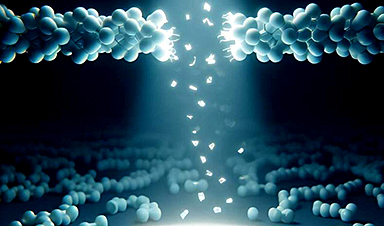
What if recycling plastics were as simple as flicking a switch? At TU/e, Assistant Professor Fabian Eisenreich is making that vision a reality by using LED light to both create and break down a new class of high-performance plastics. This innovative material enables truly circular recycling, as this process can be repeated over and over again, without any loss in quality.
This research, published in the Rising Stars edition of Advanced Materials, marks a breakthrough in sustainable chemistry and could reshape how we treat plastic waste in the future.
“In fact, we are molecular designers,” is how Eisenreich describes himself and his fellow scientists from the Polymer Performance Materials research group. In their labs at the Department of Chemical Engineering and Chemistry, that is what the focus is on.
“Our line of research centers on ‘design for recycling.’ We create new polymers to enable innovative recycling strategies for plastics. At the same time, we use organic (bio-based) materials, avoid toxic substances, and minimize waste to keep the entire process as sustainable as possible.”
Quality of polymer chains deteriorates
These polymers are developed to enable chemical closed-loop recycling, the ultimate goal of the research group. “Plastics typically consist of moldable polymer chains. Due to the current way in which plastics are usually recycled—in a nutshell: heating, melting, and reshaping—the quality of those polymer chains deteriorates over time. So you can’t keep doing that indefinitely, which means that new plastic will eventually have to be made anyway.”
Chemical closed-loop recycling is therefore the ideal alternative, according to Eisenreich. “With the right chemical reaction, a polymer chain can be selectively broken down into its original building blocks. These can then be reused to make exactly the same polymer again, with identical properties and quality.” Achieving this requires polymers designed to undergo that precise reaction—hence the focus of the Polymer Performance Materials group’s research.
Selectively splitting a polymer with light
Within that context, Eisenreich specifies his own research on photochemical recycling, powered by LED light. “Making polymers by means of light is relatively simple. But breaking and making them again in the same way, aka recycling, is much more complicated and therefore a whole new line of research. The challenge lies in using light to selectively split stable chemical bonds within the polymer, so the original building blocks can be recovered.”
Recently, Eisenreich and Ahsen Sare Yalin, a third-year Ph.D. candidate in his group, became the first to successfully pull off this trick in his lab.
Reshape the way we deal with plastic waste
“We see it as a breakthrough in sustainable chemistry that can reshape the way we deal with plastic waste in the future,” says Eisenreich. “At the moment, our designer polymer is still a niche material and therefore not suitable for everyday plastic applications. Instead, it is aimed at specialized uses, for example, as a recyclable adhesive that binds strongly to glass and other plastics.”
Ultimately, further development should broaden the application possibilities. Moreover, Eisenreich sees plenty of potential in closed-loop recycling technology with light. “I also work on 3D printing recyclable polymers using light, which is a very interesting process. You start with a liquid material that takes on a solid form as soon as light falls on it. You can use this process to print complex 3D objects.”
His goal is to one day realize photochemical recycling of traditional plastics with only sunlight. “Then you don’t need any other energy source, how cool would that be?” Eisenreich’s chemical breakthrough is therefore not only shining new light on plastic recycling, but also on his entire field. “This is not just a new material. It’s a new way forward.”
More information: Ahsen Sare Yalin et al, A Light‐Driven Closed‐Loop Chemical Recycling System for Polypinacols, Advanced Materials (2025). DOI: 10.1002/adma.202506733
Journal information: Advanced Materials
Provided by Eindhoven University of Technology

News
Scientists Just Overturned a 100-Year-Old Belief About Bacteria in the Lungs
New findings raise questions about the role of microbes living in the lungs. More than 35 trillion bacteria live throughout the human body, forming microbiomes in the gut, mouth, lungs, skin, and urogenital tract. [...]
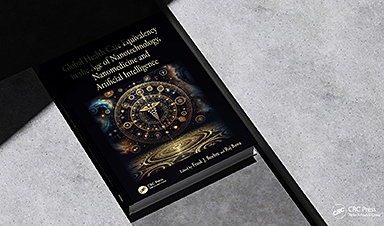
GHCE Concept
From the preface of the book Global Health Care Equivalency in the Age of Nanotechnology, Nanomedicine and Artificial Intelligence, Edited by Frank Boehm: Since the publication of my first book (Nanomedical Device and Systems [...]
Novartis, Ionis drug failure spurs questions
Pelacarsen didn’t protect heart health despite lowering levels of a protein particle, “Lp(a),” in a large clinical trial — a result with important implications for cardiovascular drug research. Dive Brief: An RNA drug from [...]

New injectable treatment helps the brain rebuild after stroke
Biomedical engineers at Duke University have created an injectable biomaterial that may help the brain recover from damage left behind by an ischemic stroke. In experiments with mice, the material transformed the cavity created [...]

Scientists Discover a Hidden “Immune Organ” Inside the Skull
Researchers discovered lymph node-like immune hubs inside skull bone marrow that appear to act as rapid-response centers for the brain. For decades, the brain was thought to operate largely apart from the immune system. [...]
Engineered tRNAs and lipid nanoparticles target nonsense mutation cystic fibrosis
Researchers have developed a potential new approach for treating a form of cystic fibrosis caused by so-called nonsense mutations, combining chemically modified transfer RNAs with lipid nanoparticles designed to deliver the therapy directly to [...]
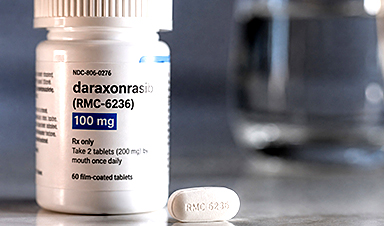
New pancreatic cancer drug carries a $39,800 monthly list price
A groundbreaking treatment for one of the most common forms of pancreatic cancer has been approved in pill form by the FDA. Revolution Medicines’ oral tablet daraxonrasib, branded as Rasonque, reduced the risk of [...]
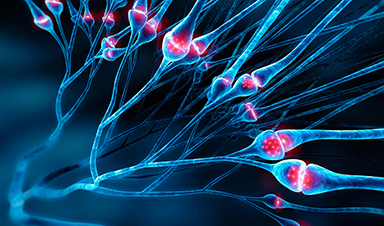
Researchers Have Discovered a New Way To Reduce Chronic Nerve Pain
A cancer-linked protein called BRAF may help drive chronic nerve pain, and existing cancer drugs targeting it reduced pain sensitivity in preclinical models. Chronic nerve pain can persist long after an injury and often [...]
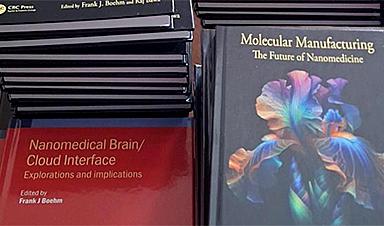
Our books now available worldwide!
Online Sellers other than Amazon, Routledge, and IOPP Indigo Global Health Care Equivalency in the Age of Nanotechnology, Nanomedicine and Artifcial Intelligence Global Health Care Equivalency In The Age Of Nanotechnology, Nanomedicine And Artificial [...]

Quantum-Enabled Regenerative Health: Reimagining Wellness, Precision Health and Longevity Medicine
Introduction Healthcare is approaching a frontier where the quantum portfolio could influence not only how disease is diagnosed and treated, but how health itself is measured, modeled, predicted and preserved. Quantum computing, quantum simulation, [...]

FDA Clears First-of-Its-Kind Nonmedication Treatment for PTSD
The FDA has cleared a system that uses brain activity data to personalize magnetic stimulation for PTSD, adding a new nonmedication treatment option. Every day in the United States, approximately 17.5 veterans die by suicide, [...]
FDA approves breakthrough drug to treat advanced pancreatic cancer
The Food and Drug Administration (FDA) approved on Wednesday a drug that could extend the survival of those with metastatic pancreatic cancer. The drug, called daraxonrasib, will be sold under the brand name Rasonque [...]

AI Decodes a Hidden DNA Signal Linked to Disease-Causing Mutations
Machine learning identifies the likely “initiator” and enables new predictions about DNA mutations that can cause disease. Every human cell depends on tens of thousands of genes being switched on at the right time [...]

Pope Leo Urges Global Response to Congo’s Deadliest Ebola Outbreak
Pope Leo called for international action to address the Ebola outbreak in the Democratic Republic of Congo. The epidemic has claimed over 2,500 lives and is the nation's largest recorded outbreak. The Pope emphasized [...]

Is there a summer COVID-19 surge this year? Yep, it’s ramping up again
Hantavirus. Ebola. West Nile. Measles. And, of course, cyclospora — that stomach parasite making people miserable across the country. Americans have plenty to worry about this summer. But remember COVID-19? It may not be [...]
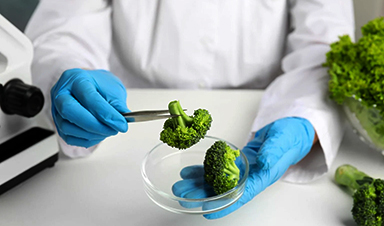
Natural Compound in Broccoli Could Help Treat a Rare, Incurable Neurological Disease
Swinburne researchers have discovered how broccoli could help treat an extremely rare and incurable disease that affects only about 200 Australians. A naturally occurring compound in broccoli is being investigated as a possible treatment [...]