A tiny robot that can travel deep into the lungs to detect and treat the first signs of cancer has been developed by researchers at the University of Leeds.
The ultra-soft tentacle, which measures just 2 millimeters in diameter and is controlled by magnets, can reach some of the smallest bronchial tubes and could transform the treatment of lung cancer.
It paves the way for a more accurate, tailored, and far less invasive approach to treatment and has been developed by engineers, scientists, and clinicians based at the STORM Lab in Leeds.
Superior Accuracy, Reduced Tissue Damage
The researchers tested the magnetic tentacle robot on the lungs of a cadaver and found that it can travel 37% deeper than the standard equipment and leads to less tissue damage.
The results of their investigations, which were funded by the European Research Council, are published today (July 27) in Nature Engineering Communications.
Professor Pietro Valdastri, Director of the STORM Lab and research supervisor, said: “This is a really exciting development.
“This new approach has the advantage of being specific to the anatomy, softer than the anatomy, and fully-shape controllable via magnetics. These three main features have the potential to revolutionize navigation inside the body.”
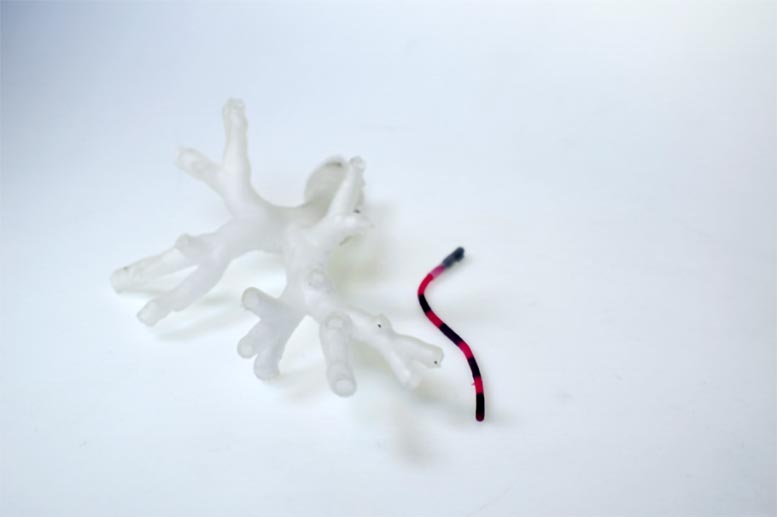
A close-up of the phantom lung and the magnetic tentacle robot. Credit: STORM Lab, University of Leeds
Addressing the Lung Cancer Challenge
Lung cancer has the highest worldwide cancer mortality rate. In early-stage non-small cell lung cancer, which accounts for around 84% of cases, surgical intervention is the standard of care. However, this is typically highly invasive and leads to the significant removal of tissue. This approach is not suitable for all patients and can have an impact on lung function.
Lung cancer screening programs have led to better survival rates but have also highlighted the urgent need to find non-invasive ways to diagnose and treat patients early.
The Future of Biopsies and Treatments
As well as improving navigation within the lungs during biopsies, the magnetic tentacle robot could pave the way for far less invasive treatment, allowing clinicians to target only malicious cells while allowing healthy tissue and organs to continue normal function.
The report’s co-author, Dr Giovanni Pittiglio, who carried out the research while conducting his PHD at the University of Leeds’s School of Electronic and Electrical Engineering, added: “Our goal was, and is, to bring curative aid with minimal pain for the patient.
“Remote magnetic actuation enabled us to do this using ultra-soft tentacles which can reach deeper, while shaping to the anatomy and reducing trauma.”
The team will now set about collecting all the data that will allow them to start human trials.
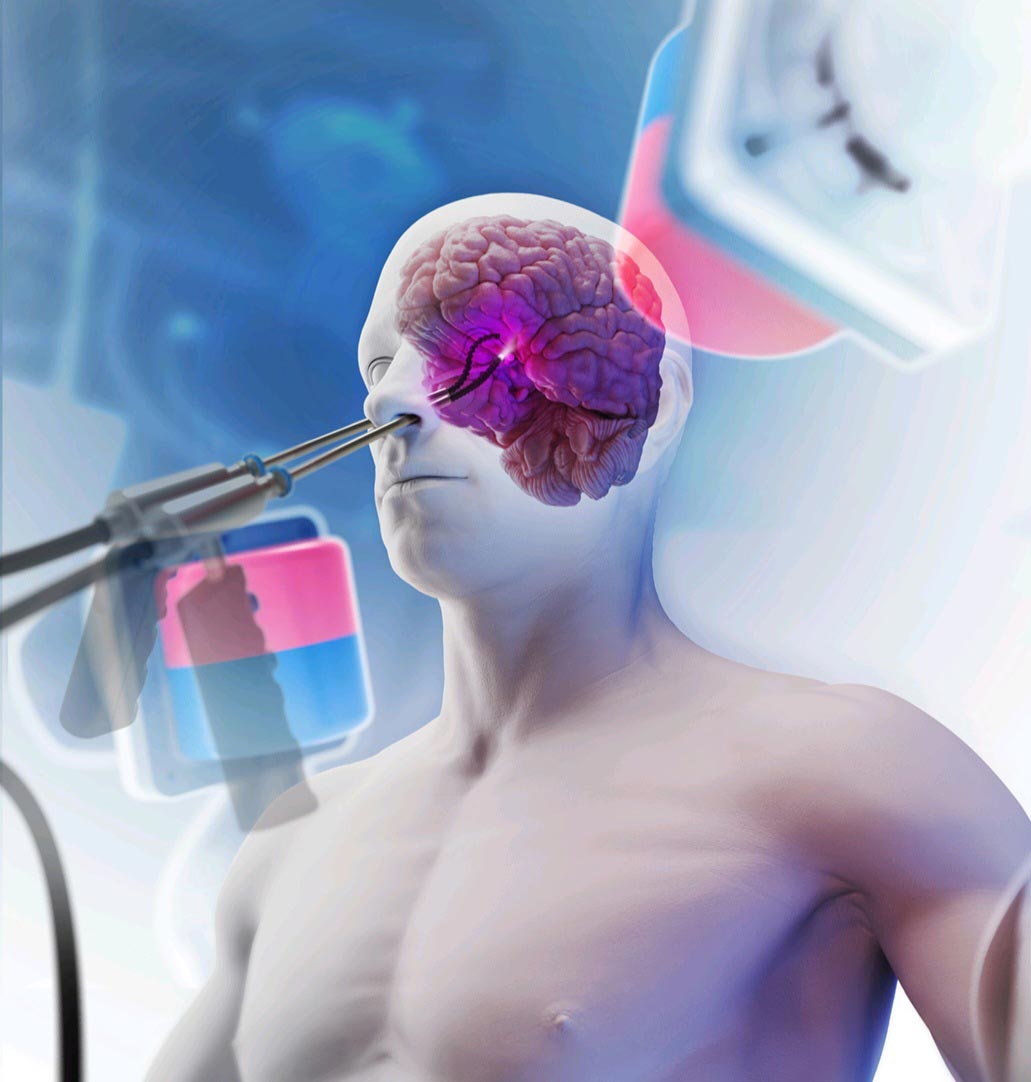
First demonstration of bimanual magnetic soft robots for skull-base surgery. Credit: STORM Lab, University of Leeds
Collaborative Magnetic Tentacle Robots for Brain Surgery
Researchers at the STORM Lab have also been investigating ways of controlling two independent magnetic robots so that they can work together in a confined area of the human anatomy, allowing one to move a camera and the other to control a laser to remove tumors.
The devices are made of silicone to minimize tissue damage and are steered by magnets mounted on robotic arms outside the patient’s body.
Using a replica of a skull, the team successfully trialed the use of two robots to carry out endonasal brain surgery, a technique that allows a surgeon to go through the nose to operate on areas at the front of the brain and the top of the spine.
The researchers needed the magnetic robots to move independently of each other so that one could move the camera, while the other could direct a laser onto a tumor.
Overcoming Magnetic Interference
Normally, two magnets placed closely together would attract each other, creating a challenge for the researchers. They overcame it by designing the bodies of the tentacles in a way that they can bend only in specific directions and by relocating the north and south poles in each magnetic robot tentacle.
They were then able to simulate the removal of a benign tumor on the pituitary gland at the base of the cranium, proving for the first time ever that it is possible to control two of the robots in one confined area of the body.
The findings of their research, which was jointly funded by the European Research Council and the Physical Sciences Research Council, are published today (July 27) in Advanced Intelligent Systems.
The paper’s lead author, Zaneta Koszowska, a researcher at the University of Leeds School of Electronic and Electrical Engineering, said: “This is a significant contribution to the field of magnetically controlled robotics.
“Our findings show that diagnostic procedures with a camera, as well as full surgical procedures, can be performed in small anatomical spaces.”
References:
“Magnetic personalized tentacles for targeted photothermal cancer therapy in peripheral lungs” 27 July 2023, Nature Engineering Communications.
DOI: 10.1038/s44172-023-00098-9
“Independently Actuated Soft Magnetic Manipulators for 2 Bimanual Operations in Confined Anatomical Cavities” 27 July 2023, Advanced Intelligent Systems.
DOI: 10.1002/aisy.202300062
Funding: Engineering and Physical Sciences Research Council and HORIZON EUROPE European Research Council

News

Scientists Find a Berry Compound That Helps Muscle Cells Burn Fat
Pterostilbene, a compound found naturally in some foods, affects how skeletal muscles process fats by stabilizing a protein called PPARδ and increasing its signaling activity. Pterostilbene, a natural compound found in blueberries, grapes, and [...]
Two Hidden Forces Help Build the Human Brain Before Birth
Scientists have uncovered two surprising forces that help guide how the human brain forms before birth. Before birth, the human brain is shaped in large part by an unusual class of stem cells known [...]

Researchers Uncover a Hidden Trigger Behind Chronic Inflammation
The findings offer new insights that could help guide the development of future therapies. A protein called human resistin may help flip on one of the immune system’s most powerful inflammatory switches. Researchers at [...]

Scientists Have Uncovered Previously Hidden Microbial Activity on Human Skin
The most abundant microbes on your skin may not be the ones doing most of the work. Human skin supports vast communities of bacteria, fungi, and viruses that can influence its protective barrier, immune [...]

Brazilian Tree Compounds Fight COVID-19 on Multiple Fronts
Scientists found compounds in a Brazilian tree that hit SARS-CoV-2 on multiple fronts, revealing a promising new lead in the search for COVID-19 treatments. Researchers have found that galloylquinic acids extracted from the leaves [...]

Cutting Two Amino Acids Slowed Prostate Cancer in Mice
A newly identified link between amino acid metabolism and cholesterol production may help prostate tumors adapt to hormone therapy. Prostate cancer can find ways around treatments designed to deprive tumors of the hormones they [...]

Largest-Ever Physics Survey Raises New Doubts About Our Model of the Universe
Physicists around the world remain deeply divided on key mysteries of the universe, from dark matter to quantum gravity. The standard cosmological model failed to gain majority support, and no leading theory dominated the [...]

Scientists Just Overturned a 100-Year-Old Belief About Bacteria in the Lungs
New findings raise questions about the role of microbes living in the lungs. More than 35 trillion bacteria live throughout the human body, forming microbiomes in the gut, mouth, lungs, skin, and urogenital tract. [...]

GHCE Concept
From the preface of the book Global Health Care Equivalency in the Age of Nanotechnology, Nanomedicine and Artificial Intelligence, Edited by Frank Boehm: Since the publication of my first book (Nanomedical Device and Systems [...]

Novartis, Ionis drug failure spurs questions
Pelacarsen didn’t protect heart health despite lowering levels of a protein particle, “Lp(a),” in a large clinical trial — a result with important implications for cardiovascular drug research. Dive Brief: An RNA drug from [...]
New injectable treatment helps the brain rebuild after stroke
Biomedical engineers at Duke University have created an injectable biomaterial that may help the brain recover from damage left behind by an ischemic stroke. In experiments with mice, the material transformed the cavity created [...]

Scientists Discover a Hidden “Immune Organ” Inside the Skull
Researchers discovered lymph node-like immune hubs inside skull bone marrow that appear to act as rapid-response centers for the brain. For decades, the brain was thought to operate largely apart from the immune system. [...]

Engineered tRNAs and lipid nanoparticles target nonsense mutation cystic fibrosis
Researchers have developed a potential new approach for treating a form of cystic fibrosis caused by so-called nonsense mutations, combining chemically modified transfer RNAs with lipid nanoparticles designed to deliver the therapy directly to [...]

New pancreatic cancer drug carries a $39,800 monthly list price
A groundbreaking treatment for one of the most common forms of pancreatic cancer has been approved in pill form by the FDA. Revolution Medicines’ oral tablet daraxonrasib, branded as Rasonque, reduced the risk of [...]
Researchers Have Discovered a New Way To Reduce Chronic Nerve Pain
A cancer-linked protein called BRAF may help drive chronic nerve pain, and existing cancer drugs targeting it reduced pain sensitivity in preclinical models. Chronic nerve pain can persist long after an injury and often [...]

Our books now available worldwide!
Online Sellers other than Amazon, Routledge, and IOPP Indigo Global Health Care Equivalency in the Age of Nanotechnology, Nanomedicine and Artifcial Intelligence Global Health Care Equivalency In The Age Of Nanotechnology, Nanomedicine And Artificial [...]