Signals are processed only if they reach the brain during brief receptive cycles. This timing mechanism explains how attention filters information and may inform therapies and brain-inspired technologies.
It has long been recognized that the brain gives priority to the information we direct our attention toward. A well-known example is the cocktail party effect.
"In an environment full of voices, music, and background noise, the brain manages to concentrate on a single voice. The other noises are not objectively quieter, but are perceived less strongly at that moment," explains Dr. Eric Drebitz, a brain researcher at the University of Bremen.
In such cases, the brain channels its processing power toward the most relevant input—like the voice of a conversation partner—while other sounds are still registered but not processed as deeply.
Drebitz: "Until now, it was unclear how this survival-critical mechanism of selecting relevant information is controlled. When you cross a street and a car suddenly appears from the side, the brain immediately focuses its processing on this one piece of visual information – the movement of the vehicle. Other impressions, such as signs, passersby, or billboards, fade into the background as they distract our attention and slow down our reaction. It is only through this targeted prioritization that we are able to react quickly and take evasive action."
Timing: The Key to Information Processing
A research team led by neuroscientists Andreas Kreiter and Eric Drebitz has now delivered the first causal evidence for how the brain selects and processes important information.
"Whether a signal is processed further in the brain depends crucially on whether it arrives at the right moment – during a short phase of increased receptivity of the nerve cells," explains Drebitz. "Nerve cells do not function continuously, but in rapid cycles. They are highly active and receptive for just a few milliseconds, followed by a period of lower activity and responsiveness. This cycle repeats roughly every 10 to 20 milliseconds. Only when a signal arrives just before the peak of this active phase does it alter neuronal behavior."
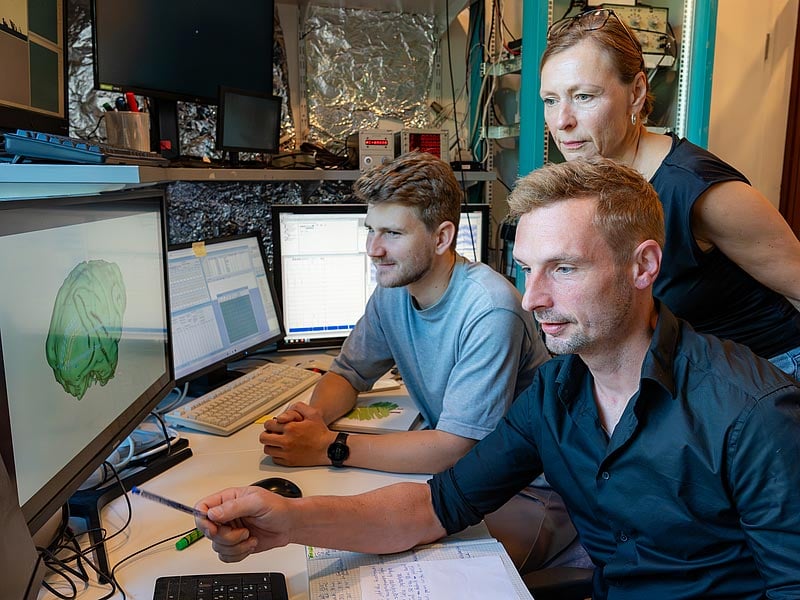
This precise timing is the core principle of information processing. Attention takes advantage of this mechanism by adjusting the rhythm of nerve cells so that relevant signals reach them within the receptive window, while irrelevant signals are filtered out.
In order to prove the cause of this fundamental mechanism of our brain, selective stimulus transmission was studied in rhesus monkeys – a species that is very similar to humans in the organization of the cerebral cortex. The animals performed a visual task on a screen while very weak electrical stimuli were generated in an early section of the visual processing pathway (area V2). These artificial signals were unrelated to the task and served solely as test stimuli. The team then analyzed how these signals affected a downstream area (area V4).
"The artificially triggered signals only influenced the activity of the nerve cells in V4 when they arrived during a short phase of increased receptivity. If the same signal arrived too early or too late, it had no effect. If it arrived within the sensitive time window, it not only changed the activity of the nerve cells, but also the behavior of the animals: they reacted more slowly and made more mistakes – from which it can be concluded that the test signal, which contained no information for the task, became part of the processing and thus interfered with the performance of the actual task," explains Drebitz.
Important for Understanding the Brain and Treating Alzheimer's and ADHD
"The results provide a basis for developing more precise models of the brain. They show how information is selected and prioritized before it leads to perception, learning, and behavior," says Drebitz. However, this knowledge is not only important for foundation research, but also for the field of medicine, "since diseases such as Alzheimer's and ADHD are associated with problems in the selective processing and storage of relevant information. And also for new technologies such as brain-computer interfaces that communicate directly with the brain." For such systems to work reliably, they must feed in information at precisely timed intervals and correctly read the nerve cell patterns. The development of artificial intelligence (AI) could also benefit from these principles, as they could serve as a template for particularly flexible and efficient processing.
Reference: "Gamma-band synchronization between neurons in the visual cortex is causal for effective information processing and behavior" by Eric Drebitz, Lukas-Paul Rausch and Andreas K. Kreiter, 11 August 2025, Nature Communications.
DOI: 10.1038/s41467-025-62732-8
Never miss a breakthrough: Join the SciTechDaily newsletter.

News

Back and shoulder surgery is often worse than useless
Millions of operations should be scrapped SIX IN TEN Britons have surgery at some point. So do lots of Americans, at a cost of perhaps $500bn a year, a third of all spending on [...]
Cocaine plays with mind, hijacks brain circuit, drives increasingly rigid and repetitive behavior
Researchers have found that cocaine hijacks brain circuit, which to drive increasingly rigid and repetitive behavior. The brain circuit that normally participates in selecting natural mouth and face movements, but which becomes disproportionately engaged [...]
Injectable nanodevices could provide effective treatment for drug-resistant glioblastoma
The brain cancer glioblastoma is one of the most aggressive and treatment-resistant cancers known to medicine, carrying a median survival of just 12-15 months, even with the best available care. Now, researchers at the [...]
New Treatment Cuts “Bad” Cholesterol in Half for a Full Year
A single infusion of an experimental CRISPR-Cas9 therapy was reported to safely lower LDL cholesterol by 52.5% and triglycerides by 47.8%, as measured 12 months after treatment. What if one infusion could keep cholesterol [...]
Too Much RNA Can Drain a Cell’s Energy, Scientists Discover
A virus may cripple a cell’s power supply simply by producing too much of a molecule the cell needs to survive. New research from the Texas A&M College of Veterinary Medicine and Biomedical Sciences [...]

West African scientists warn of weakening health systems and urge stronger outbreak detection
LOME, Togo (AP) — West African laboratory scientists called on governments Friday to strengthen capacity to detect disease outbreaks to avoid another major outbreak, saying health systems across the region are becoming weaker. Participants [...]

A Little-Known Protein Could Point to a New Way To Treat Alzheimer’s
A study suggests that increasing SORLA protein levels could help treat Alzheimer’s disease and other disorders involving tau protein. Increasing SORLA, a protein with a protective role in the brain, helped mice withstand damage [...]
Cancer’s Hidden Antioxidant Shield Helps It Escape the Immune System
Blocking an antioxidant protein that tumors use to suppress immune attacks improved cancer immunotherapy responses in mice. Cancer cells can release antioxidants that interfere with the immune cells trying to kill them. Researchers have [...]

Scientists Find a Berry Compound That Helps Muscle Cells Burn Fat
Pterostilbene, a compound found naturally in some foods, affects how skeletal muscles process fats by stabilizing a protein called PPARδ and increasing its signaling activity. Pterostilbene, a natural compound found in blueberries, grapes, and [...]
Two Hidden Forces Help Build the Human Brain Before Birth
Scientists have uncovered two surprising forces that help guide how the human brain forms before birth. Before birth, the human brain is shaped in large part by an unusual class of stem cells known [...]
Researchers Uncover a Hidden Trigger Behind Chronic Inflammation
The findings offer new insights that could help guide the development of future therapies. A protein called human resistin may help flip on one of the immune system’s most powerful inflammatory switches. Researchers at [...]
Scientists Have Uncovered Previously Hidden Microbial Activity on Human Skin
The most abundant microbes on your skin may not be the ones doing most of the work. Human skin supports vast communities of bacteria, fungi, and viruses that can influence its protective barrier, immune [...]
Brazilian Tree Compounds Fight COVID-19 on Multiple Fronts
Scientists found compounds in a Brazilian tree that hit SARS-CoV-2 on multiple fronts, revealing a promising new lead in the search for COVID-19 treatments. Researchers have found that galloylquinic acids extracted from the leaves [...]
Cutting Two Amino Acids Slowed Prostate Cancer in Mice
A newly identified link between amino acid metabolism and cholesterol production may help prostate tumors adapt to hormone therapy. Prostate cancer can find ways around treatments designed to deprive tumors of the hormones they [...]
Largest-Ever Physics Survey Raises New Doubts About Our Model of the Universe
Physicists around the world remain deeply divided on key mysteries of the universe, from dark matter to quantum gravity. The standard cosmological model failed to gain majority support, and no leading theory dominated the [...]
Scientists Just Overturned a 100-Year-Old Belief About Bacteria in the Lungs
New findings raise questions about the role of microbes living in the lungs. More than 35 trillion bacteria live throughout the human body, forming microbiomes in the gut, mouth, lungs, skin, and urogenital tract. [...]