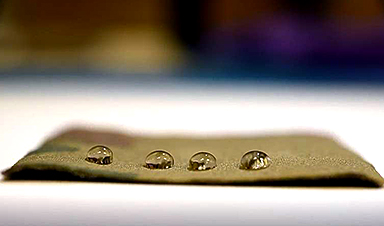
A new material developed by researchers from University of Toronto Engineering could offer a safer alternative to the nonstick chemicals commonly used in cookware and other applications.
The new substance repels both water and grease about as well as standard nonstick coatings—but it contains much lower amounts of per- and polyfluoroalkyl substances (PFAS), a family of chemicals that have raised environmental and health concerns.
“The research community has been trying to develop safer alternatives to PFAS for a long time,” says Professor Kevin Golovin, who heads the Durable Repellent Engineered Advanced Materials (DREAM) Laboratory at U of T Engineering.
“The challenge is that while it’s easy to create a substance that will repel water, it’s hard to make one that will also repel oil and grease to the same degree. Scientists had hit an upper limit to the performance of these alternative materials.”
Since its invention in the late 1930s, Teflon—also known as polytetrafluoroethylene or PTFE—has become famous for its ability to repel water, oil and grease alike. Teflon is part of a larger family of substances known as per- and polyfluoroalkyl substances (PFAS).
PFAS molecules are made of chains of carbon atoms, each of which is bonded to several fluorine atoms. The inertness of carbon-fluorine bonds is responsible for the nonstick properties of PFAS.
However, this chemical inertness also causes PFAS to resist the normal processes that would break down other organic molecules over time. For this reason, they are sometimes called ‘forever chemicals.’
In addition to their persistence, PFAS are known to accumulate in biological tissues, and their concentrations can become amplified as they travel up the food chain.
Various studies have linked exposure to high levels of PFAS to certain types of cancer, birth defects and other health problems, with the longer chain PFAS generally considered more harmful than the shorter ones.
Despite the risks, the lack of alternatives means that PFAS remain ubiquitous in consumer products: they are widely used not only in cookware, but also in rain-resistant fabrics, food packaging and even in makeup.
“The material we’ve been working with as an alternative to PFAS is called polydimethylsiloxane or PDMS,” says Golovin.
“PDMS is often sold under the name silicone, and depending on how it’s formulated, it can be very biocompatible—in fact it’s often used in devices that are meant to be implanted into the body. But until now, we couldn’t get PDMS to perform quite as well as PFAS.”
To overcome this problem, Ph.D. student Samuel Au developed a new chemistry technique that the team is calling nanoscale fletching. The technique is described in a paper published in Nature Communications.
“Unlike typical silicone, we bond short chains of PDMS to a base material—you can think of them like bristles on a brush,” says Au.
“To improve their ability to repel oil, we have now added in the shortest possible PFAS molecule, consisting of a single carbon with three fluorines on it. We were able to bond about seven of those to the end of each PDMS bristle.
“If you were able to shrink down to the nanometer scale, it would look a bit like the feathers that you see around the back end of an arrow, where it notches to the bow. That’s called fletching, so this is nanoscale fletching.”
Au and the team coated their new material on a piece of fabric, then placed drops of various oils on it to see how well it could repel them. On a scale developed by the American Association of Textile Chemists and Colorists, the new coating achieved a grade of 6, placing it on par with many standard PFAS-based coatings.
“While we did use a PFAS molecule in this process, it is the shortest possible one and therefore does not bioaccumulate,” says Golovin.
“What we’ve seen in the literature, and even in the regulations, is that it’s the longest-chain PFAS that are getting banned first, with the shorter ones considered much less harmful. Our hybrid material provides the same performance as what had been achieved with long-chain PFAS, but with greatly reduced risk.”
Golovin says that the team is open to collaborating with manufacturers of nonstick coatings who might wish to scale up and commercialize the process. In the meantime, they will continue working on even more alternatives.
“The holy grail of this field would be a substance that outperforms Teflon, but with no PFAS at all,” says Golovin.
“We’re not quite there yet, but this is an important step in the right direction.”
More information: Samuel Au et al, Nanoscale fletching of liquid-like polydimethylsiloxane with single perfluorocarbons enables sustainable oil-repellency, Nature Communications (2025). DOI: 10.1038/s41467-025-62119-9
Journal information: Nature Communications
Provided by University of Toronto

News

Cutting Two Amino Acids Slowed Prostate Cancer in Mice
A newly identified link between amino acid metabolism and cholesterol production may help prostate tumors adapt to hormone therapy. Prostate cancer can find ways around treatments designed to deprive tumors of the hormones they [...]

Largest-Ever Physics Survey Raises New Doubts About Our Model of the Universe
Physicists around the world remain deeply divided on key mysteries of the universe, from dark matter to quantum gravity. The standard cosmological model failed to gain majority support, and no leading theory dominated the [...]

Scientists Just Overturned a 100-Year-Old Belief About Bacteria in the Lungs
New findings raise questions about the role of microbes living in the lungs. More than 35 trillion bacteria live throughout the human body, forming microbiomes in the gut, mouth, lungs, skin, and urogenital tract. [...]

GHCE Concept
From the preface of the book Global Health Care Equivalency in the Age of Nanotechnology, Nanomedicine and Artificial Intelligence, Edited by Frank Boehm: Since the publication of my first book (Nanomedical Device and Systems [...]

Novartis, Ionis drug failure spurs questions
Pelacarsen didn’t protect heart health despite lowering levels of a protein particle, “Lp(a),” in a large clinical trial — a result with important implications for cardiovascular drug research. Dive Brief: An RNA drug from [...]

New injectable treatment helps the brain rebuild after stroke
Biomedical engineers at Duke University have created an injectable biomaterial that may help the brain recover from damage left behind by an ischemic stroke. In experiments with mice, the material transformed the cavity created [...]

Scientists Discover a Hidden “Immune Organ” Inside the Skull
Researchers discovered lymph node-like immune hubs inside skull bone marrow that appear to act as rapid-response centers for the brain. For decades, the brain was thought to operate largely apart from the immune system. [...]

Engineered tRNAs and lipid nanoparticles target nonsense mutation cystic fibrosis
Researchers have developed a potential new approach for treating a form of cystic fibrosis caused by so-called nonsense mutations, combining chemically modified transfer RNAs with lipid nanoparticles designed to deliver the therapy directly to [...]
New pancreatic cancer drug carries a $39,800 monthly list price
A groundbreaking treatment for one of the most common forms of pancreatic cancer has been approved in pill form by the FDA. Revolution Medicines’ oral tablet daraxonrasib, branded as Rasonque, reduced the risk of [...]

Researchers Have Discovered a New Way To Reduce Chronic Nerve Pain
A cancer-linked protein called BRAF may help drive chronic nerve pain, and existing cancer drugs targeting it reduced pain sensitivity in preclinical models. Chronic nerve pain can persist long after an injury and often [...]

Our books now available worldwide!
Online Sellers other than Amazon, Routledge, and IOPP Indigo Global Health Care Equivalency in the Age of Nanotechnology, Nanomedicine and Artifcial Intelligence Global Health Care Equivalency In The Age Of Nanotechnology, Nanomedicine And Artificial [...]

Quantum-Enabled Regenerative Health: Reimagining Wellness, Precision Health and Longevity Medicine
Introduction Healthcare is approaching a frontier where the quantum portfolio could influence not only how disease is diagnosed and treated, but how health itself is measured, modeled, predicted and preserved. Quantum computing, quantum simulation, [...]

FDA Clears First-of-Its-Kind Nonmedication Treatment for PTSD
The FDA has cleared a system that uses brain activity data to personalize magnetic stimulation for PTSD, adding a new nonmedication treatment option. Every day in the United States, approximately 17.5 veterans die by suicide, [...]

FDA approves breakthrough drug to treat advanced pancreatic cancer
The Food and Drug Administration (FDA) approved on Wednesday a drug that could extend the survival of those with metastatic pancreatic cancer. The drug, called daraxonrasib, will be sold under the brand name Rasonque [...]

AI Decodes a Hidden DNA Signal Linked to Disease-Causing Mutations
Machine learning identifies the likely “initiator” and enables new predictions about DNA mutations that can cause disease. Every human cell depends on tens of thousands of genes being switched on at the right time [...]

Pope Leo Urges Global Response to Congo’s Deadliest Ebola Outbreak
Pope Leo called for international action to address the Ebola outbreak in the Democratic Republic of Congo. The epidemic has claimed over 2,500 lives and is the nation's largest recorded outbreak. The Pope emphasized [...]