The 2025 Nobel Prize in chemistry was awarded to Richard Robson, Susumu Kitagawa and Omar Yaghi on Oct. 8, 2025, for the development of metal-organic frameworks, or MOFs, which are tunable crystal structures with extremely high porosity. These are a class of materials that have truly changed the way scientists design and think about matter, inspiring progress in various applications.
I’m a MOF scientist and for many of us in the field, this recognition feels both historic and deeply personal. MOFs are not just elegant crystals you’d admire under a microscope; they’re an entire universe of structures, each like a miniature city of tunnels and rooms waiting to be filled. They’ve been my scientific home since I first stepped into research, and they still feel a little bit like magic to me.
So, what exactly are MOFs?
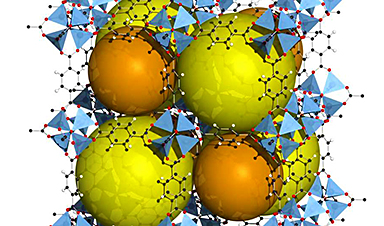
Metal-organic frameworks are like crystalline scaffolds built from two ingredients: metals that act like connective joints and organic—that is, carbon-based—molecules that behave as bridges to link those joints in a repeating pattern. The result is a highly ordered, porous framework—a kind of molecular architecture that’s both sturdy and full of empty space.
These frameworks are so porous, like sponges with tiny voids, that it’s almost impossible to picture them. One gram of a MOF has so many pores that it can expose as much internal surface area as a soccer field. It’s astonishing that a handful of powder could hide an entire landscape of surface within it.
That enormous surface area is one of the unique things that make MOFs so powerful, and it comes from the nanoscale pores—tiny molecular rooms that can trap, separate, transform or transport gases, ions and other molecules. In a way, MOFs are like molecular hotels with countless doors, each programmed to admit only certain guests.
Why scientists love them
What fascinates me most about metal-organic frameworks is their limitless design space. Just by glancing at the periodic table, every metal could, in principle, serve as a cornerstone, and countless organic molecules can act as bridges connecting them. Even using the same combination can produce entirely different architectures.
So far, scientists have synthesized more than 90,000 MOFs, and computational chemists have predicted hundreds of thousands more. Few material families offer this much versatility.
I like to think of MOFs as puzzles or Lego sets, but on the atomic scale. You can replace a single piece, or change its color or shape, and end up with a material that behaves completely differently.
Add a new “decoration”—what chemists call a functional group—and the framework suddenly recognizes a new molecule. Stretch the organic bridges, and the same architecture inflates like a balloon, giving what we call isoreticular MOFs. These have the same structure, but bigger pores. In short, MOFs can come in almost every imaginable shape, size and texture.
Beyond their scientific elegance, MOFs are incredibly promising for real-world technologies. Different structures and functionalities lead to different properties and, therefore, different uses.
Some MOFs act as molecular sieves, selectively capturing carbon dioxide from industrial exhaust or even directly from air. Others clean polluted water by removing heavy metals, dyes or “forever chemicals.”
Certain MOFs can also carry drugs or imaging agents inside the body for medical applications. In the energy world, they function as electrodes or electrolytes that make batteries safer and more efficient. And many serve as catalysts, accelerating chemical reactions that transform one molecule into another.
When I began my Ph.D., my senior colleagues warned me that MOFs might be too delicate—beautiful crystals that would crumble at the first hint of air or moisture. And indeed, some of the early frameworks were fragile curiosities, admired more for their elegance than their endurance. But that perception has changed dramatically.
Many MOFs are now remarkably robust. The material I first worked on was a titanium-based metal-organic framework named MIL-125. It was first reported by Gérard Férey, one of the foundational figures in the MOF and porous framework community who sadly died in 2017. MIL-125 was not only stable, it was practically indestructible in my lab. After synthesizing two grams of it, I stored it on my bench in an open vial and used that same batch for every catalytic experiment throughout my Ph.D. No glovebox, no desiccator—just a jar of yellow powder sitting happily on my bench.
That experience taught me something important: While stability can be a legitimate concern, MOFs have grown up. Thanks to smart chemistry, we have materials that can withstand water, heat and repeated use. Since their foundation, researchers around the world have introduced new properties to these materials—from electrical conductivity to light responsiveness—and, crucially, made major progress in scaling up MOF synthesis for industrial applications.
Scaling is the key step in bridging the gap between fundamental discovery and large-scale deployment. Researchers are no longer content with studying MOFs in milligrams—we’re often planning for grams, kilograms and beyond.
Some startups are turning these advances into real technologies—from storing gases more safely, to pulling clean water straight from desert air, to building more energy-efficient air conditioners. What once felt like science fiction—powders that breathe, trap and transform molecules—is now science fact.
Despite these advances, researchers will need to continue improving the stability and scalability of MOFs to fully realize these materials’ potential in the real world.
A Nobel moment that honors creativity
The 2025 Nobel Prize in chemistry goes beyond honoring three remarkable scientists—it celebrates an entire community: a generation of chemists and engineers who transformed a single idea into a thriving field. The pioneering visions of Richard Robson, Susumu Kitagawa and Omar Yaghi laid the foundations for a vibrant discipline that has grown to encompass everything from gas storage and catalysis to energy and environmental technologies.
When I attended my first MOF conference as a second-year Ph.D. student, I listened in awe to many of the pioneers of this field, some of whom are now Nobel laureates. Back then, MOFs felt like magical sponges, and that sense of wonder never left me. It led me to continue my research on conductive MOFs: materials that can carry electricity. Now, in my own research group, we study how these frameworks can make batteries safer and more efficient, and how they can capture waste gases and turn them into useful chemicals using sunlight.
For me, this Nobel Prize celebrates more than a discovery, it celebrates a philosophy: Chemistry is creative, we can design and engineer matter with imagination, and sometimes emptiness can be the very essence of a material.
Provided by The Conversation
This article is republished from The Conversation under a Creative Commons license. Read the original article.

News
Cutting Two Amino Acids Slowed Prostate Cancer in Mice
A newly identified link between amino acid metabolism and cholesterol production may help prostate tumors adapt to hormone therapy. Prostate cancer can find ways around treatments designed to deprive tumors of the hormones they [...]

Largest-Ever Physics Survey Raises New Doubts About Our Model of the Universe
Physicists around the world remain deeply divided on key mysteries of the universe, from dark matter to quantum gravity. The standard cosmological model failed to gain majority support, and no leading theory dominated the [...]

Scientists Just Overturned a 100-Year-Old Belief About Bacteria in the Lungs
New findings raise questions about the role of microbes living in the lungs. More than 35 trillion bacteria live throughout the human body, forming microbiomes in the gut, mouth, lungs, skin, and urogenital tract. [...]

GHCE Concept
From the preface of the book Global Health Care Equivalency in the Age of Nanotechnology, Nanomedicine and Artificial Intelligence, Edited by Frank Boehm: Since the publication of my first book (Nanomedical Device and Systems [...]

Novartis, Ionis drug failure spurs questions
Pelacarsen didn’t protect heart health despite lowering levels of a protein particle, “Lp(a),” in a large clinical trial — a result with important implications for cardiovascular drug research. Dive Brief: An RNA drug from [...]

New injectable treatment helps the brain rebuild after stroke
Biomedical engineers at Duke University have created an injectable biomaterial that may help the brain recover from damage left behind by an ischemic stroke. In experiments with mice, the material transformed the cavity created [...]

Scientists Discover a Hidden “Immune Organ” Inside the Skull
Researchers discovered lymph node-like immune hubs inside skull bone marrow that appear to act as rapid-response centers for the brain. For decades, the brain was thought to operate largely apart from the immune system. [...]

Engineered tRNAs and lipid nanoparticles target nonsense mutation cystic fibrosis
Researchers have developed a potential new approach for treating a form of cystic fibrosis caused by so-called nonsense mutations, combining chemically modified transfer RNAs with lipid nanoparticles designed to deliver the therapy directly to [...]

New pancreatic cancer drug carries a $39,800 monthly list price
A groundbreaking treatment for one of the most common forms of pancreatic cancer has been approved in pill form by the FDA. Revolution Medicines’ oral tablet daraxonrasib, branded as Rasonque, reduced the risk of [...]

Researchers Have Discovered a New Way To Reduce Chronic Nerve Pain
A cancer-linked protein called BRAF may help drive chronic nerve pain, and existing cancer drugs targeting it reduced pain sensitivity in preclinical models. Chronic nerve pain can persist long after an injury and often [...]
Our books now available worldwide!
Online Sellers other than Amazon, Routledge, and IOPP Indigo Global Health Care Equivalency in the Age of Nanotechnology, Nanomedicine and Artifcial Intelligence Global Health Care Equivalency In The Age Of Nanotechnology, Nanomedicine And Artificial [...]

Quantum-Enabled Regenerative Health: Reimagining Wellness, Precision Health and Longevity Medicine
Introduction Healthcare is approaching a frontier where the quantum portfolio could influence not only how disease is diagnosed and treated, but how health itself is measured, modeled, predicted and preserved. Quantum computing, quantum simulation, [...]

FDA Clears First-of-Its-Kind Nonmedication Treatment for PTSD
The FDA has cleared a system that uses brain activity data to personalize magnetic stimulation for PTSD, adding a new nonmedication treatment option. Every day in the United States, approximately 17.5 veterans die by suicide, [...]

FDA approves breakthrough drug to treat advanced pancreatic cancer
The Food and Drug Administration (FDA) approved on Wednesday a drug that could extend the survival of those with metastatic pancreatic cancer. The drug, called daraxonrasib, will be sold under the brand name Rasonque [...]

AI Decodes a Hidden DNA Signal Linked to Disease-Causing Mutations
Machine learning identifies the likely “initiator” and enables new predictions about DNA mutations that can cause disease. Every human cell depends on tens of thousands of genes being switched on at the right time [...]

Pope Leo Urges Global Response to Congo’s Deadliest Ebola Outbreak
Pope Leo called for international action to address the Ebola outbreak in the Democratic Republic of Congo. The epidemic has claimed over 2,500 lives and is the nation's largest recorded outbreak. The Pope emphasized [...]