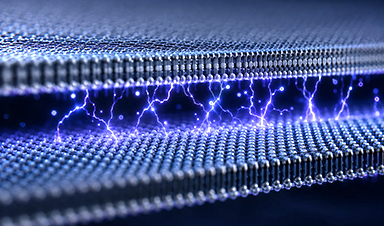
Controlled electrical discharges could enable triboelectric nanogenerators to achieve higher peak currents, extending nano-enabled energy harvesting into chemical processing and self-powered sensing.
Paper: Electrostatic discharge as a breakthrough strategy for triboelectric nanogenerators.
A new review published in the journal Communications Materials explores how electrostatic discharge (ESD) can help address long-standing performance limitations in triboelectric nanogenerators (TENGs). The review highlights how ESD enables current amplification through the electron avalanche effect while also allowing direct-current (DC) generation in specific device architectures. It also summarizes recent advances in ESD-based TENG architectures and emerging applications in chemical decontamination, nitrogen fixation, ammonia synthesis, and gas sensing.
Overcoming the Limitations of Conventional Triboelectric Nanogenerators
Triboelectric nanogenerators (TENGs) have emerged as promising devices for sustainable energy harvesting. They convert mechanical energy from everyday activities, such as motion, vibration, and airflow, into electrical energy. Their lightweight design, broad material compatibility, and ability to operate under low-frequency mechanical motion make them well-suited for wearable electronics, wireless sensors, and Internet of Things (IoT) devices.
Despite these advantages, conventional TENGs still face significant challenges. Most devices generate alternating current (AC) with outputs limited to the nanoampere or microampere range. Many electronic systems, however, are designed for DC power and require higher usable current levels for reliable operation. Researchers have increased surface charge density to boost device performance, but conventional devices still generally produce low current outputs. As a result, large-scale commercialization of TENGs has remained challenging.
This review explores a different strategy that deliberately uses controlled electrostatic discharge (ESD) instead of suppressing it. Although ESD is traditionally viewed as harmful because sudden electrical discharges can damage electronic components, controlled ESD can dramatically increase peak current output while generating DC-based output in some architectures. It also highlights how this strategy expands potential TENG applications beyond energy harvesting into chemical removal, fertilizer production, and self-powered sensing technologies.
Exploring Electrostatic Discharge Across TENG Designs
The authors provide a comprehensive overview of recent advances in ESD-based triboelectric nanogenerators, focusing on device design, operating mechanisms, electrical performance, and emerging applications. This broad assessment illustrates how electrostatic discharge can significantly improve TENG performance.
The first section of the review explains the mechanism behind ESD-assisted energy generation. When a strong electric field develops across a small air gap, it ionizes nearby gas molecules, creating a conductive channel. The resulting electron avalanche rapidly multiplies charge carriers, producing a much higher current than conventional triboelectric devices. The temporary air gap also serves as an electrical switch, enabling several TENG designs to generate direct current rather than alternating current.
The authors classified ESD-based TENGs into three major categories: contact-separation devices, sliding-mode devices, and complex architectures that incorporate additional electrical components or approaches for analyzing ESD phenomena. They also summarized applications that use ESD-generated microplasma and ionization for chemical removal, nitrogen fixation for fertilizer production, ammonia synthesis, and gas sensing.
Electrostatic Discharge Significantly Expands TENG Performance
The review summarizes studies in which electrostatic discharge can substantially alter the electrical output characteristics of triboelectric nanogenerators. The electron avalanche triggered by ESD amplifies electrical current from the microampere range to the milliampere or even ampere range, potentially addressing one of the key limitations of conventional TENGs.
Another major advantage of ESD-based TENGs is their ability to generate direct current. In several contact-separation and sliding-mode designs, the temporary air gap acts as an electrical switch, preventing reverse charge flow during operation. Some designs can therefore produce DC-based output without external rectifier circuits, although the resulting signals may still consist of short, high-current pulses. This capability may improve compatibility with practical electronic systems, although power-management circuits remain necessary to match the high-impedance output with conventional electronics.
The review also reports substantial performance improvements across different device architectures. One contact-separation design produced DC peak power of about 1.83 mW, while ion-enhanced field-emission TENGs produced peak currents of 100–250 mA and delivered 635% higher average power than conventional devices. Sliding-mode systems achieved a constant DC output, whereas a non-contact sliding system with an ion gate reported an average power density 2,454 times higher than a conventional TENG.
The review describes self-powered systems that generate microplasma to degrade the sulfur-mustard simulant 2-chloroethyl ethyl sulfide (2-CEES), achieving more than 99% removal under the reported conditions. Nitrogen microplasma discharge can also support nitrogen fixation for nitrate-containing fertilizer production and low-yield ammonia synthesis. ESD also enables self-powered gas sensors that sense carbon dioxide concentration and distinguish gas composition, including argon and helium, under controlled conditions. These examples show how ESD could extend TENGs beyond simple energy harvesters into potentially multifunctional platforms for environmental, agricultural, and sensing applications.
Assessing the Path Toward Commercialization of Self-Powered Nanogenerators
The review identifies electrostatic discharge as a promising strategy for overcoming the performance limitations of conventional triboelectric nanogenerators. By exploiting the electron avalanche effect, ESD-based devices deliver much higher current outputs while generating DC-based output in specific architectures. These advances could improve compatibility with real-world electronic systems and broaden the practical role of TENGs beyond energy harvesting.
The authors also identify several challenges that must be addressed before widespread commercialization. Future research should develop energy storage systems capable of handling short, high-current discharge pulses, design materials that withstand microplasma-induced carbonization and damage during repeated electrostatic discharges, and optimize power management circuits that efficiently match TENG outputs with conventional electronics. Refining device architectures for specific applications may help improve energy conversion efficiency and overall performance.
While TENGs are being developed for self-powered sensors and wearable systems, the ESD-based applications reviewed here remain mostly experimental and focus on gas sensing and sustainable chemical processing. As demand for autonomous and energy-efficient technologies grows, ESD-based TENGs could become useful platforms for next-generation nanotechnology, but they require validation beyond laboratory experiments.
- Chung, S. H., Lee, S., and Chung, J. (2026). Electrostatic discharge as a breakthrough strategy for triboelectric nanogenerators. Communications Materials, 7, 191. DOI: 10.1038/s43246-026-01289-5, https://www.nature.com/articles/s43246-026-01289-5

News – Curated by Amanda Scott, Alias Group Creative
Follow her on Bluesky

MIT Scientists Reprogram Immune Cells Inside the Body To Destroy Cancer
Natural killer cells reprogrammed inside mice eliminated lymphoma tumors and helped damaged livers heal, though whether this approach could help people with cancer or autoimmune disease remains unknown. To make a cancer treatment from [...]

Melanoma mRNA Vaccine Shows Promise in Preventing Disease Recurrence
Key takeaways: Phase 3 trial finds personalized intismeran plus pembrolizumab may better prevent high-risk melanoma recurrence after surgery The trial enrolled 1,137 patients and builds on phase 2 results showing about half the recurrence [...]
Scientists Discover a Powerful New Weapon Against a Dangerous Gut Infection
The promise of an experimental treatment for C. difficile gut infections lies partly in the bacteria it leaves alive, according to early laboratory and mouse research. Broad-spectrum antibiotics can disrupt the gut’s microbial community, [...]
Your Bones May Hold a Hidden Clue to Blood Cancer Survival
For people with blood cancers called myelodysplastic syndromes, osteoporosis may hold an overlooked clue to survival, a three-year observational study suggests. In blood cancers that develop in the bone marrow, an important clue to [...]

Researchers Discover What Reading for Pleasure May Be Doing to Your Brain
Reading for pleasure may offer surprising benefits for the brain, with research linking the habit to better mental health, stronger cognitive abilities, and a lower risk of dementia. Reading for pleasure may do far [...]

Scientists Discover a Hidden Trigger That Keeps Inflammation Alive
Inflammation persists after proteins detach from immune receptors, revealing a potential target for autoimmune treatments. Since a Nobel Prize-winning discovery in the 1990s identified molecules called Toll-like Receptors as the guardians of the human [...]
A Virus Gives Itself Away the Moment It Attacks
Researchers have found the trigger behind a powerful bacterial defense against viruses. Viruses that prey on bacteria could become an increasingly important tool for treating bacterial infections, particularly as antibiotic resistance makes some infections [...]

Scientists Discover Aspirin May Slash Dementia Risk by 70% – but Only for Certain People
Aspirin was linked to a sharply lower dementia risk in some older adults, and their genes may hold the clue. A Monash University analysis found that older adults with a particular genetic profile had [...]

Inflammation May Awaken Dormant Cancer Cells Years After Treatment
The body’s response to inflammation may disturb cancer cells that have been lying silent for years, giving them an opportunity to grow again. Researchers at the Francis Crick Institute have found that gut inflammation [...]

Where do nanoparticles go once they enter the body?
New international best practice guidance, co-written at ANSTO, sets out how to measure where nanoparticles like titanium dioxide end up in the body and how long they remain. The guidance has been shared by [...]

Long-Acting HIV Shots Could Solve a Major Treatment Challenge for Young People
A major African trial suggests that changing how HIV treatment is delivered could significantly improve viral suppression in adolescents. Young people with HIV were more likely to keep the virus suppressed when they received [...]

WHO Factsheets – The top 10 causes of death
In 2023, the 10 leading causes of death accounted for 33 million deaths, or 54% of the total 61 million deaths worldwide. The top global causes of death, in order of total number of lives lost, [...]

Aging Cells May Be Hiding From the Immune System – Scientists Think They Know How
Your immune system is supposed to clear out damaged cells. Researchers may have found how some of them hide and linger as the body ages. Researchers led by Cedars-Sinai Health Sciences University have identified [...]

Your Voice May Reveal How Fast Your Brain Is Aging
Researchers have developed a machine-learning “speech clock” that estimates age from subtle patterns in how people speak and what they say. It is possible that people’s voices may contain certain signals of aging that [...]

Optogenetics Pioneers Win 2026 Nobel Prize in Physiology or Medicine
The 2026 Nobel Prize in Physiology or Medicine has been awarded to Peter Hegemann, Georg Nagel, and Karl Deisseroth for the development of optogenetics, a revolutionary technology that uses light to control individual neurons [...]
Molecular Manufacturing: The Future of Nanomedicine – From NanoappsMedical Inc.
This book explores the revolutionary potential of atomically precise manufacturing technologies to transform global healthcare, as well as practically every other sector across society. This forward-thinking volume examines how envisaged Factory@Home systems might enable the cost-effective [...]