
Despite decades of research, the X-chromosome’s impact on Alzheimer’s was largely ignored until now. Explore how seven newly discovered genetic loci could revolutionize our understanding of the disease.
Conventional investigations of the genetic contributors to Alzheimer’s disease (AD) risk and progression have ignored the role of the X-chromosome, primarily due to technical analysis limitations. To address these knowledge gaps, a recent study published in the journal Molecular Psychiatry leveraged extensive X-Chromosome-Wide Association Study (XWAS) data from 115,841 AD cases (including clinically diagnosed and proxy cases) and 613,671 controls to identify genetic signals indicative of AD pathophysiology.
The study considered three patterns of X-chromosome inactivation (XCI) in females (r-XCI, s-XCI, and e-XCI) and found no AD-associated genome-wide signals in the non-pseudoautosomal regions of the X-chromosome. Notably, the study identified seven loci with X-chromosome-wide significance thresholds that may contribute to AD-associated genes (e.g., FRMPD4, DMD, and WNK3), which were highlighted as essential targets for future research.
Background
Alzheimer’s disease (AD) is an age-associated neurodegenerative disorder characterized by progressive memory and cognitive decline. It remains the most common precursor to adult dementia, with hitherto no identified cure. Decades of research have highlighted several (>80) genetic contributors (loci) to AD risk. Unfortunately, traditional technical limitations have resulted in the X-chromosome being predominantly excluded from these investigations.
The X-chromosome comprises 5% of the genome, with previous research suggesting it contains up to 15% of known genetic intellectual disability-contributing genes. Significant sexual dimorphism (male versus female differences) in both X-chromosome properties (women have two X-chromosomes, while men have only one) and AD outcomes (women are at higher AD risk and live longer with AD than their male counterparts, while men demonstrate more rapid AD-associated cognitive decline) necessitates enhanced understanding of the X-chromosome’s role in AD risk and progression.
About the Study
The present study aimed to address gaps in our understanding of the X-chromosome’s role in AD risk and progression by using an in-depth X-Chromosome-Wide Association Study (XWAS). The study dataset was derived from 35 previous studies, two independent family cohorts, and two biobanks (UK Biobank [UKB] and FinnGen). It included 115,841 AD cases (52,214 clinically diagnosed and 55,868 proxy cases), AD-proxies (defined as ‘either parent demonstrating dementia’ in females, and ‘mothers demonstrating dementia’ in males), and 613,671 controls (55% women), all of whom were of European ancestry.
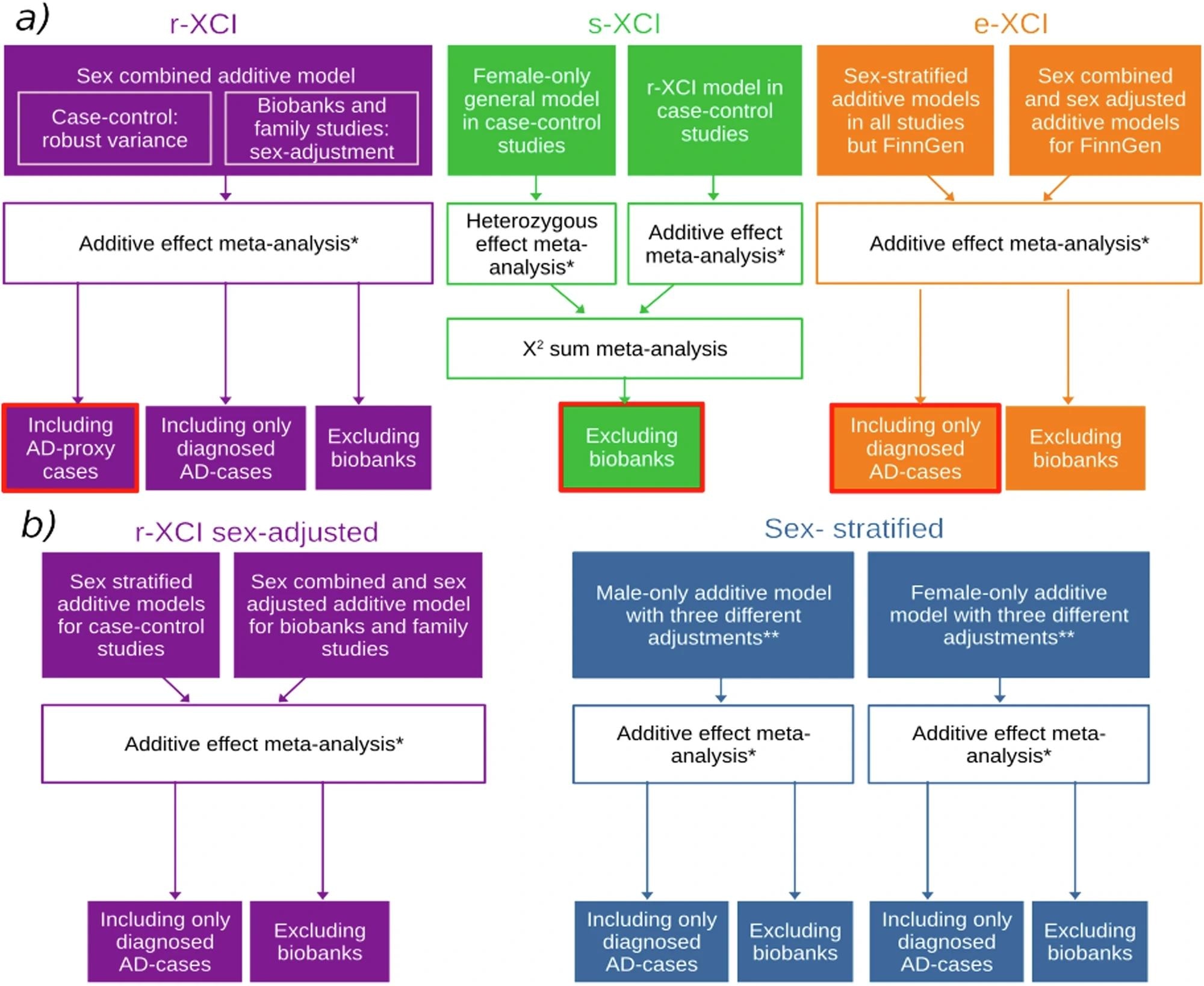 a Main analyses and b sensitivity analyses. Box colors indicate the approach: purple, green, orange and blue represent r-XCI, s-XCI, e-XCI and sex-stratified approaches, respectively. Boxes circled in red are the main r-XCI, s-XCI and e-XCI analyses. *Fixed effect meta-analysis with an inverse-variance weighted approach as implemented in METAL. **Sex-stratified models were adjusted on 1) principal components (PCs) and/or the genotyping center; 2) PCs, center and age; 3) PCs, center, age and APOE.
Following sensitivity analyses, 63,838 diagnosed AD cases and 806,335 controls were included for downstream analyses. The study further incorporated cerebrospinal fluid biomarker analyses (Aβ42 and pTau) and cognitive impairment assessments (Mini-Mental State Examination [MMSE]) in a subset of included participants (5,522 and 2,661, respectively). Notably, the study excluded pseudoautosomal regions from the analyses, primarily due to their exclusion from most participants’ genotyping chips.
Analytical computation included association tests carried out under three X-chromosome inactivation (XCI) regimes accounting for different female XCI states – 1. Random XCI (r-XCI), 2. Skewed XCI (s-XCI), and 3. Escape XCI (e-XCI). Researchers additionally conducted sex-stratified analyses to account for variability induced by XCI mechanisms, which could result in stronger-than-expected effect sizes in males. Stringent quality control measures and sensitivity analyses were applied to ensure high data reliability and to mitigate potential false negatives arising from biobank-specific methodological differences.
“To maintain balance around allelic dosage between the sexes, X-chromosome inactivation (XCI) occurs in females. This process is where one X chromosome is transcriptionally silenced during female development. The choice of the silenced copy is most often random (random XCI or r-XCI), but inactivation can also be skewed toward a specific copy (skewed XCI or s-XCI). Importantly, up to one‐third of X‐chromosome genes ‘escape’ inactivation and are expressed from both X‐chromosomes in female cells (escape XCI or e-XCI).”
Finally, genetic colocalization computations comparing study outcomes (identified genetic loci) with preexisting protein- and expression-quantitative trait loci (pQTL and eQTL, respectively) datasets were employed to identify traits and biomarkers representative of cognitive decline.
Study Findings
The XWAS analyses conducted herein identified 666,264 r-XCI, 442,001 e-XCI, and 438,420 s-XCI variants, of which 288,320, 276,902, and 263,169, respectively, were common (minor allele frequency [MAF] ≥ 1%). Notably, none of the approaches employed identified genome-wide significant signals, suggesting that the non-pseudoautosomal regions of the X-chromosome are devoid of common AD-associated genetic risk factors.
Seven loci with X-chromosome-wide significance thresholds were identified, including four common loci (Xp22.32, FRMPD4, DMD, and Xq25) and three rare loci (WNK3, PJA1, and DACH2). These loci are highlighted as targets for future investigation and may hold the key to discovering clinical, therapeutic, and pharmacological interventions against AD genesis and progression.
FRMPD4, a brain-expressed gene linked to cognitive reserve, showed particularly robust signals. In contrast, rarer variants such as those in PJA1 and DACH2 demonstrated poor data quality (e.g., sparse variant coverage and lower imputation quality), underscoring the need for methodological optimizations in future research.
Conclusions
The present study represents the largest XWAS on AD to date, analyzing data from over 115,000 cases and 613,000 controls. It presents the first attempt at accounting for X-chromosome complexities, such as variability in female XCI patterns and the limitations of biobank-specific methods. While no genome-wide significant associations were found, seven suggestive loci, including FRMPD4, DMD, and WNK3, were identified. In tandem with gene expression and epigenetic investigations, this study may form the basis of future clinical interventions against AD risk and progression.
- Le Borgne, J., Gomez, L., Heikkinen, S., Amin, N., Ahmad, S., Choi, S. H., Bis, J., Rodriguez, O. G., Kleineidam, L., Young, J., Tripathi, K. P., Wang, L., Varma, A., Damotte, V., De Rojas, I., Palmal, S., Lipton, R., Reiman, E., McKee, A., . . . Bellenguez, C. (2024). X‐chromosome-wide association study for Alzheimer’s disease. Molecular Psychiatry, 1-12. DOI: 10.1038/s41380-024-02838-5, https://www.nature.com/articles/s41380-024-02838-5

News

Scientists Discover a Hidden “Immune Organ” Inside the Skull
Researchers discovered lymph node-like immune hubs inside skull bone marrow that appear to act as rapid-response centers for the brain. For decades, the brain was thought to operate largely apart from the immune system. [...]

Engineered tRNAs and lipid nanoparticles target nonsense mutation cystic fibrosis
Researchers have developed a potential new approach for treating a form of cystic fibrosis caused by so-called nonsense mutations, combining chemically modified transfer RNAs with lipid nanoparticles designed to deliver the therapy directly to [...]

New pancreatic cancer drug carries a $39,800 monthly list price
A groundbreaking treatment for one of the most common forms of pancreatic cancer has been approved in pill form by the FDA. Revolution Medicines’ oral tablet daraxonrasib, branded as Rasonque, reduced the risk of [...]

Researchers Have Discovered a New Way To Reduce Chronic Nerve Pain
A cancer-linked protein called BRAF may help drive chronic nerve pain, and existing cancer drugs targeting it reduced pain sensitivity in preclinical models. Chronic nerve pain can persist long after an injury and often [...]

Our books now available worldwide!
Online Sellers other than Amazon, Routledge, and IOPP Indigo Global Health Care Equivalency in the Age of Nanotechnology, Nanomedicine and Artifcial Intelligence Global Health Care Equivalency In The Age Of Nanotechnology, Nanomedicine And Artificial [...]

Quantum-Enabled Regenerative Health: Reimagining Wellness, Precision Health and Longevity Medicine
Introduction Healthcare is approaching a frontier where the quantum portfolio could influence not only how disease is diagnosed and treated, but how health itself is measured, modeled, predicted and preserved. Quantum computing, quantum simulation, [...]

FDA Clears First-of-Its-Kind Nonmedication Treatment for PTSD
The FDA has cleared a system that uses brain activity data to personalize magnetic stimulation for PTSD, adding a new nonmedication treatment option. Every day in the United States, approximately 17.5 veterans die by suicide, [...]

FDA approves breakthrough drug to treat advanced pancreatic cancer
The Food and Drug Administration (FDA) approved on Wednesday a drug that could extend the survival of those with metastatic pancreatic cancer. The drug, called daraxonrasib, will be sold under the brand name Rasonque [...]

AI Decodes a Hidden DNA Signal Linked to Disease-Causing Mutations
Machine learning identifies the likely “initiator” and enables new predictions about DNA mutations that can cause disease. Every human cell depends on tens of thousands of genes being switched on at the right time [...]

Pope Leo Urges Global Response to Congo’s Deadliest Ebola Outbreak
Pope Leo called for international action to address the Ebola outbreak in the Democratic Republic of Congo. The epidemic has claimed over 2,500 lives and is the nation's largest recorded outbreak. The Pope emphasized [...]

Is there a summer COVID-19 surge this year? Yep, it’s ramping up again
Hantavirus. Ebola. West Nile. Measles. And, of course, cyclospora — that stomach parasite making people miserable across the country. Americans have plenty to worry about this summer. But remember COVID-19? It may not be [...]

Natural Compound in Broccoli Could Help Treat a Rare, Incurable Neurological Disease
Swinburne researchers have discovered how broccoli could help treat an extremely rare and incurable disease that affects only about 200 Australians. A naturally occurring compound in broccoli is being investigated as a possible treatment [...]
Antibody recycling, FcRn and the next generation of biologics
FcRn plays a central role in regulating the half-life of IgG antibodies and albumin, making it a critical target in both antibody engineering and autoimmune disease therapy. This article explores the biology of FcRn, [...]

Ebola kills 2,300 in three months with no vaccine available for Congo’s deadliest ever outbreak
It’s Congo’s 17th outbreak, with a toll that has eclipsed that of the country’s 2018-2020 outbreak when 2,299 deaths out of 3,481 cases were recorded. The latest data shows 101 new cases and 33 [...]

Beyond an Agency: How AI, Creativity and Commercialization Are Converging Into a New Growth Model
At a moment when AI is forcing a fundamental rethink of how work gets done, the life sciences industry is grappling with a deeper question: what role should human creativity play in an increasingly [...]

New $60 Blood Test Detects Lung Cancer Without Costly DNA Sequencing
A simple blood test that detects chemical changes in DNA identified more than 90% of stage 2-4 lung cancers in an early study, without relying on costly DNA sequencing. Researchers at Tel Aviv University and collaborating [...]