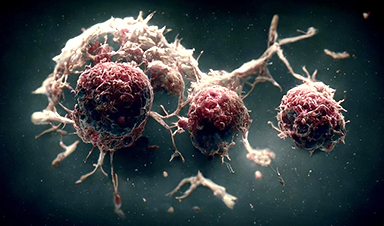
Researchers discovered that in a rare kidney cancer, RNA builds droplet-like hubs that act as growth control centers inside tumor cells. By engineering a molecular switch to dissolve these hubs, they were able to halt cancer growth completely.
RNA Builds Liquid Hubs That Drive Tumor Growth
A new study published in Nature Communications reveals that RNA, which normally passes along genetic messages, can be repurposed inside cancer cells to create liquid-like "droplet hubs" in the nucleus. These hubs operate as control points that activate genes linked to unchecked growth. The team went beyond observing the process and created a molecular switch capable of breaking these hubs apart on command, which effectively shuts down the cancer's ability to expand.
RNA as a Construction Worker in Cancer
The cancer at the center of this work is translocation renal cell carcinoma (tRCC), a disease that affects children and young adults and currently has very few treatment options. It develops from TFE3 oncofusions, which form when chromosomes exchange and fuse in incorrect locations.
Before this study, researchers did not fully understand how these fusion proteins caused such aggressive tumor behavior. The Texas A&M group discovered that the proteins recruit RNA to act as a structural framework. Instead of serving only as carriers of information, the RNAs assemble condensates that gather important molecules into dense pockets. These pockets become transcriptional hubs that activate cancer-promoting genes.
"RNA itself is not just a passive messenger, but an active player that helps build these condensates," said Yun Huang, PhD, professor at the Texas A&M Health Institute of Biosciences and Technology and senior author.
The team also identified that an RNA-binding protein known as PSPC1 helps reinforce these droplets, making them even more effective drivers of tumor growth.
Mapping Cancer's Hidden Machinery
To uncover how this system operates, the researchers used several advanced molecular tools:
- CRISPR gene editing to "tag" fusion proteins in patient-derived cancer cells, allowing them to track where the proteins travel.
- SLAM-seq, a next-generation sequencing method that measures newly produced RNA to reveal which genes are turned on or off as droplets appear.
- CUT&Tag and RIP-seq to determine where the fusion proteins attach to DNA and RNA.
- Proteomics to identify the proteins that enter the droplets, which highlighted PSPC1 as a key contributor.
Combining these techniques provided the most complete picture so far of how TFE3 oncofusions hijack RNA to build growth hubs inside cancer cells.
Breaking Apart Cancer's Growth Hubs
Once the mechanism became clear, the researchers asked whether disrupting these droplets could stop the cancer. To test this, they engineered a nanobody-based chemogenetic tool that acts as a precision molecular switch.
- A nanobody (a miniature antibody fragment) is fused with a dissolver protein.
- The nanobody attaches to the cancer-driving fusion proteins.
- A chemical trigger activates the dissolver, which melts the droplets and breaks apart the hubs.
This approach stopped tumor growth entirely in both cultured cancer cells and mouse models.
"This is exciting because tRCC has very few effective treatment options today," said Yubin Zhou, MD, PhD, professor and director of the Center for Translational Cancer Research. "Targeting condensate formation gives us a brand-new angle to attack the cancer, one that traditional drugs have not addressed. It opens the door to therapies that are much more precise and potentially less toxic."
Beyond tRCC: A New Approach to Pediatric Cancers
For the researchers, the ability to take these hubs apart was just as important as discovering how they form.
"By mapping how these fusion proteins interact with RNA and other cellular partners, we are not only explaining why this cancer is so aggressive but also revealing weak spots that can be therapeutically exploited," said Lei Guo, PhD, research assistant professor at the Institute of Biosciences and Technology.
Many pediatric cancers are driven by similar fusion proteins. A tool capable of dissolving condensates could therefore provide a generalized strategy for shutting down growth at its source.
Why It Matters
tRCC accounts for nearly 30% of renal cancers in children and adolescents, yet treatment choices remain limited and outcomes are often challenging. This study not only clarifies how the cancer builds its growth machinery but also demonstrates a practical way to disrupt that machinery.
"This research highlights the power of fundamental science to generate new hope for young patients facing devastating diseases," Huang added.
Just as cutting the power to a coworking hub would stop all activity, dismantling cancer's "droplet hubs" could eliminate its ability to expand. By revealing how RNA constructs these hubs and by designing a method to take them apart, Texas A&M Health researchers have identified both a critical weakness and a promising path toward treating one of the most difficult childhood cancers.
Reference: "RNA-mediated condensation of TFE3 oncofusions facilitates transcriptional hub formation to promote translocation renal cell carcinoma" by Lei Guo, Rongjie Zhao, Yi-Tsang Lee, Junhua Huang, James Wengler, Logan Rivera, Tingting Hong, Tianlu Wang, Kunjal Rathod, Ashley Suris, Yitian Wu, Xiaoli Cai, Rui Wang, Yubin Zhou and Yun Huang, 30 September 2025, Nature Communications.
DOI: 10.1038/s41467-025-63761-z

News

Scientists Just Overturned a 100-Year-Old Belief About Bacteria in the Lungs
New findings raise questions about the role of microbes living in the lungs. More than 35 trillion bacteria live throughout the human body, forming microbiomes in the gut, mouth, lungs, skin, and urogenital tract. [...]

GHCE Concept
From the preface of the book Global Health Care Equivalency in the Age of Nanotechnology, Nanomedicine and Artificial Intelligence, Edited by Frank Boehm: Since the publication of my first book (Nanomedical Device and Systems [...]

Novartis, Ionis drug failure spurs questions
Pelacarsen didn’t protect heart health despite lowering levels of a protein particle, “Lp(a),” in a large clinical trial — a result with important implications for cardiovascular drug research. Dive Brief: An RNA drug from [...]
New injectable treatment helps the brain rebuild after stroke
Biomedical engineers at Duke University have created an injectable biomaterial that may help the brain recover from damage left behind by an ischemic stroke. In experiments with mice, the material transformed the cavity created [...]

Scientists Discover a Hidden “Immune Organ” Inside the Skull
Researchers discovered lymph node-like immune hubs inside skull bone marrow that appear to act as rapid-response centers for the brain. For decades, the brain was thought to operate largely apart from the immune system. [...]
Engineered tRNAs and lipid nanoparticles target nonsense mutation cystic fibrosis
Researchers have developed a potential new approach for treating a form of cystic fibrosis caused by so-called nonsense mutations, combining chemically modified transfer RNAs with lipid nanoparticles designed to deliver the therapy directly to [...]

New pancreatic cancer drug carries a $39,800 monthly list price
A groundbreaking treatment for one of the most common forms of pancreatic cancer has been approved in pill form by the FDA. Revolution Medicines’ oral tablet daraxonrasib, branded as Rasonque, reduced the risk of [...]
Researchers Have Discovered a New Way To Reduce Chronic Nerve Pain
A cancer-linked protein called BRAF may help drive chronic nerve pain, and existing cancer drugs targeting it reduced pain sensitivity in preclinical models. Chronic nerve pain can persist long after an injury and often [...]

Our books now available worldwide!
Online Sellers other than Amazon, Routledge, and IOPP Indigo Global Health Care Equivalency in the Age of Nanotechnology, Nanomedicine and Artifcial Intelligence Global Health Care Equivalency In The Age Of Nanotechnology, Nanomedicine And Artificial [...]

Quantum-Enabled Regenerative Health: Reimagining Wellness, Precision Health and Longevity Medicine
Introduction Healthcare is approaching a frontier where the quantum portfolio could influence not only how disease is diagnosed and treated, but how health itself is measured, modeled, predicted and preserved. Quantum computing, quantum simulation, [...]

FDA Clears First-of-Its-Kind Nonmedication Treatment for PTSD
The FDA has cleared a system that uses brain activity data to personalize magnetic stimulation for PTSD, adding a new nonmedication treatment option. Every day in the United States, approximately 17.5 veterans die by suicide, [...]

FDA approves breakthrough drug to treat advanced pancreatic cancer
The Food and Drug Administration (FDA) approved on Wednesday a drug that could extend the survival of those with metastatic pancreatic cancer. The drug, called daraxonrasib, will be sold under the brand name Rasonque [...]

AI Decodes a Hidden DNA Signal Linked to Disease-Causing Mutations
Machine learning identifies the likely “initiator” and enables new predictions about DNA mutations that can cause disease. Every human cell depends on tens of thousands of genes being switched on at the right time [...]

Pope Leo Urges Global Response to Congo’s Deadliest Ebola Outbreak
Pope Leo called for international action to address the Ebola outbreak in the Democratic Republic of Congo. The epidemic has claimed over 2,500 lives and is the nation's largest recorded outbreak. The Pope emphasized [...]

Is there a summer COVID-19 surge this year? Yep, it’s ramping up again
Hantavirus. Ebola. West Nile. Measles. And, of course, cyclospora — that stomach parasite making people miserable across the country. Americans have plenty to worry about this summer. But remember COVID-19? It may not be [...]

Natural Compound in Broccoli Could Help Treat a Rare, Incurable Neurological Disease
Swinburne researchers have discovered how broccoli could help treat an extremely rare and incurable disease that affects only about 200 Australians. A naturally occurring compound in broccoli is being investigated as a possible treatment [...]