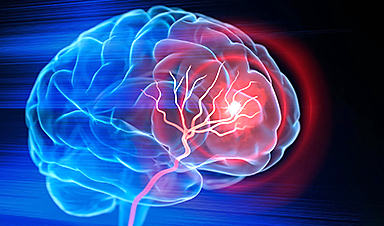
Biomedical engineers at Duke University have created an injectable biomaterial that may help the brain recover from damage left behind by an ischemic stroke. In experiments with mice, the material transformed the cavity created by lost brain tissue into a more favorable environment for healing.
The treatment recruited the body’s own immune cells, encouraged the formation of new blood vessels, supported changes in neural tissue, and improved motor function in the animals.
The findings were published in Cell Biomaterials.
The Challenge of Repairing Brain Tissue After Stroke
Millions of people experience ischemic strokes each year. These strokes occur when a blood clot blocks blood flow to part of the brain.
Emergency treatments such as clot-dissolving drugs and procedures that physically remove the clot can restore circulation and help save brain tissue that is still viable. However, once brain tissue has died, restoring blood flow cannot replace what has already been lost.
Severe strokes can destroy substantial amounts of tissue, leaving a cavity where healthy brain tissue once existed. After doctors remove the clot, recovery depends largely on rehabilitation. Rehabilitation can help surviving brain circuits adapt, but it does not directly rebuild the damaged region.
“Once brain tissue has been lost, restoring blood flow is no longer enough,” said Tatiana Segura, the Robert Plonsey Distinguished Professor of Biomedical Engineering at Duke. “Our goal is to engineer the injured space so that immune, vascular and neural repair processes can begin to work together.”
Building a Scaffold for Brain Repair
Segura and her team sought to create an environment inside the stroke cavity that could support several types of repair at once.
They used MAPS, or microporous annealed particle scaffolds. These scaffolds consist of individual hydrogel microparticles that assemble into a porous structure. The open spaces provide cells with a framework they can enter and use while rebuilding neural tissue.
Building on earlier successes with the biomaterial, the researchers wanted to determine whether they could also use the body’s immune system to guide and strengthen the repair process.
For that part of the strategy, they focused on astrocytes. These star-shaped cells play important roles in normal brain function and respond quickly when the brain is injured.
Astrocytes communicate with surrounding cells partly by releasing extracellular vesicles, or EVs. These extremely small packages carry proteins, lipids and genetic material that can influence the behavior of other cells.
Keeping Repair Signals Where They Are Needed
The researchers collected EVs from lab-grown astrocytes and tested them with different signaling molecules designed to attract immune cells, encourage blood vessel repair and improve function.
Instead of simply injecting the EVs into the damaged area, the scientists chemically attached them to the surfaces of the hydrogel microparticles. Doing so kept the signals concentrated within the scaffold, giving incoming cells a better opportunity to encounter them.
“We are not simply placing a material into the brain,” Segura said. “We are engineering a local environment that can coordinate several parts of the repair response.”
One signaling combination stood out. IL-4 and C1q were particularly effective at drawing potentially helpful immune cells into the injured region.
Those cells included macrophages as well as a surprisingly persistent population of neutrophils.
An Unexpected Role for Neutrophils
Neutrophils are often linked to inflammation and tissue damage during the early stages of a stroke. The new results suggest their role may be more complicated.
At a later point after injury, and when surrounded by the right signals and material environment, neutrophils may instead help support tissue repair.
Researchers tested their importance by reducing the neutrophil-rich immune-cell population. When they did so, blood vessel formation declined substantially and the scaffold underwent less remodeling.
The result indicated that these immune cells were playing an important role in the healing response.
“This result changes how we think about neutrophils after stroke,” said Shangjing Xin, lead scientist of the study and a postdoctoral fellow in the Segura Laboratory. “Their role appears to depend on when they arrive, where they are located, and the signals they receive from their surroundings. Our study demonstrates a potential engineering strategy to recruit and retain these cells at the right time.”
New Blood Vessels and Neural Growth
As immune cells entered the treated area, new blood vessels also formed throughout the stroke cavity.
Researchers found more axonal fibers both inside and around the injured region. Axons are essential structures that allow brain cells to transmit signals.
The biological changes were accompanied by improvements in movement.
Mice treated with the optimized scaffold performed better on a grid-walking test designed to measure mistakes in forelimb placement. By eight weeks, their performance could not be statistically distinguished from that of healthy control mice. The improvement also persisted for the remainder of the study.
The Scaffold Was Essential
The researchers also tested whether the extracellular vesicles could produce similar effects without the biomaterial scaffold.
They could not.
EVs administered without the MAP scaffold failed to produce comparable blood vessel repair. That finding suggests the biomaterial was doing more than simply transporting therapeutic signals into the brain.
Its porous architecture, combined with its ability to keep EV signals concentrated in the damaged region, appeared to be critical to the repair response.
Still an Early Stage Treatment
Despite the promising results, the approach remains preclinical.
So far, researchers have tested the treatment in mouse models by injecting the material directly into the damaged area of the brain.
Further research will be necessary to assess safety, understand precisely how different immune-cell populations influence recovery, and determine whether the treatment works in larger models that more closely resemble human stroke.
The researchers also currently obtain the EVs from primary rat astrocytes.
As a next step, Segura’s laboratory is investigating EVs produced by human induced pluripotent stem cell-derived astrocytes. Such cells could offer a more scalable and clinically relevant source while giving researchers greater control over the signals contained inside the EVs.
“You do not restore an ecosystem simply by containing the initial damage,” Segura said. “You have to create the conditions that allow life to return. That is how we think about the stroke cavity. The material is not intended to reproduce the brain itself, but to create an environment where the body’s own cells can enter, communicate and participate in rebuilding vascularized tissue.”
Materials provided by Duke University. Original written by Michaela Martinez.

News – Curated by Amanda Scott, Alias Group Creative
Follow her on Bluesky
Scientists Discover a Powerful New Weapon Against a Dangerous Gut Infection
The promise of an experimental treatment for C. difficile gut infections lies partly in the bacteria it leaves alive, according to early laboratory and mouse research. Broad-spectrum antibiotics can disrupt the gut’s microbial community, [...]
Your Bones May Hold a Hidden Clue to Blood Cancer Survival
For people with blood cancers called myelodysplastic syndromes, osteoporosis may hold an overlooked clue to survival, a three-year observational study suggests. In blood cancers that develop in the bone marrow, an important clue to [...]

Researchers Discover What Reading for Pleasure May Be Doing to Your Brain
Reading for pleasure may offer surprising benefits for the brain, with research linking the habit to better mental health, stronger cognitive abilities, and a lower risk of dementia. Reading for pleasure may do far [...]
Scientists Discover a Hidden Trigger That Keeps Inflammation Alive
Inflammation persists after proteins detach from immune receptors, revealing a potential target for autoimmune treatments. Since a Nobel Prize-winning discovery in the 1990s identified molecules called Toll-like Receptors as the guardians of the human [...]
A Virus Gives Itself Away the Moment It Attacks
Researchers have found the trigger behind a powerful bacterial defense against viruses. Viruses that prey on bacteria could become an increasingly important tool for treating bacterial infections, particularly as antibiotic resistance makes some infections [...]
Scientists Discover Aspirin May Slash Dementia Risk by 70% – but Only for Certain People
Aspirin was linked to a sharply lower dementia risk in some older adults, and their genes may hold the clue. A Monash University analysis found that older adults with a particular genetic profile had [...]
Inflammation May Awaken Dormant Cancer Cells Years After Treatment
The body’s response to inflammation may disturb cancer cells that have been lying silent for years, giving them an opportunity to grow again. Researchers at the Francis Crick Institute have found that gut inflammation [...]
Where do nanoparticles go once they enter the body?
New international best practice guidance, co-written at ANSTO, sets out how to measure where nanoparticles like titanium dioxide end up in the body and how long they remain. The guidance has been shared by [...]
Long-Acting HIV Shots Could Solve a Major Treatment Challenge for Young People
A major African trial suggests that changing how HIV treatment is delivered could significantly improve viral suppression in adolescents. Young people with HIV were more likely to keep the virus suppressed when they received [...]

WHO Factsheets – The top 10 causes of death
In 2023, the 10 leading causes of death accounted for 33 million deaths, or 54% of the total 61 million deaths worldwide. The top global causes of death, in order of total number of lives lost, [...]
Aging Cells May Be Hiding From the Immune System – Scientists Think They Know How
Your immune system is supposed to clear out damaged cells. Researchers may have found how some of them hide and linger as the body ages. Researchers led by Cedars-Sinai Health Sciences University have identified [...]

Your Voice May Reveal How Fast Your Brain Is Aging
Researchers have developed a machine-learning “speech clock” that estimates age from subtle patterns in how people speak and what they say. It is possible that people’s voices may contain certain signals of aging that [...]
Optogenetics Pioneers Win 2026 Nobel Prize in Physiology or Medicine
The 2026 Nobel Prize in Physiology or Medicine has been awarded to Peter Hegemann, Georg Nagel, and Karl Deisseroth for the development of optogenetics, a revolutionary technology that uses light to control individual neurons [...]
Molecular Manufacturing: The Future of Nanomedicine – From NanoappsMedical Inc.
This book explores the revolutionary potential of atomically precise manufacturing technologies to transform global healthcare, as well as practically every other sector across society. This forward-thinking volume examines how envisaged Factory@Home systems might enable the cost-effective [...]
What is ‘American Covid’ and how bad is it?
Cases of so-called ‘American Covid’ are on the rise in the UK. The strain is officially called XFG, or ‘Stratus’, and is the most common variant in North America, hence the name. It might soon [...]
Researcher at Russian plague laboratory dies of ‘unknown’ infection
Russian authorities have imposed "anti-epidemic measures" after a laboratory worker at an institute in Siberia dedicated to studying the plague and other infectious diseases died of a mysterious illness. The researcher, a 28-year-old female [...]