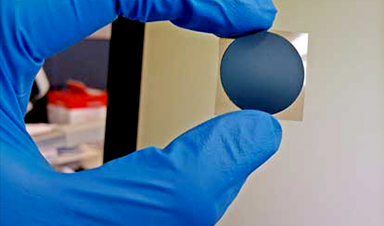
Light-up specks find and track tiny tumors

Scientists have created a method to detect tiny tumors and track their spread using light-emitting nanoparticles. The technology could lead to earlier cancer detection, more precise treatments, and even improvement in patient cure rates and survival times. “We’ve always had this dream that we can track the progression of cancer in real time, and that’s [...]

By |2018-03-22T14:32:26+00:00December 22nd, 2017|Categories: News|0 Comments

Fluorescent nanomedicine can guide tumor removal, kill remaining cancer cells

Oregon State University scientists have developed a nanomedicine platform for cancer that can help doctors know which tissue to cut out as well as kill any malignant cells that can't be surgically removed. The platform allows for greater precision and thoroughness in cancer treatment. Here's how it works: Nanoparticles tightly loaded with a dye compound [...]

By |2018-03-22T14:32:26+00:00December 21st, 2017|Categories: News|0 Comments

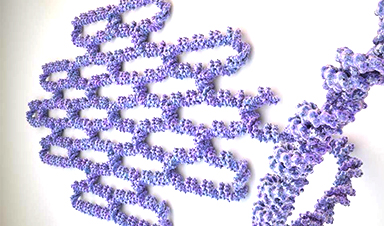
DNA That Folds Like Origami Has Applications for Drug-Delivering Nanobots

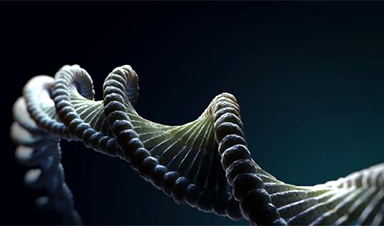
From an article by Kyree Leary at futurism.com: In 1953, a pair of scientists named James D. Watson and Francis H.C. Crick — with help from the data supplied by the research of another scientist, Rosalind Franklin, — successfully modeled the structure of DNA for the first time. Since then, whenever we think of DNA, we usually imagine the [...]

By |2018-03-22T14:32:26+00:00December 20th, 2017|Categories: News|0 Comments

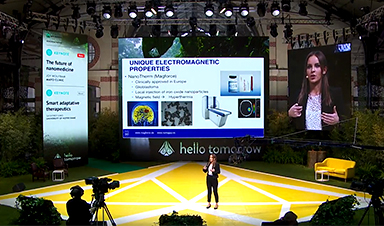
The Future of Nanomedicine – Dr Joy Wolfram at the HT Summit 2017

  Dr Joy Wolfram from the Mayo Clinic explains how nanomedicine has the potential to change the way we treat disease. Filmed at the 2017 Hello Tomorrow Global Summit. Joy Wolfram, Ph.D., focuses her research in nanomedicine on the development of new strategies for the treatment of disease. In particular, her team is [...]

By |2018-03-22T14:32:26+00:00December 19th, 2017|Categories: News|0 Comments

Nanotubes go with the flow to penetrate brain tissue

  Rice University researchers have invented a device that uses fast-moving fluids to insert flexible, conductive carbon nanotube fibers into the brain, where they can help record the actions of neurons. The Rice team’s microfluidics-based technique promises to improve therapies that rely on electrodes to sense neuronal signals and trigger actions in patients [...]

By |2018-03-22T14:32:26+00:00December 19th, 2017|Categories: News|0 Comments

Researchers Use Single-Stranded DNA, RNA to Create Self-Assembling Nanostructures

Nanotechnologists are making use of DNA, the genetic material that is present in living organisms, as well as its multifunctional counterpart RNA, as the raw material in attempts to design miniscule devices that could potentially function as drug delivery vehicles, miniature nanofactories for the production of chemicals and pharmaceuticals, or extremely sensitive elements of optical [...]

By |2018-03-22T14:32:26+00:00December 17th, 2017|Categories: News|0 Comments

Out With the Old? Blockchain Requires a New Regulatory Approach by Eva Kaili

  The following article is an exclusive contribution to CoinDesk's 2017 in Review. Eva A. Kaili is a member of the European Parliament, where she chairs the Science and Technology Options Assessment (STOA) panel aimed at assessing AI, fintech and blockchain.   From the article by Eva Kaili at coindesk.com: "The internet is once more in a [...]

By |2018-03-22T14:32:26+00:00December 17th, 2017|Categories: News|0 Comments

3D nanoscale imaging made possible

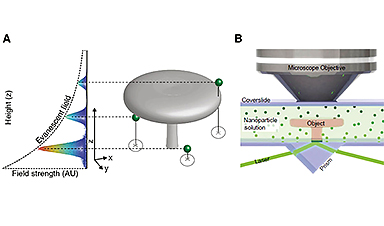
Imaging at the nanoscale is important to a plethora of modern applications in materials science, physics, biology, medicine and other fields. Limitations of current techniques are, e.g. their resolution, imaging speed or the inability to look behind opaque objects with arbitrary shapes. However, imaging like this would be useful e.g. for investigating spongy electrodes, thus [...]

By |2018-03-22T14:32:27+00:00December 16th, 2017|Categories: News|0 Comments

Nanoparticles as a solution against antibiotic resistance?

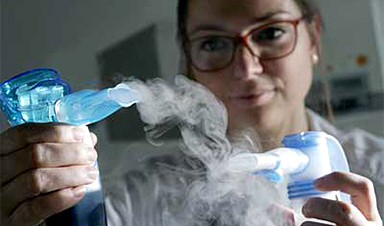
Around one in 3,300 children in Germany is born with Mucoviscidosis. A characteristic of this illness is that one channel albumen on the cell surface is disturbed by mutations. Thus, the amount of water of different secretions in the body is reduced which creates a tough mucus. As a consequence, inner organs malfunction. Moreover, the [...]

By |2018-03-22T14:32:27+00:00December 15th, 2017|Categories: News|0 Comments

Plasmonic biosensors enable development of new easy-to-use health tests

Researchers at Aalto University, Finland, have developed a biosensor that enables creating a range of new easy-to-use health tests similar to home pregnancy tests (Advanced Materials, "Plasmonic Metaparticles on a Blackbody Create Vivid Reflective Colors for Naked-eye Environmental- and Clinical Bio-detection"). The plasmonic biosensor can detect diseased exosomes even by the naked eye. Exosomes, important [...]

By |2018-03-22T14:32:27+00:00December 14th, 2017|Categories: News|0 Comments
Go to Top