Macrophage nanosponges could keep sepsis in check

A team of researchers at the University of California San Diego has developed macrophage “nanosponges” that can safely absorb and remove molecules from the bloodstream that are known to trigger sepsis. These macrophage nanosponges, which are nanoparticles cloaked in the cell membranes of macrophages, have so far improved survival rates in mice with sepsis. This [...]
By |2018-03-22T14:32:24+00:00January 5th, 2018|Categories: News|0 Comments

Physicists take first step toward cell-sized robots – Video

  An electricity-conducting, environment-sensing, shape-changing machine the size of a human cell? Is that even possible? Cornell physicists Paul McEuen and Itai Cohen not only say yes, but they’ve actually built the “muscle” for one. With postdoctoral researcher Marc Miskin at the helm, the team has made a robot exoskeleton that can rapidly [...]

By |2018-03-22T14:32:25+00:00January 4th, 2018|Categories: News|0 Comments

Carbon nanotubes devices may have a limit to how ‘nano’ they can be

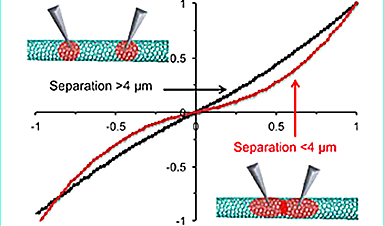
Carbon nanotubes bound for electronics not only need to be as clean as possible to maximize their utility in next-generation nanoscale devices, but contact effects may limit how small a nano device can be, according to researchers at the Energy Safety Research Institute (ESRI) at Swansea University in collaboration with researchers at Rice University. Carbon [...]

By |2018-03-22T14:32:25+00:00January 3rd, 2018|Categories: News|0 Comments

Atomristor – memristor effect in atomically thin nanomaterials

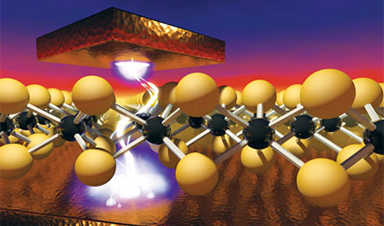
In trying to bring brain-like (neuromorphic) computing closer to reality, researchers have been working on the development of memory resistors, or memristors, which are resistors in a circuit that 'remember' their state even if you lose power. Today, most computers use random access memory (RAM), which moves very quickly as a user works but does [...]

By |2018-03-22T14:32:25+00:00January 2nd, 2018|Categories: News|0 Comments

Blockchains, Cryptoeconomics, and Emerging Technology Risks

The recent rise in the value of BitCoin, whether a bubble or not, has stimulated great interest in the blockchain, and a recent opinion piece in the New York Times places it in the context of falling confidence in institutions and governments. From “The Bitcoin Boom: In Code We Trust” by Tim Wu, Dec. 18, [...]

By |2018-03-22T14:32:25+00:00December 30th, 2017|Categories: News|0 Comments

Scientists Use Electron Microscopy to Study Magnetic Fields of Bacterial Cells and Nano-Objects

A research team led by a scientist from the U.S. Department of Energy’s Ames Laboratory has demonstrated for the first time that the magnetic fields of bacterial cells and magnetic nano-objects in liquid can be studied at high resolution using electron microscopy. This proof-of-principle capability allows first-hand observation of liquid environment phenomena, and has the [...]

By |2018-03-22T14:32:25+00:00December 29th, 2017|Categories: News|0 Comments

Fewer laboratory animals thanks to secondary nanobodies

Antibodies are indispensable in biological research and medical diagnostics. However, their production is time-consuming, expensive, and requires the use of many animals. Scientists at the Max Planck Institute for Biophysical Chemistry in Göttingen, Germany, have now developed so-called secondary nanobodies that can replace the most-used antibodies and may drastically reduce the number of animals in [...]

By |2018-03-22T14:32:25+00:00December 27th, 2017|Categories: News|0 Comments

Nanowire device detects cancer with a urine test

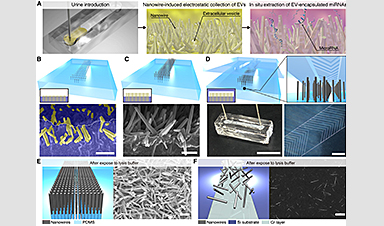
Cells communicate with each other through a number of different mechanisms. Some of these mechanisms are well-known: in animals, for example, predatory threats can drive the release of norepinephrine, a hormone that travels through the bloodstream and triggers heart and muscle cells to initiate a “fight-or-flight” response. A far less familiar mode of cellular transport [...]

By |2018-03-22T14:32:25+00:00December 26th, 2017|Categories: News|0 Comments

Plants that glow – Illumination from nanobionic plants might one day replace some electrical lighting

Imagine that instead of switching on a lamp when it gets dark, you could read by the light of a glowing plant on your desk. MIT engineers have taken a critical first step toward making that vision a reality. By embedding specialized nanoparticles into the leaves of a watercress plant, they induced the plants to [...]

By |2018-03-22T14:32:26+00:00December 24th, 2017|Categories: News|0 Comments

Nanomedical Device and Systems Design: Challenges, Possibilities, Visions – Discounted until Jan. 1 2018

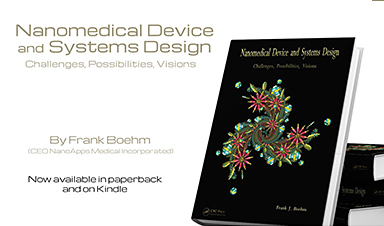
  Features Explores and presents innovative nanotechnological and biomimetically derived strategies in the design of potential nanomedical devices and their constituents Contains several post-chapter Proposed Research Tasking Lists to facilitate the further investigation and potential development of specific nanomedical capacities Includes eight chapters contributed by some of the leading experts in nanotechnology, nanomaterials, and [...]

By |2018-03-22T14:32:26+00:00December 23rd, 2017|Categories: News|0 Comments
Go to Top